Why Does Blog Type Matter for Traffic Growth?
The type of blog post you choose significantly impacts reader engagement and SEO performance. Different formats, such as guides, listicles, or case studies, are optimized to meet specific reader intents, improving metrics like dwell time, click-through rates, and social sharing. Understanding and applying the right blog type can lead to higher search engine rankings and sustained audience attention.
Search engines like Google analyze user intent, structure, and content depth. Blog types that clearly meet a reader’s need—like guides, lists, or case studies—rank higher and retain attention longer.
Why is Understanding Reader Intent Crucial?
Understanding reader intent is crucial because it ensures your content directly answers the exact problem a user is trying to solve, which is the single most important factor for ranking on search engines. When your content matches what a user expects to find, they stay on your page longer, trust your brand, and are far more likely to convert into customers or subscribers.
The Four Core Types of Reader Intent
To create high-traffic content, you must align your blog post format with the specific type of intent your reader has:
- Informational Intent ("Know"): The reader is looking for an answer to a question or wants to learn a concept.
- Best Blog Formats: How-To Guides, Ultimate Guides, Listicles, and Data-Driven Posts.
- Commercial Intent ("Investigate"): The reader is researching options, comparing solutions, or looking for recommendations before buying.
- Best Blog Formats: Product Reviews, Side-by-Side Comparisons, and Expert Roundups.
- Transactional Intent ("Do/Buy"): The reader is ready to make a purchase, download a resource, or sign up for a service immediately.
- Best Blog Formats: Case Studies, Success Stories, and optimized landing pages with strong calls-to-action.
- Navigational Intent ("Go"): The reader is trying to find a specific website or physical location they already know exists.
Why Ignoring Reader Intent Ruins Your Blog
- Destroys Search Engine Rankings: Google and AI search engines prioritize user satisfaction. If a user clicks your link, realizes it does not match their intent, and immediately hits the back button, search engines will quickly demote your page.
- Wastes Writing Time: You can write a beautifully crafted, 5,000-word editorial essay, but if users searching that keyword actually wanted a quick, 10-item numbered listicle, your post will struggle to get traction.
- Kills Your Conversion Rates: If you target a keyword with informational intent (e.g., "what is coding") but try to aggressively push a paid programming course right away, readers will leave because they are not yet in a buying mindset.
How to Uncover Your Reader's Intent
Before you type a single word, type your target keyword into a search engine and look at the first page of results:
- Look at the organic results: Are they mostly step-by-step tutorials, numbered lists, or video links?
- Check the "People Also Ask" box: What specific sub-questions are users asking?
- Analyze the search format: Build your post using the dominant structure that search engines are already rewarding.
Matching the blog type with search intent helps readers find exactly what they’re looking for—fast.
Evaluate Search Engine Results Page (SERP) Layouts
Analyzing the layout and features of the live Search Engine Results Page (SERP) reveals the exact format and content structure that search engine algorithms have determined best satisfies user expectations for a given query:
- Dominant Content Formats: Observe whether top-ranking positions are held by step-by-step how-to guides, bulleted listicles, long-form ultimate guides, or video embeds. If the SERP is dominated by numbered lists, publishing a dense opinion piece will struggle to match reader preference.
- SERP Feature Analysis: Identify specialized SERP features present on the page, such as Featured Snippets (indicating a need for quick, direct answers), People Also Ask boxes (revealing critical sub-topics to cover), or Local Packs (signaling local commercial intent).
- Intent-Driven Layout Alignment: Replicate the structural framework that search engines are actively rewarding by structuring your titles, headings, and visual assets to match the top-ranking SERP patterns.
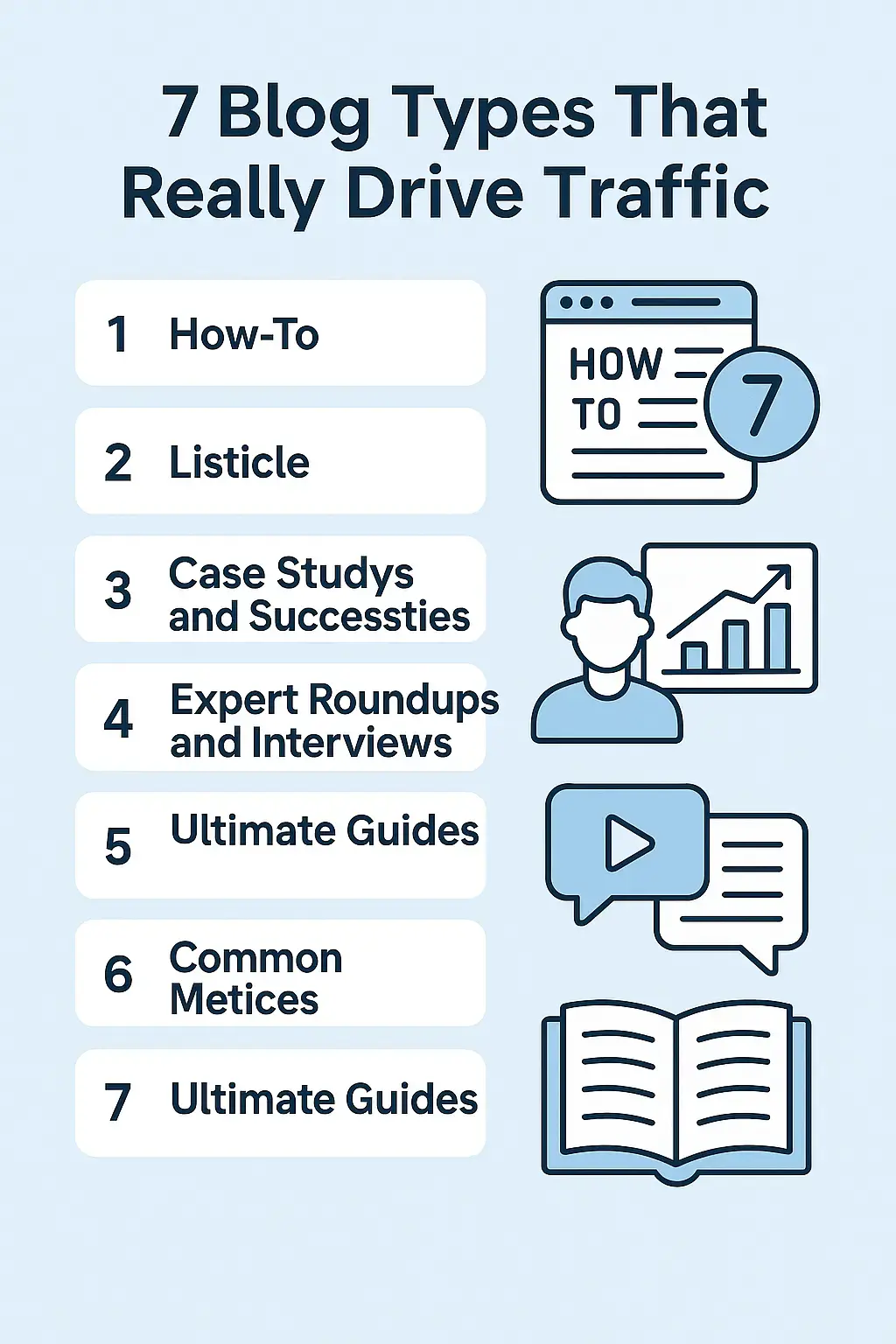
What Are 7 Blog Types That Drive Traffic?
The 7 blog types that drive the most traffic are highly structured, search-optimized content formats designed to match exact user intent, attract backlinks, and rank dominatingly in both traditional and AI search engines.
1.What Are How-To Guides (Educational Blogs)?
How-to guides are step-by-step, educational blog posts that teach readers exactly how to complete a specific task, master a skill, or solve a distinct problem. They are the backbone of organic search traffic because they directly answer the "how do I do this?" queries that millions of users type into search engines every day.
Why they work:
- Readers love actionable, step-by-step advice.
- They perform well for voice search queries (“How do I…?”).
- They position your blog as an authority.
Example:
How to protect your WP database from cyber threats.
Pro Tip: Use screenshots, infographics, and bullet steps for clarity. These posts often earn backlinks and feature in Google’s “Featured Snippets.”
Increasing Rich Snippet Eligibility with HowTo Schema Markup
To maximize search visibility and click-through rates (CTR) for educational blogs, implement HowTo Structured Data (JSON-LD). HowTo schema explicitly labels the sequential structure of your guide for search engine crawlers, making your content eligible for enhanced HowTo Rich Snippets on Google Search results.
By defining your step-by-step instructions via structured schema markup, search engines can easily display key elements directly on the SERP:
- Key Schema Properties: Define essential schema fields such as
@type: "HowTo",name(the title of your guide),description,totalTime, andsupply/toolarrays. - Step-by-Step Breakdown: Structure each actionable stage inside a
HowToStepobject containingHowToDirectiontext, step titles, and associated step-by-step images. - Enhanced Visual Eligibility: Rich snippet listings showcase collapsible steps, estimated completion times, and image previews directly in search results, increasing visual footprint and driving higher organic CTR.
SEO Impact: Implementing HowTo schema markup bridges the gap between standard text content and search engine understandability—helping your educational blog posts secure featured snippets, voice search results, and prominent visual placements on search engine result pages.
2. What Are Listicles (Numbered List Posts)?
Listicles (a blend of "list" and "article") are blog posts structured entirely around a numbered or bulleted list of tips, tools, ideas, or examples. Instead of long, dense paragraphs, they break information down into highly digestible, snack-sized sections, making them the most popular and frequently clicked content format on the internet.
Why they work:
- Numbers promise a clear value (“7 tips,” “10 mistakes,” etc.).
- They are easy to skim and digest.
- They are great for social shares and CTR.
Example:
- “10 Best Productivity Tools for Bloggers in 2025”
Use odd numbers in your titles—studies show they attract more clicks.
3. What Are Case Studies and Success Stories?
Case studies and success stories are real-world, proof-focused blog articles that demonstrate exactly how a specific strategy, product, or service solved a major problem for a real customer or business. Instead of just telling readers what works, these posts show them how it worked by using a concrete, chronological timeline backed by verifiable metrics and personal testimonials.
For a practical B2B proof point, reference our software development company SEO case study.
Why they work:
- Authentic stories increase credibility.
- They are great for B2B and marketing blogs.
- They have high potential for backlinks and PR mentions.
Example:
- “How Our SEO Strategy Boosted Organic Traffic by 300% in 60 Days”
Include visuals (before-and-after charts, screenshots) for extra engagement.
4. What Are Expert Roundups and Interviews?
Expert roundups and interviews are collaborative blog formats that leverage the knowledge, authority, and existing audiences of industry specialists to create high-value content. Instead of relying solely on your own expertise, you gather insights directly from recognized figures in your niche to answer specific questions or share deep industry experiences.
Why they work:
- Leverage experts’ audiences when they share your post.
- Builds relationships and authority in your niche.
- Great for link-building.
Example:
- “12 Content Marketing Experts Share Their Top 2025 Strategies”
Tag contributors on social media for additional exposure.
5. What Are Data-Driven & Research-Based Posts?
Data-driven and research-based posts are blog articles or content pieces built entirely around hard facts, statistical trends, original experiments, and verified academic or industry research. Instead of offering opinions, assumptions, or anecdotal advice, these posts use data as the primary evidence to prove a point, solve a problem, or explain a complex topic.
Why they work:
- Trusted by journalists and bloggers for citations.
- They are excellent for backlinks and organic SEO.
- They encourage longer dwell time.
Example:
- “New Study: 70% of Readers Prefer Long-Form Content in 2025”
Include charts, infographics, and references to credible sources for added authority.
6. What Are Trending Topics & Newsjacking Blogs?
Trending topics and newsjacking blogs are fast-paced, highly reactive content pieces that capitalize on current events, viral pop-culture moments, breaking industry news, or surging internet search trends to capture rapid waves of massive traffic. Rather than relying on static, evergreen information, these blogs inject a brand's unique voice, perspective, or expertise into a topic that already dominates the public conversation.
Why they work:
- High search volume in a short period.
- Great for brand visibility and shareability.
Example:
- “How Google’s 2025 Algorithm Update Affects Bloggers”
Stay ahead using tools like Google Trends or Feedly.
Blog Commenting for SEO
Is commenting still effective for SEO? While blog comments can drive engagement and foster community, their direct impact on SEO has diminished over time. Search engines primarily value high-quality, original content on your own site, and spammy or low-value comments are unlikely to boost rankings. However, meaningful discussions can indirectly benefit SEO by increasing dwell time and encouraging social sharing.
7. What Are Ultimate Guides (Pillar Content)?
Ultimate guides are long-form, comprehensive resources designed to dominate SEO rankings.
Why they work:
- Serve as evergreen content.
- Improve internal linking and user retention.
- Attract consistent backlinks.
- “The Ultimate Guide to SEO Blogging (2025 Edition)”
Break down each section with H2s, visuals, and actionable insights.
Maximizing Information Gain Score in Ultimate Guides
As search engines evolved beyond simple word-count metrics, Google introduced patents and updates focused on measuring Information Gain—an algorithmic metric that evaluates how much new, unique, or actionable information a web page offers a user compared to existing top-ranking results.
For Ultimate Guides to rank and retain top positions, long-form content cannot merely summarize or repeat what is already published on the SERP (Search Engine Result Page). Search algorithms penalize redundant summaries and prioritize guides that demonstrate a high Information Gain Score through:
- Original Insights & Data: Incorporating proprietary research, internal survey results, or unique case studies that cannot be found on competing websites.
- First-Hand Experience (E-E-A-T): Including real-world examples, step-by-step walkthroughs, and personal expert commentary that demonstrate direct hands-on experience.
- Novel Frameworks & Visuals: Presenting information through original diagrams, custom infographics, interactive calculators, or distinct visual workflows rather than generic text.
- Addressing Unanswered SERP Gaps: Answering nuanced, hard-to-find edge cases and technical follow-up questions that competing pillar pages overlook.
Why This Matters: Google calculates an Information Gain Score to prevent users from seeing identical, rehashed content across search results. By providing depth, unique perspective, and non-generic answers in your Ultimate Guides, you signal higher unique value—ensuring your pillar content ranks higher and remains immune to automated content consolidation updates.
How Do the 7 Blog Types Compare in Traffic and Backlinks?
The table below compares the seven blog types in terms of traffic velocity, backlink potential, and primary traffic sources.
| Blog Type | Traffic Velocity | Backlink Potential | Primary Traffic Source |
|---|---|---|---|
| Listicles | Fast (High Click Appeal) | Medium | Social Media & Organic Search |
| How-To Guides | Steady Growth | High | Organic Search Engines |
| Data-Driven Posts | Steady Growth | Highest | Editorial Referrals & Citations |
| Expert Roundups | Fast (Viral Spikes) | High | Social Media & Influencer Shares |
| Case Studies | Slow & Targeted | Medium | Email Lists & Direct Intent |
| Ultimate Guides | Steady Growth | Highest | Organic Search |
| Product Reviews | Steady Growth | Medium | Commercial Search Intent |
How Can You Optimize Any Blog Type for Maximum Traffic?
To get the most traffic for any blog, you must pick strong keywords, write clear content, and share your posts online. Focus on helping your readers and making your pages fast and easy to read.
Key Steps for More Traffic
- Find Good Keywords: Look for words people type into search engines. Use them in your titles and headings.
- Write Great Content: Make your posts useful, clear, and longer than five hundred words. Give real answers to user questions.
- Use Clean Links: Add links to other pages on your site and get good links from other safe sites.
- Speed Up Pages: Make sure your blog loads fast on phones and computers.
- Share on Social Media: Post your links on platforms where your readers spend time.
How to Use SEO Tools and Analytics for Blog Optimization?
Tools like Google Analytics, Ahrefs, and SEMrush help track which blog types bring the most engagement.
Review data regularly to:
- Identify top-performing topics.
- Adjust your strategy based on audience behavior.
- Improve CTR and conversion rates.
What Common Mistakes Should You Avoid When Choosing Blog Types?
When choosing blog types and topics, avoid picking a niche solely on personal passion without checking market demand, ignoring your target reader's search intent, choosing a topic that is too broad or narrow, failing to research competitors, and forgetting to align your blog type with your core goals.
Strategy Pitfalls
- Ignoring audience needs: Writing only for yourself instead of solving real reader problems.
- Skipping market research: Assuming people want your content without checking search data or active demand.
- Going too broad: Trying to cover too many unrelated topics, which confuses search engines and visitors.
- Choosing dead-end niches: Selecting a topic with zero search volume or no way to monetize or grow.
Execution Mistakes
- Neglecting search intent: Choosing a format (like a personal diary) when users want a helpful how-to guide or listicle.
- Forgetting business goals: Launching a blog type that does not support your broader brand or sales targets.
- Failing to differentiate: Copying other blogs without adding a unique angle or personal voice.
Remember: consistency + strategy = sustained traffic.
FAQs About Blog Types That Drive Traffic
How to Choose the Right Blog Type for Sustainable Growth?
To truly drive traffic, focus on content variety, depth, and intent alignment. Mix educational guides, data-backed studies, and evergreen pillars to maintain consistent audience growth.
Selecting the right blog type for your niche and goals can significantly increase traffic. Experiment with different formats, analyze performance, and refine your strategy based on what resonates most with your audience.
About the Author

Brian Keary
Founder & Lead Developer
Brian is the founder of BKThemes with over 20 years of experience in web development. He specializes in WordPress, Shopify, and SEO optimization. A proud alumnus of the University of Wisconsin-Green Bay, Brian has been creating exceptional digital solutions since 2003.
Expertise
Writing since 2003