Storefront performance in 2026 places immediate pressure on digital commerce. When a shopper lands on an online store, they expect fast loading times, clear layout architecture, and immediate access to product categories. Pre-made themes can be efficient, but unnecessary JavaScript, third-party app code, and excessive customization may affect storefront performance. Investing in a custom Shopify website design allows merchants to create a storefront tailored to their brand requirements, catalog structure, and operational workflows.
Building a distinct online presence requires a careful evaluation of financial investment, architectural advantages, and long-term maintenance overhead. Standard themes offer quick setup cycles, while custom work can provide greater control over user experience and functionality. However, a custom design does not automatically provide unlimited control over Shopify checkout or guarantee lower costs. Understanding the structural differences between pre-packaged themes and bespoke builds helps business owners allocate capital effectively.
Understanding Custom Shopify Website Design
A custom Shopify build involves designing and developing a storefront around specific business requirements rather than relying entirely on an off-the-shelf theme. Developers can craft layouts, navigational menus, product pages, and content sections to reflect the identity of the brand. This approach provides greater control over user-interface design and information architecture, although checkout customization remains subject to Shopify plan restrictions.
Off-the-shelf themes may include features intended for many different merchant scenarios. Additional apps and custom scripts can also increase the amount of code that a storefront must load. In contrast, a disciplined custom build can focus on the code required for specific business functions. Shopify recommends minimizing JavaScript and avoiding parser-blocking scripts because storefront performance can support conversion rates, repeat business, and search-engine rankings. See the Shopify theme performance best practices.
Merchants may gain more freedom to implement distinctive visual storytelling, specialized product filtering, and custom cart interfaces. Nevertheless, custom functionality should be evaluated carefully: custom code can create performance and maintenance costs if it introduces excessive scripts or directly modifies theme code unnecessarily.
Financial Investment and Development Timelines
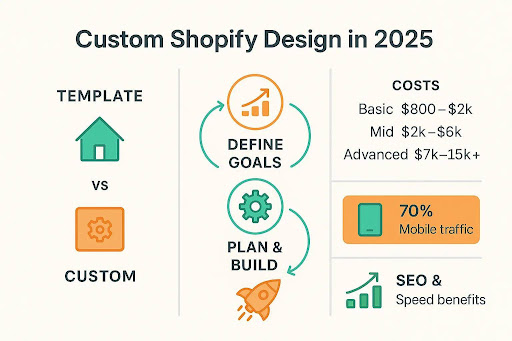
The financial commitment for a custom Shopify storefront varies depending on complexity and scope. Shopify’s official pages do not establish a standard market-wide price for custom website design. Agency and freelancer quotes may reflect UX research, branding, theme development, integrations, content migration, testing, and maintenance. Therefore, any vendor estimate should be treated as a project-specific example rather than a universal benchmark.
Basic design work may involve a limited catalog, a small number of templates, and straightforward content requirements. Larger projects may require advanced filtering, custom typography, tailored layout sections, specialized integrations, and extensive quality assurance. Enterprise projects can also involve Shopify Plus, partner development, and variable platform costs.
Ongoing platform expenses influence the total cost of ownership. Shopify charges recurring subscription fees, and plan pricing, billing cycles, card-processing rates, and third-party transaction fees vary by plan and location. Merchants should review the official Shopify pricing plans and billing overview before preparing financial projections.
Shopify’s plans include commerce hosting, unlimited bandwidth, custom-domain support, and SSL/TLS, which reduces the need to procure and maintain separate hosting infrastructure. That convenience does not eliminate recurring platform expenses or payment-processing costs. Eligible merchants using Shopify Payments generally avoid Shopify’s additional third-party transaction fee, although card-processing fees still apply.
Key Features of a Custom Shopify Website Design
- Personalized homepage and product layouts
- Custom-built checkout flows
- SEO-optimized structure
- Advanced integrations (CRMs, analytics, third-party APIs)
- Tailored promotional banners and micro-animations
Performance Optimization and Code Efficiency
Page speed can influence conversion rates, search-engine rankings, and user retention. When third-party apps add scripts to a generic theme, they may increase browser work and affect rendering performance. The effect depends on the app, its implementation, the theme, and the storefront’s overall codebase.
Customizing a theme allows developers to select and organize features around actual business requirements rather than adding every available function. A lean implementation can reduce unnecessary code, but there is no universal percentage by which custom development reduces server requests or improves loading speed. Performance should be measured with testing before and after each significant change.
Common Mistakes to Avoid
- Ignoring mobile responsiveness
- Installing too many third-party apps
- Skipping speed testing and UX evaluation
Best Practices for Shopify Custom Website Design
- Keep the interface minimal yet elegant
- Use optimized, high-resolution images
- Integrate tracking tools like Google Analytics or Hotjar
Shopify evaluates app impact using changes in Lighthouse scores and recommends theme app extensions because they avoid directly editing theme code and can reduce the risk of breaking changes. The Shopify storefront performance documentation provides guidance for assessing app impact and managing storefront code.
To maintain performance over time, developers should minimize heavy JavaScript execution, avoid parser-blocking scripts, and test the storefront across relevant devices and connections. A custom build can support this discipline, but poor implementation can produce the same performance problems found in heavily modified themes.
Mobile Responsiveness and User Experience
Mobile responsiveness cannot be treated as an afterthought. Custom design allows a team to consider touch targets, navigation, product discovery, image treatment, and content hierarchy for smaller viewports. It also makes it easier to test the complete user experience across different screen sizes.
Standard themes may require configuration or customization to support a particular mobile experience. A bespoke design can prioritize thumb-friendly controls, simplified navigation, and clear product information. However, these improvements depend on research, testing, and implementation quality rather than customization alone.
Advanced projects can also integrate accelerated checkout methods into product pages, carts, and cart drawers. Shopify notes that first-request rendering may be slower before the relevant JavaScript has loaded, so developers must balance convenience with initial performance. The Shopify documentation on accelerated checkout outlines the available implementation considerations.
Custom checkout work also has plan limitations. Checkout UI extensions are available, but extensions targeting the information, shipping, and payment steps are restricted to Shopify Plus stores. Custom design therefore does not mean unlimited checkout control on standard plans.
Eliminating Technical Debt and Maintenance Burdens
Technical debt accumulates when temporary fixes, outdated apps, conflicting scripts, and undocumented changes build up inside a storefront. Over time, this clutter can make layouts harder to maintain and performance issues more difficult to diagnose.
A custom build can establish a documented architectural foundation from the beginning. Because the implementation is organized around the brand’s requirements, developers may find it easier to manage updates and remove unnecessary dependencies. However, custom code also becomes an ongoing responsibility. It must be tested, documented, and updated as Shopify, apps, browsers, and business requirements change.
Minimizing unnecessary third-party subscriptions may lower monthly software overhead, but custom development does not automatically replace every app. Some merchants will still need applications or integrations for reviews, search, marketing, analytics, fulfillment, or other operations. Shopify identifies additional expenses for custom development, one-time theme purchases, and third-party apps, so the initial design quote should not be treated as the complete ownership cost. See the Shopify Plus plan documentation.
Futureproofing Your Storefront for Emerging Tech
The ecommerce landscape evolves rapidly, introducing new consumer expectations and technical capabilities. Merchants may eventually explore new recommendation systems, interactive product experiences, specialized APIs, or other integrations.
Pre-made themes may require additional customization to support unusual requirements. A well-organized custom architecture can provide flexibility for future changes, but it cannot eliminate the need for future development, testing, or platform decisions. New functionality may also introduce new app, partner, or platform costs.
Merchants considering Shopify Plus should evaluate the business case carefully. In the United States, Shopify lists Shopify Plus at 2,300 per month on a three-year term. Complex businesses may also face variable platform fees and partner-development costs. Current pricing and feature availability can vary by country, plan, billing term, and payment provider, so merchants should consult the Shopify Pricing Page.
Conclusion
Investing in custom Shopify website design shifts an online business away from relying entirely on rigid templates and toward a storefront shaped around specific brand and operational requirements. By prioritizing clean code, mobile usability, disciplined performance practices, and maintainable integrations, brands can create a more focused digital experience.
The initial design quote is only one part of the financial decision. Recurring platform fees, payment-processing costs, applications, custom development, testing, and maintenance all contribute to total ownership cost. A custom design may be valuable when its improvements are tied to measurable business needs, but it should not be presented as an automatic guarantee of lower expenses or higher conversion rates.
Frequently Asked Questions (FAQ)
What is a custom Shopify website design?
A custom Shopify website design involves building or substantially adapting a storefront around specific brand, user-experience, and operational requirements rather than relying entirely on a pre-made theme. It can provide greater control over layouts, navigation, content presentation, and selected integrations.
How much does a custom Shopify build cost?
Pricing varies according to project scope. Shopify does not publish a standard market-wide price for custom website design. Vendor quotes may differ based on UX research, branding, theme development, integrations, content migration, testing, and maintenance. Platform subscriptions, payment fees, apps, and possible partner-development costs should also be included in the budget.
Why is mobile optimization important for ecommerce?
Mobile optimization helps ensure that navigation, touch targets, product information, and purchasing flows work clearly across smaller screens. Custom design can support a mobile-first experience, but the results depend on implementation and testing rather than customization alone.
How does custom code improve site performance?
Custom code can reduce unnecessary functionality when it is carefully planned and implemented. Shopify recommends minimizing JavaScript and avoiding parser-blocking scripts. However, custom code can also reduce performance when it adds excessive scripts or poorly implemented integrations, so performance should be measured throughout development.
Do custom Shopify builds reduce ongoing expenses?
They may reduce unnecessary dependencies in some projects, but savings are not guaranteed. Custom builds can also create ongoing expenses for development, maintenance, testing, one-time themes, and third-party apps. The complete ownership cost should be evaluated before work begins.
When should a business upgrade to Shopify Plus?
A business may evaluate Shopify Plus when it needs features or checkout customization restricted to Plus stores, or when its operational complexity justifies the higher platform cost. Shopify lists U.S. Plus pricing at $2,500 per month on a one-year term or $2,300 per month on a three-year term. Businesses should compare those costs with their specific requirements and expected benefits.
Strategic Planning and Vendor Selection
Choosing to move away from a standard theme is a major decision for a growing ecommerce brand, but execution requires careful planning. Before writing code, stakeholders should map the user workflow, inventory taxonomy, content requirements, integrations, and operational workflows. This preparation helps ensure that design choices support business goals rather than visual aesthetics alone.
When evaluating prospective design partners, look for demonstrated expertise in Shopify development, responsive design, performance testing, accessibility, integrations, and long-term maintenance. Ask vendors to explain what is included in the quote, which services are excluded, how revisions are handled, and how the finished storefront will be supported after launch.
A structured design process typically follows several key phases:
- Discovery and Audit: Reviewing existing analytics, customer feedback, storefront code, and sales data to identify conversion bottlenecks and content gaps.
- Wireframing and UX Design: Creating low-fidelity blueprints that map navigation paths, category structures, product pages, and purchasing flows for desktop and mobile devices.
- Visual Styling and Brand Integration: Developing design systems, typography rules, imagery guidelines, and interactive elements that align with the brand.
- Development and Testing: Writing maintainable theme code, integrating necessary APIs, measuring performance, and running quality-assurance tests across relevant browsers and devices.
Implementing these steps methodically can prevent avoidable revisions later in the development cycle. It also clarifies which requirements belong in the initial launch and which can be scheduled for later improvements.
Measuring Return on Investment
Evaluating the financial impact of a custom storefront requires looking beyond the initial invoice. A standard theme may have a lower upfront cost, while a custom design may require more research and development. Both approaches can involve app subscriptions, payment fees, platform charges, and ongoing maintenance.
To track the effectiveness of a new storefront, establish clear key performance indicators before launch. Monitor metrics such as average order value, mobile engagement, site performance, and checkout completion. Comparing pre-launch and post-launch data can help determine whether improvements in page structure, usability, and speed are producing measurable results.
For businesses making infrastructure decisions, official Shopify resources are a practical starting point. Merchants can review current hosting inclusions, plan features, billing terms, and payment-related charges through the Shopify pricing plans overview and Shopify pricing page. Rates and feature availability can change, so estimates should be confirmed before a project begins.
Ultimately, investing in a tailored web presence is about building a storefront that supports a specific business strategy. By prioritizing maintainable code, mobile usability, disciplined performance practices, and transparent budgeting, merchants can make a more informed decision about whether custom Shopify design is appropriate for their operation. A successful project connects design choices to measurable customer and business needs rather than treating customization as an end in itself.
Looking for implementation support? Visit our web development services page for the full service overview.
About the Author

Brian Keary
Founder & Lead Developer
Brian is the founder of BKThemes with over 20 years of experience in web development. He specializes in WordPress, Shopify, and SEO optimization. A proud alumnus of the University of Wisconsin-Green Bay, Brian has been creating exceptional digital solutions since 2003.
Expertise
Writing since 2003