Migrating to Shopify: Why You Need Ongoing SEO Support
A lot of businesses think a Shopify migration has a clear finish line:
- move the products
- launch the new theme
- test checkout
- set redirects
- celebrate
That would be lovely.
In reality, a Shopify migration is often where the real SEO work begins.
Yes, launch day matters. Redirects matter. Metadata matters. Collection structure matters. But the truth is that many of the most expensive migration problems do not show up immediately. They appear after search engines start recrawling your site, re-evaluating your URLs, and testing whether the new version deserves the same visibility as the old one.
That’s why ongoing SEO support is not a “nice extra.” It’s one of the most important parts of a successful migration.
If you’re moving to Shopify, you don’t just need a build partner. You need a team that can protect rankings, preserve link equity, monitor search behavior, and continue improving performance after the new store goes live.
That’s exactly where BKThemes has an advantage.
Why a Shopify Migration Can Hurt SEO Even When the Site Looks Great
This is one of the biggest misconceptions in e-commerce.
A store can launch beautifully and still perform worse in search.
Why? Because search engines don’t rank websites based on how relieved your team feels after launch week. They rank sites based on signals like:
- crawlability
- content continuity
- internal linking
- canonical logic
- redirect quality
- structured data
- page speed
- mobile usability
- backlink preservation
- topical relevance
If any of those weaken during or after migration, visibility can drop.
That’s why businesses migrating platforms should treat technical SEO as part of the migration process, not something to revisit "once everything settles down."
Because when "everything settles down," rankings may already be slipping.
What Ongoing SEO Support Actually Means
Let’s clear this up, because this phrase gets used loosely.
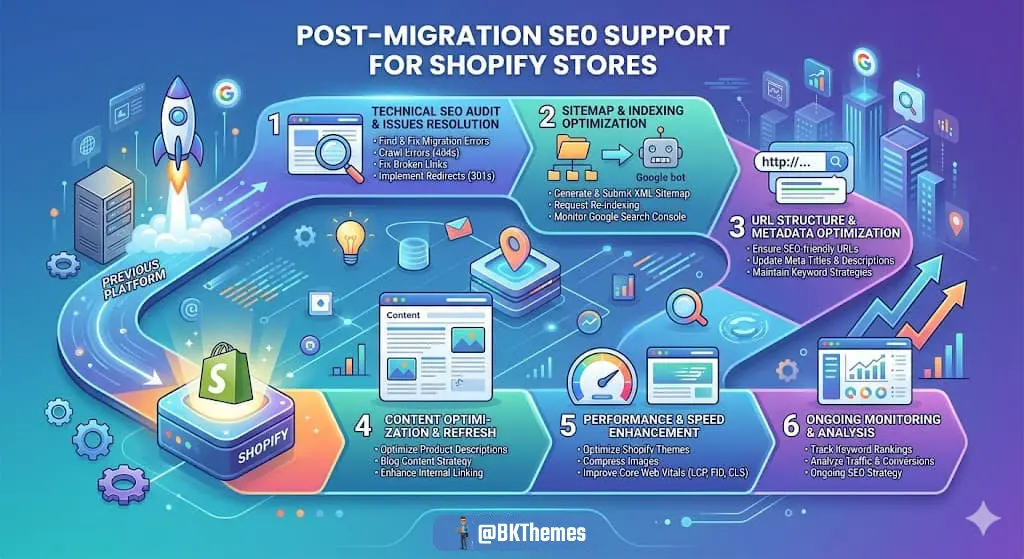
Ongoing SEO support after Shopify migration means actively monitoring, fixing, and improving the site after launch so the new store can preserve or grow organic performance.
That usually includes:
- checking indexation and crawl behavior
- reviewing redirects and fixing misses
- monitoring top landing pages
- updating internal links
- refining metadata
- validating structured data
- improving collection and product page optimization
- reviewing Core Web Vitals
- spotting ranking drops early
- preserving backlink equity
It is not just "we'll keep an eye on it."
That phrase usually means nobody will look until something is broken.
Check out our Shopify Maintenance Plans to keep your store running like a well-oiled machine, ensuring your customers have the best shopping experience possible.
What Can Go Wrong After a Shopify Migration?
Quite a bit, honestly.
And the frustrating part is that many problems are subtle at first.
1. Redirect gaps start leaking authority
You may have mapped the big URLs correctly but missed:
- blog subpages
- tag archives
- old seasonal landing pages
- paginated collections
- image attachment URLs
- discontinued product variants
Those gaps can waste existing authority and create frustrating dead ends for both users and crawlers. That’s why redirect planning and review should continue after launch, not stop at deployment. For more on this, see our guide to SEO-friendly redirects.
2. Top-performing pages may lose relevance
Sometimes migrated pages technically exist but no longer match their original search intent as well as they used to.
This can happen when:
- content is shortened
- headings are rewritten poorly
- category context is removed
- supporting content disappears
- internal links are stripped out
The page is live, but it is no longer as strong.
3. Internal linking weakens without anyone noticing
During migration, navigation and collection structures often change. That can leave formerly strong pages less supported than before.
A solid internal linking strategy helps search engines understand which pages matter most and how topics relate across the store.
If that structure weakens after migration, rankings often follow.
4. Shopify templates can create SEO inconsistencies
Shopify is powerful, but it also introduces templated logic that needs oversight.
Without ongoing SEO review, you may run into issues with:
- duplicate title patterns
- thin collection pages
- weak product descriptions
- tag or filter URL confusion
- inconsistent schema output
- bloated app-generated code
These aren’t always launch-day emergencies. They’re growth killers that creep in quietly.
5. Performance problems can undermine recovery
A new Shopify store may look cleaner than the old platform, but apps, scripts, media files, and theme decisions can still slow it down.
And yes, speed still matters.
Search engines have made it clear that page experience and performance affect usability and visibility. Shopify merchants should keep an eye on site speed and common causes of slowdown, especially after adding apps or redesign features.
For reference, Google’s own SEO Starter Guide and page experience documentation reinforce how technical quality supports search performance.
Why Launch Day Is Not the Finish Line
This is the key point.
A migration is not complete because the site is live.
A migration is complete when:
- the right pages are indexed
- traffic is stable or improving
- rankings are preserved where they should be
- redirects are working
- crawl issues are under control
- conversions are healthy
- the new store is positioned to grow
That usually takes follow-up work.
The businesses that recover and grow fastest after migration are usually the ones with a partner still involved after launch.
Why BKThemes Is Built for Post-Migration SEO Success
A lot of providers can move a store to Shopify.
Fewer can support what happens next.
BKThemes is better positioned for post-migration success because the work doesn’t stop at design and development. The focus continues into:
- technical validation
- ranking support
- architecture review
- internal linking improvements
- structured data refinement
- content preservation
- ongoing optimization
That matters because Shopify migration is not just a development event. It’s a search visibility event.
BKThemes approaches migration with growth in mind
That means looking beyond:
- "Did the theme deploy correctly?"
- "Did the products import?"
- "Does checkout work?"
And asking better questions like:
- Which legacy pages are carrying authority?
- Which collections deserve stronger support?
- Where could crawl efficiency improve?
- Which old backlinks need preserved destinations?
- What pages need metadata refinement now that the structure changed?
- Which content gaps are easier to address post-launch?
That’s how post-migration SEO support becomes strategic instead of reactive.
The Biggest SEO Mistake Businesses Make After Migrating
They assume temporary ranking fluctuations are “normal” and wait too long to investigate.
Yes, some short-term movement can happen after migration.
No, that does not mean every traffic drop should be shrugged off.
Waiting too long can turn fixable issues into entrenched losses.
If your top-performing pages disappear from search, if non-priority pages start ranking instead, or if your collection pages lose visibility, you want a partner who notices fast and knows what to do next.
That’s one reason why BKThemes’ combination of migration support and website management best practices is valuable beyond launch week.
What Ongoing SEO Support Should Include After Shopify Migration
If you’re hiring a provider, this is what you want to see after launch.
Technical review
- crawl testing
- redirect validation
- broken-link review
- canonical review
- sitemap submission
- Search Console monitoring
- schema testing
Content and page review
- top page performance tracking
- collection-page optimization
- product-page content refinement
- metadata checks
- internal-link opportunities
Performance and UX review
- page speed testing
- mobile usability checks
- app impact review
- Core Web Vitals monitoring
Authority preservation
- backlink destination review
- redirect corrections for linked pages
- top linked-page monitoring
- content retention strategy for valuable URLs
This is where BKThemes can do more than a design-first migration vendor. It can help make the new Shopify store stronger than the one it replaced.
Downloadable Checklist: Shopify Post-Migration SEO Checklist
If you want a practical way to review your store after launch, use this checklist:
Download: Shopify Post-Migration SEO Checklist
What’s inside the checklist
- redirect validation points
- indexation checks
- internal linking review
- collection and product page SEO review
- metadata QA
- schema verification
- page speed and mobile checks
- backlink preservation reminders
- post-launch monitoring tasks
It’s designed for store owners, marketers, and agencies who want a cleaner migration handoff and fewer unpleasant surprises.
Who Needs Ongoing SEO Support Most?
Not every migration carries the same level of risk.
Ongoing support becomes especially important if you have:
- an established store with existing rankings
- a blog with search traffic
- a large product catalog
- many legacy URLs
- backlinks pointing to old pages
- multiple collections or category layers
- a seasonal or high-revenue search channel
- plans to scale content after migration
In those cases, the post-launch period is too important to leave to guesswork.
Final Thoughts
Migrating to Shopify can absolutely be the right move.
It can improve usability, performance, merchandising, and operational simplicity.
But the migration itself is only part of the story.
If you want to protect rankings, preserve authority, and grow search visibility after launch, you need ongoing SEO support that continues after the platform switch. That means monitoring, refining, and strengthening the new store as search engines respond to the changes.
That’s where BKThemes stands out.
Not just as a Shopify migration provider, but as a partner focused on post-migration success.
Because a migration should not just get you onto Shopify.
It should put you in a stronger position than before.
Frequently Asked Questions
Want a safer path to Shopify migration?
If you’re planning a move to Shopify, don’t stop at launch. Build a migration plan that includes ongoing SEO support, technical review, and post-launch growth work — so your new store doesn’t just go live, it moves forward.
About the Author

Brian Keary
Founder & Lead Developer
Brian is the founder of BKThemes with over 20 years of experience in web development. He specializes in WordPress, Shopify, and SEO optimization. A proud alumnus of the University of Wisconsin-Green Bay, Brian has been creating exceptional digital solutions since 2003.
Expertise
Writing since 2003