
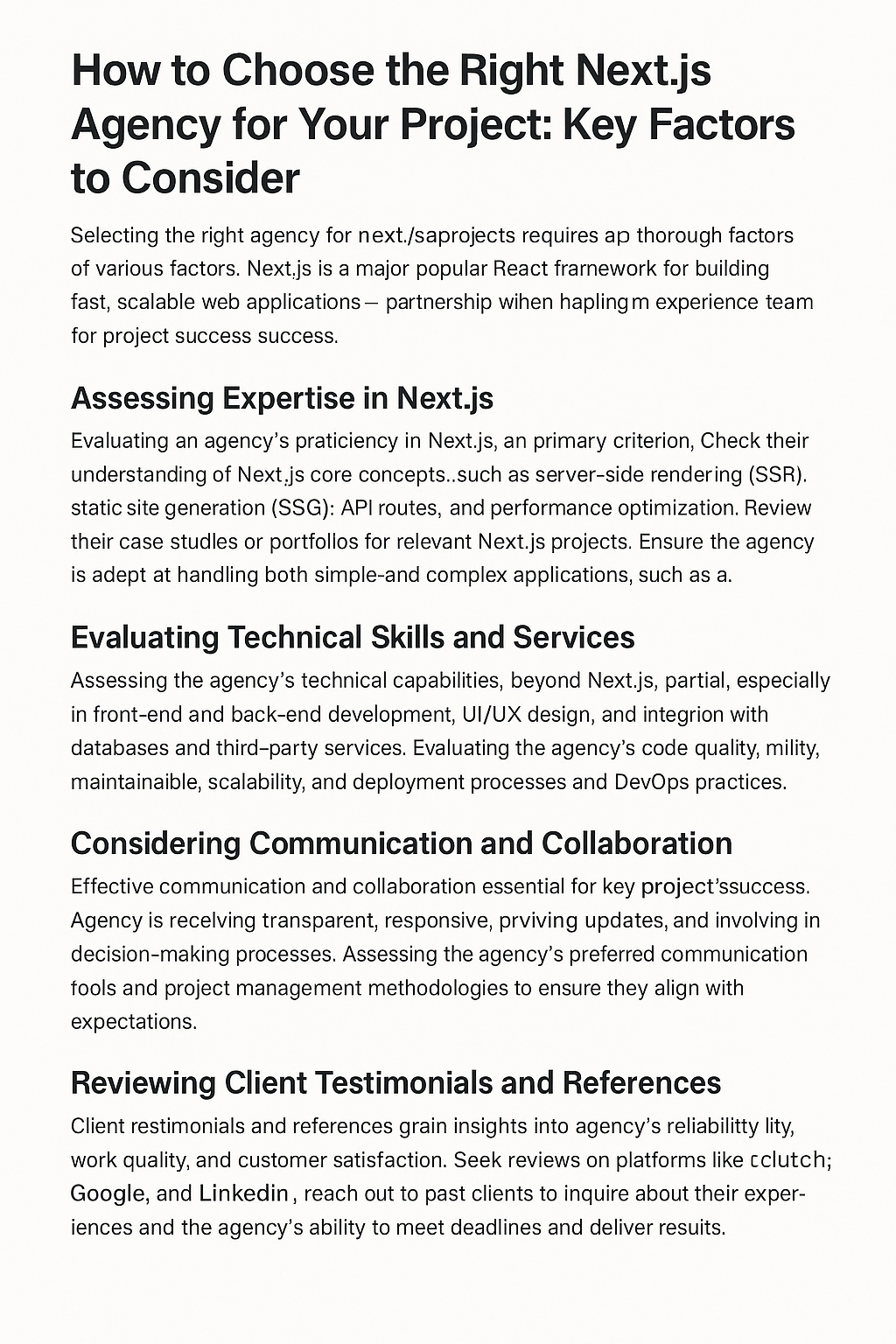
Did you know that over 40% of high-performing web applications in 2026 rely on the React ecosystem to deliver lightning-fast user experiences? Selecting a Next.js agency requires evaluating technical expertise, architectural standards, and long-term maintenance capabilities. This guide outlines the criteria for vetting development partners to ensure your project meets performance and scalability requirements.
Key Takeaways
- Prioritize technical expertise over low-cost promises to save money in the long run.
- Always ask for live examples of high-traffic sites the agency has built.
- Ensure the contract includes full ownership and documentation of your source code.
- Treat the agency as a partner; look for transparent, proactive communication habits.
- SEO and performance are architectural decisions, not just marketing tasks.
Who should use this guide?
This guide is designed for startup founders, product managers, and internal marketing leads who are ready to transition their current stack to a more robust, SEO-friendly framework. You are the person responsible for the bottom line, and you know that a slow website is essentially a digital "closed" sign for your customers. If you are struggling with a legacy platform that just won't keep up with your traffic spikes, this roadmap will help you identify the right partner to modernize your presence. You likely value long-term stability over a quick fix and want to ensure your investment pays dividends for years to come.
For whom is this guide not intended?
This guide is not intended for hobbyists building personal blogs or developers looking for a tutorial on how to write their first component. If you are looking for a cheap freelancer to patch together a template with zero regard for architectural integrity, you will find this advice too rigorous. This is also not for those who believe that "any web developer can do it," as Next.js requires a specialized mindset geared toward server-side rendering and static site generation. If your project goals do not involve high-performance requirements, complex data fetching, or a need for a massive SEO boost, you might be over-engineering your search for an agency.
Why Next.js matters for your business
Next.js is a top choice in 2026 because it blends fast dynamic pages with strong search engine optimization. It uses server rendering and smart caching to give search engines instant content while keeping user data fresh. If you are interested in how this fits into a broader digital strategy, you should read more about mastering your digital presence the power of a custom next theme to see how design and code intersect.
Why Next.js Works Well
- Server Rendering: Pages build on the server so search bots see full HTML right away.
- Fast Speed: Code splits automatically to keep load times very low.
- Flexible Caching: You can choose how and when data updates on your pages.
- Good Tools: Built-in image and font optimization help performance scores.
How It Solves the Tension
- For Search Engines: Pages load with text ready to read. Bots do not wait for client JavaScript to run.
- For Users: Pages update live with real-time data when needed. You get the best parts of static sites and apps.
Mistakes to avoid when hiring an agency
The biggest mistake most businesses make is prioritizing price tags over proven architecture. Many agencies will promise you the moon but deliver a fragile, unmaintainable mess that requires a total rewrite within six months. Avoid teams that cannot articulate the difference between static site generation and incremental static regeneration, as this indicates a lack of deep framework knowledge. Do not ignore the importance of communication cycles; if an agency is hesitant to show you their workflow, they are likely hiding a lack of transparency. You must also watch out for "vendor lock-in" tactics where an agency writes proprietary, undocumented code that traps you in their ecosystem forever.
How to vet an agency's technical prowess
You should start by asking to see a live project they have built that handles high concurrent traffic. A truly skilled agency won't just show you a pretty homepage; they will walk you through their approach to API integration, state management, and edge caching. Ask them how they handle deployment pipelines and whether they follow a CI/CD process that ensures code quality before it hits production. If they seem confused by your questions regarding performance metrics like Core Web Vitals, they probably aren't the right fit for your high-growth project. You can compare their approach to industry standards by reading bkthemes vs design-focused competitors: who wins? to understand where the technical bar is set.
Comparison of agency types
| Feature | Freelance Developer | Boutique Agency | Large Consultancy |
|---|---|---|---|
| Cost | Low | Moderate | High |
| Speed | Fast | Balanced | Slow |
| Scalability | Limited | High | Very High |
| Communication | Direct | Collaborative | Corporate |
| Expertise | Generalist | Specialized | Broad |
Actionable checklist for your discovery call
Before you sign any contracts, ensure your potential partner can check these boxes during your initial meetings.
- Can they show a portfolio of at least three live Next.js projects?
- Do they have a clear strategy for optimizing images and assets?
- Are they willing to provide documentation for all custom components?
- Do they have a plan for ongoing maintenance and security patches?
- Can they explain how they integrate SEO best practices into the development phase?
- Are they comfortable working with your existing API and database structure?
What is the primary benefit of choosing a specialized agency?
The primary benefit of choosing a specialized agency is the reduction of long-term technical debt. A generalist might get your site live, but a specialist builds it to handle the traffic you expect to have in three years. They understand the patterns that make code reusable, scalable, and easy to debug. By investing in experts, you avoid the "spaghetti code" trap that plagues so many growing businesses, saving you thousands in refactoring costs down the road. They bring a level of foresight that prevents bottlenecks before they even manifest in your production environment.
How do you evaluate their communication style?
You evaluate their communication style by assessing their transparency and their ability to explain complex topics in plain language. If an agency uses jargon to intimidate you, they are failing their primary duty as a consultant. Look for partners who use collaborative tools like Slack, Trello, or Jira to keep you in the loop, rather than burying updates in long, confusing email chains. A great agency treats you as a partner, proactively flagging potential issues before they become crises. If they are silent for days at a time during the discovery phase, imagine how they will act when you are in the middle of a critical launch.
Why is documentation essential for your project?
Documentation is essential for any project because it creates a single source of truth that aligns team goals, preserves key decisions, and speeds up onboarding.
Key Benefits of Project Documentation
- Clarity and Alignment: It defines project scope, roles, and expectations so everyone works toward the same objectives.
- Time Savings: It stops team members from answering the same questions or repeating work already done by others.
- Easy Onboarding: New hires read the material to learn systems and workflows without waiting for a manager.
- Knowledge Transfer: It keeps forward momentum going even when key team members leave or work across different time zones.
- Better Accountability: It maintains a clear record of tasks, budgets, and risk management logs for stakeholders.
How do you handle the transition to a new agency?
The transition to a new agency should be handled through a phased audit of your existing codebase. Start by having the new team perform a technical deep dive to identify high-priority vulnerabilities and performance bottlenecks. Do not try to change everything at once; focus on the most impactful areas first, like your checkout flow or your primary landing pages. Clear communication between the outgoing and incoming teams is vital, so ensure your contract includes a handover clause. If you are moving from a platform that wasn't serving your needs, you might find that you need to rethink your entire approach to growth.
What is the role of SEO in your development phase?
SEO is not an afterthought; it must be baked into the architecture from the very first line of code. A specialized agency will ensure that your site is structured with semantic HTML, proper header hierarchies, and lightning-fast load times that satisfy Google's requirements. They understand that content is only king if the site is fast enough to deliver it to the user. By focusing on technical SEO early, you avoid costly retrofitting later on, ensuring your site ranks higher from the moment it goes live. When you pick a agency that builds with SEO first you are assured the site will perform at peak performance. This is where our custom coding excels above others. We always develop with the SEO included. No need for extra plugins or apps.
Frequently Asked Questions
Why choose Next.js over other frameworks?
Developers choose Next.js over other frameworks because it provides a production-ready, full-stack architecture out of the box. Unlike traditional single-page application (SPA) libraries like plain React—which require you to manually piece together tools for routing, optimization, and state management—Next.js handles the heavy lifting automatically.
How long does a typical Next.js project take to build?
The timeline depends entirely on the scope of your project, but a standard MVP can take anywhere from eight to twelve weeks. Complex enterprise applications will naturally require more time for planning, development, testing, and deployment cycles.
What should I look for in an agency's portfolio?
Look for variety in their work and evidence of performance. Do they have experience with the specific industry you are in? Can they explain the logic behind their design and architectural choices?
How do I know if an agency is overcharging me?
Compare their quotes against your internal budget and the complexity of the requirements. If an agency is significantly cheaper than everyone else, they are likely cutting corners. If they are significantly higher, ask for a detailed breakdown of their hourly rates and project deliverables.
Can I switch to a new agency halfway through a project?
Yes, but it is challenging and often expensive. It requires a thorough audit of the existing code and a very clear handover process between the two parties. It is always better to vet your agency thoroughly at the start to avoid this situation.
Conclusion
Finding the right Next.js agency is about aligning your business goals with a team that has the technical maturity to execute your vision. You aren't just buying code; you are buying a partnership that will influence how your customers interact with your brand for years to come. By focusing on technical transparency, robust documentation, and a clear SEO strategy, you position your project for long-term success. Take your time, ask the hard questions, and don't settle for anything less than a team that understands the value of your digital future. Your project deserves a foundation that is as strong as your ambitions.
About the Author

Brian Keary
Founder & Lead Developer
Brian is the founder of BKThemes with over 20 years of experience in web development. He specializes in WordPress, Shopify, and SEO optimization. A proud alumnus of the University of Wisconsin-Green Bay, Brian has been creating exceptional digital solutions since 2003.
Expertise
Writing since 2003