
The SEO detail you're ignoring while obsessing over alt text and meta descriptions
Discover why user-friendly URLs matter more than alt text for image SEO in 2026. Learn how messy, auto-generated image URLs undermine your optimization efforts and what to do about them.
TL;DR
- Image URLs matter more than alt text alone - Google's 2025 update penalizes inconsistent URLs with re-crawling delays that tank image visibility
- Descriptive URLs boost rankings - Pages with keywords in URLs rank 45% higher on average, and this applies to images too
- Clean URLs supercharge structured data - Schema markup works better when referencing readable, stable image URLs instead of random strings
- Small businesses have the advantage - With fewer pages, you can fix URL structure in an afternoon while larger competitors struggle with technical debt
The URL Nobody Looks At Is Costing You Rankings
You spent hours finding the perfect product image. You compressed it, added alt text, and even named the file something descriptive. Then you uploaded it to your CMS, and it generated this: /wp-content/uploads/2025/01/IMG_4582-scaled-e1234567890.jpg.
That URL just undermined everything you did right. And you probably never noticed.
I've audited hundreds of small business websites. The pattern is consistent: owners obsess over keywords and meta descriptions while their image URLs look like someone smashed a keyboard. It's the SEO equivalent of wearing a tailored suit with untied shoes.
The Myth of "Images Don't Need SEO"
Here's what most small business owners believe: image SEO means alt text. Add a description, maybe include a keyword, and move on. The URL? That's a technical detail the CMS handles.
This belief made sense five years ago. Search engines weren't sophisticated enough to care much about image URLs. Alt text carried the weight.
But Google's algorithms evolved. Google's 2025 image SEO update made something explicit that was previously implied: URL consistency and structure directly impact image visibility. Sites with chaotic, changing URLs saw images vanish from Google Image Search entirely.
The old playbook is breaking down. Alt text alone isn't enough anymore.
User-Friendly URLs Are the Foundation, Not the Finishing Touch
Here's what I actually believe: user-friendly URLs are the most underinvested lever in image SEO, and fixing them costs almost nothing.
When your image URL reads /products/blue-ceramic-coffee-mug.jpg instead of /uploads/2026/img_8832.jpg, Three things happen simultaneously. Google understands what the image shows before even analyzing it. Users who hover over links see context instead of gibberish. And your structured data has clean, parseable URLs to reference.
This isn't about aesthetics. Pages with keywords in the URL rank 45% higher in SERPs on average. That statistic applies to images, too. Google treats URLs as signals of relevance and quality.

The Stability Factor Nobody Discusses
URL structure matters, but URL stability might matter more. Every time you change an image URL (new CMS, different folder structure, plugin update), Google has to re-crawl and re-index that image. During that window, your image disappears from search results.
I watched a client's product images vanish from Google Image Search for three weeks after a routine site migration. Their traffic from image search dropped 60%. The images were identical. Only the URLs changed.
Stable, descriptive URLs compound over time. Chaotic URLs reset your progress repeatedly.
The Structured Data Connection
Here's where user-friendly URLs become genuinely powerful: they supercharge your structured data implementation.
When you add schema markup to your pages (and 72% of first-page Google results use structured data), you're telling search engines exactly what your content represents. Product schema, article schema, recipe schema. They all reference images via URLs.
Clean URLs make that reference unambiguous. "image": "https://yoursite.com/products/blue-ceramic-coffee-mug.jpg" tells Google everything. "image": "https://yoursite.com/wp-content/uploads/2025/01/IMG_4582-scaled-e1234567890.jpg" tells Google nothing useful.
The structured data and the URL reinforce each other. Google sees consistency between what you claim (via schema) and what your URL suggests. That consistency builds trust in your markup.
Meanwhile, 23% of websites have no structured data at all. They're leaving rich results on the table. And many sites that do have schema undermine it with messy image URLs.
The Small Business Advantage
Large e-commerce sites with 50,000 products face genuine challenges in fixing legacy URLs. The migration risk is real. The development cost is high.
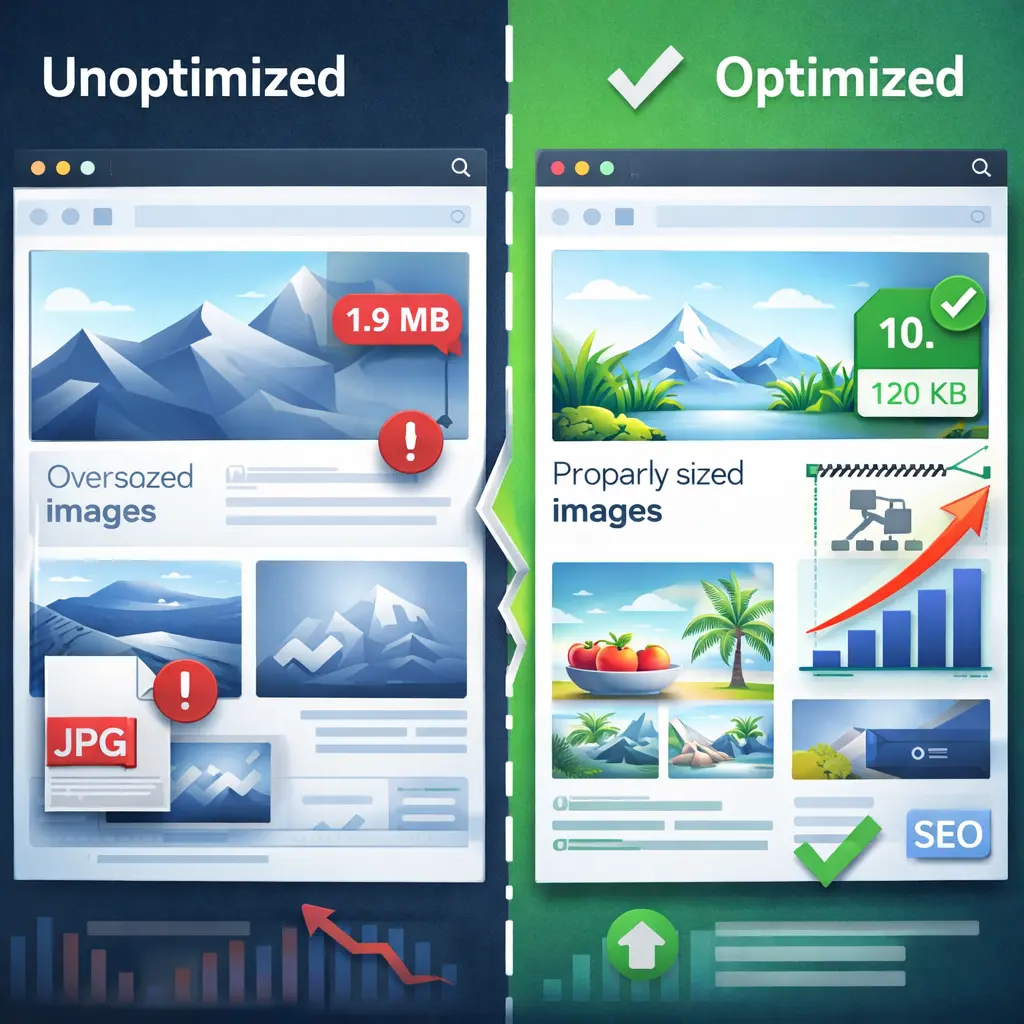
You probably have 50 to 500 pages. You can fix this in an afternoon.
Rename your key product and service images with descriptive, keyword-relevant filenames before uploading. Set up a consistent folder structure. Configure your CMS to preserve those filenames instead of appending random strings.
This is the kind of on-page SEO essential that larger competitors often can't execute cleanly. Their technical debt is your opportunity.
What Changes If You Take This Seriously
If user-friendly URLs matter as much as I'm claiming, several things follow.
First, your next website migration needs an image URL strategy, not just a page redirect plan. Most migrationchecklists ignore images entirely. That's a mistake.
Second, your image naming convention becomes a genuine SEO asset. product-name-color-angle.jpg It isn't just organized. It's strategic.
Third, your structured data implementation gets easier and more effective. Clean URLs mean clean schema. Clean schema means better click-through rates from rich results.
The cost of ignoring this? You keep uploading great images that Google struggles to understand, index, and surface. Content with images gets 94% more views, but only if those images actually appear in search results.
Think of URLs as Metadata That Never Gets Stripped
Here's the reframe that changed how I approach this: image URLs are the one piece of metadata that travels everywhere your image goes.
Alt text lives in your HTML. It can be stripped, modified, or ignored. Filenames can be renamed by CDNs or caching plugins. But the URL? It persists in backlinks, in social shares, in Google's index, and in your structured data.
When someone embeds your image, the URL goes with it. When Google crawls a page linking to your image, it sees the URL. When your schema references the image, it uses the URL.
User-friendly URLs aren't a technical detail. They're persistent, portable contexts that follow your images across the web.
The Unsexy Work That Compounds
I get why this isn't exciting. Nobody brags about their URL structure at marketing conferences. There's no viral case study about renaming image files.
But the businesses I've seen win at SEO with limited resources share a common trait: they do the boring foundational work that competitors skip. They optimize product descriptions and images methodically. They treat URLs as first-class citizens.
User-friendly URLs won't double your traffic overnight. They'll prevent you from losing traffic you've already earned. They'll make every other SEO investment work harder. And they'll compound quietly while your competitors chase the next algorithm update.
The unsung heroes rarely get credit. But they're often the reason the song works at all.
Frequently Asked Questions
Sources
- https://www.dmcockpit.com/blogs/why-consistent-image-urls-matter-more-than-ever
- https://wpcreative.com.au/seo-statistics/
- https://seosherpa.com/seo-statistics/
- https://bkthemes.design/blog/on-page-seo-essentials-newcomers-needs-to-master/
- https://bkthemes.design/blog/improving-click-through-rates-in-2025/
- https://bkthemes.design/blog/optimize-product-description/
About the Author

Brian Keary
Founder & Lead Developer
Brian is the founder of BKThemes with over 20 years of experience in web development. He specializes in WordPress, Shopify, and SEO optimization. A proud alumnus of the University of Wisconsin-Green Bay, Brian has been creating exceptional digital solutions since 2003.
Expertise
Writing since 2003