Building a digital presence has evolved far past simple static pages and basic brochures. Modern organizations rely on complex digital ecosystems that require precise execution across both design and infrastructure. When businesses evaluate web development services, they discover that expectations have shifted toward dynamic, data-driven platforms. These systems must balance speed, security, and accessibility to serve diverse user bases effectively. Understanding these shifts helps project leaders allocate resources efficiently and partner with development teams that understand current architectural standards.
What are the key components and approaches driving the evolution of modern digital ecosystems?
The evolution of modern digital ecosystems is driven by a shift from isolated, product-centric applications to interconnected, intelligent, and adaptable environments. These ecosystems rely on seamless data exchange, automated intelligence, and modular architecture.
Here are the key components and operational approaches shaping modern digital ecosystems:
1. Core Technological Components
- API-First Architecture: Application Programming Interfaces (APIs) serve as the connective tissue of the ecosystem. They enable different platforms, internal systems, and third-party services to securely share data and functionalities in real time.
- Cloud-Native Infrastructure: Modern ecosystems leverage microservices, containerization (e.g., Kubernetes), and serverless computing. This setup allows companies to scale components independently, deploy updates continuously, and minimize system downtime.
- Artificial Intelligence & Machine Learning: AI/ML engines are embedded directly into ecosystem workflows to automate decision-making, optimize resource allocation, predictive analytics, and deliver hyper-personalized user experiences.
- Unified Data Platforms: Data lakes, mesh architectures, and real-time streaming pipelines break down data silos. They ingest, clean, and analyze massive volumes of structured and unstructured data to provide a single source of truth across the network.
- Edge & IoT Computing: Processing data closer to the source (at the "edge") reduces latency and bandwidth usage. This component is crucial for industries relying on real-time feedback loops, such as autonomous systems, healthcare diagnostics, and smart infrastructure.
2. Strategic Approaches Driving Evolution
- Composable Business Architecture: Organizations are shifting toward modularity, selecting "best-of-breed" software components rather than relying on monolithic, single-vendor platforms. This approach allows businesses to swap out or upgrade individual tools quickly without disrupting the entire ecosystem.
- Decentralized Trust & Zero-Trust Security: As digital touchpoints multiply, perimeter-based security is no longer viable. Modern ecosystems adopt Zero-Trust Network Access (ZTNA)—where identity and access are continuously verified—alongside decentralized frameworks like blockchain for transparent, tamper-proof record-keeping.
- Open Ecosystem Collaborations: Companies are increasingly participating in co-opetition and open innovation. By opening their platforms to developers and third-party partners (e.g., open banking initiatives), they create broader networks that add mutual value for users and providers.
- Product-Led & User-Centric Design: Ecosystem evolution is heavily focused on reducing friction for the end-user. Approaches like unified single sign-on (SSO), cross-platform omni-channel experiences, and accessibility-first frameworks ensure that interacting with the ecosystem is intuitive across all devices.
- Composable Architecture & Specialized Microsites: As organizations shift toward modularity and composable business architectures, developers can decouple targeted marketing initiatives from the primary codebase. Rather than bloating a monolithic platform with temporary landing pages, teams deploy specialized, lightweight web experiences—making it essential to understand the rise of the microsite in modern web development to capture specific campaign audiences without disrupting core infrastructure.
What are the current accessibility and performance standards and how are they applied in web development?
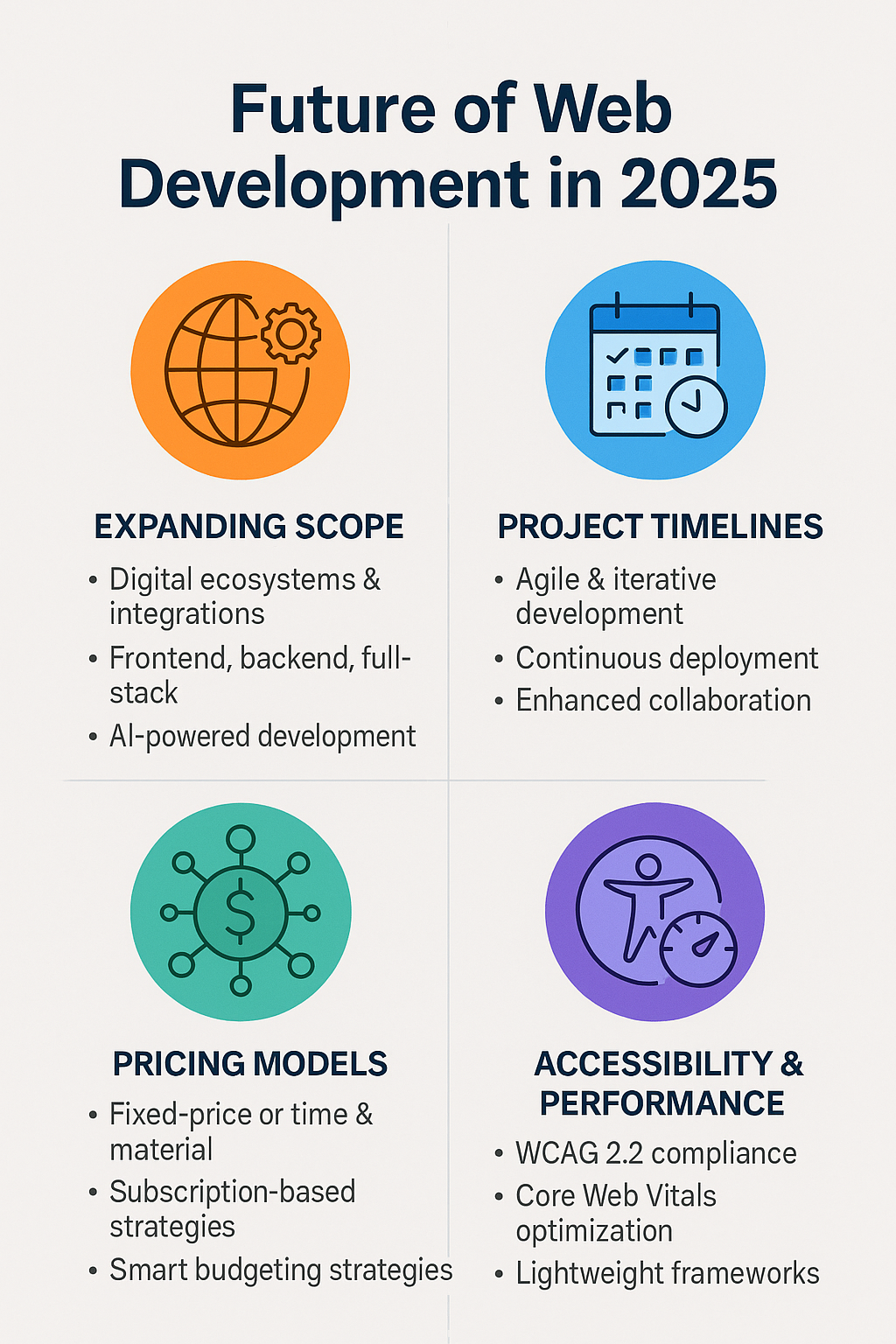
The primary benchmarks for modern web development are WCAG 2.2 for digital accessibility and Google's Core Web Vitals (LCP, INP, CLS) for performance. WCAG 2.2 became a W3C Recommendation on October 5, 2023, adding success criteria related to accessible authentication, target size, focus visibility, and redundant-entry prevention. Developers use these guidelines to help websites accommodate users with visual, auditory, or motor impairments.
WCAG 2.2 is not a universally applicable legal requirement for every website. WCAG 2.0, 2.1, and 2.2 remain active standards, while the applicable legal obligations depend on jurisdiction, sector, and contract. Teams should therefore identify the requirements relevant to each project rather than treating one version as a blanket rule.
Beyond accessibility, performance metrics remain measurable rather than subjective. Google’s Core Web Vitals guidance defines good targets as an LCP within 2.5 seconds, INP (which officially replaced FID as a Core Web Vital in March 2024) under 200 milliseconds, and CLS below 0.1. Teams can review the Google Core Web Vitals documentation and use tools such as Search Console to measure, debug, and continuously optimize performance after launch.
Automated testing tools play an important role in maintaining these standards throughout the project lifecycle. Engineers may use performance and testing tools for automated checks, bug detection, and optimization. These systems provide practical feedback during development, but they should support—not replace—human review of accessibility, usability, and functional behavior.
Learn expert custom web development strategies by visiting our detailed guide on custom web development.
What project methodologies and tools are essential for managing modern web development?
Modern web development projects require a blend of flexible, collaborative methodologies and a tightly integrated tool stack to handle rapid deployment cycles, cross-functional teams, and highly modular architectures.
1. Project Management Methodologies
- Agile Scrum: The most prevalent framework for web development. Work is structured into fixed-length cycles (Sprints, typically 2–4 weeks) where cross-functional teams deliver incremental software updates. It relies on ceremonies like Daily Standups, Sprint Planning, and Retrospectives to maintain alignment.
- Kanban: A continuous delivery framework focused on visualizing work via physical or digital boards. It eliminates fixed sprints in favor of managing workflow efficiency by setting Work-In-Progress (WIP) limits to prevent bottlenecks.
- Scrumban: A hybrid approach that combines the structured planning and review cycles of Scrum with the visual, continuous workflow optimization of Kanban—ideal for fast-paced web projects with shifting priorities.
- DevOps Methodologies: Not just an engineering discipline, but a collaborative framework that bridges the gap between development and operations. It emphasizes continuous integration, automation, and shared responsibility for deployment success.
2. Essential Project & Product Management Tools
To execute these methodologies, teams use digital platforms to track tasks, document specifications, and map product lifecycles.
- Issue & Sprint Tracking: Tools like Atlassian Jira or Linear are essential for managing backlogs, mapping sprints, tracking bugs, and monitoring team velocity.
- Lightweight Task Management: For smaller web teams or agency environments, highly visual and customizable platforms like Asana, Monday.com, or Trello provide clear project timelines and Kanban-style tracking.
- Knowledge Management & Documentation: Central repositories like Notion or Confluence are used to house API documentation, product requirement documents (PRDs), engineering wikis, and design system rules.
3. Product Development & Engineering Delivery Ecosystem
Beyond task tracking, the technical execution of web development relies on an ecosystem of integrated tools that support the modern software lifecycle.
| Category | Primary Function & Impact | Common Industry Standard Tools |
|---|---|---|
| Version Control & Collaboration | Manages codebase history, facilitates peer review via Pull Requests (PRs), and acts as the central repository. | GitHub, GitLab, Bitbucket |
| CI/CD Pipelines | Automatically tests and builds code upon submission, ensuring buggy code doesn't reach production. | GitHub Actions, CircleCI, Jenkins |
| Type-Safe Languages & Standards | Ensures robust, maintainable execution across complex frontend and backend codebases by catching errors at compile time. | TypeScript |
| UI/UX Design & Handoff | Bridges the gap between designers and developers by providing interactive mockups and component code specs. | Figma |
| Cloud Hosting & Vercel-like PaaS | Provides instant preview deployments for feature branches, streamlining stakeholder QA and approval. | Vercel, Netlify, AWS Amplify |
How does AI integrate into development workflows, and what human oversight is still required?
Artificial intelligence has altered how engineers write code, test software, and manage deployment pipelines. AI-powered assistance can help developers draft boilerplate code, write unit tests, and troubleshoot syntax errors quickly.
However, automation is not a replacement for human oversight. While generative AI can accelerate output, engineers must carefully review AI-generated code to verify security, accessibility, and functional behavior. A peer-reviewed ACM study examined whether generative-AI-created websites conformed to WCAG 2.2, reinforcing the need to evaluate generated output rather than trust it automatically. Related research on generative accessibility tools, such as the University of California, Irvine accessibility study, also supports using AI as a testing aid rather than proof of complete conformance.
What are the common pricing models and investment categories for web development projects?
Pricing models for web development typically include Fixed-Price, Time & Materials, and Retainer or Subscription options. Each model offers distinct advantages depending on whether project requirements are strictly defined or expected to evolve over time.
Basic or informational websites typically cost between $3,000 and $15,000 and take 4 to 8 weeks to build. These projects usually suit small businesses that need a clean, responsive online brochure with up to ten core pages.
E-commerce platforms generally cost $25,000 to $150,000+ with estimated timelines of 3 to 5 months. These builds require secure payment gateways, inventory management systems, and high-performance architecture to handle transactional data safely.
Custom web applications or SaaS solutions range from $40,000 to $200,000+ requiring 3 to 9+ months of dedicated engineering work. These complex platforms feature unique user logic, database structures, and API integrations that demand deep technical execution and ongoing maintenance.
Hourly rates for specialized development talent typically range from $100 to $200+ per hour, while ongoing retainer agreements often span $500 to $2,500+ per month depending on the level of support and feature updates required.
Frequently Asked Questions (FAQ)
Why Do Basic Websites Cost Less Than Custom SaaS Applications?
Basic informational websites rely on standard templates and established content management systems that require minimal custom programming. Custom software and SaaS platforms demand bespoke database architecture, complex user permission systems, and rigorous security protocols that require significantly more engineering hours.
How Long Does a Typical E-Commerce Build Take?
An e-commerce platform usually takes between 3 and 5 months to design, develop, and launch. This timeline accounts for integrating secure payment processors, configuring product catalogs, setting up shipping rules, and conducting thorough accessibility and performance testing.
Are Accessibility Standards Legally Required for All Websites?
No single WCAG version is legally required for every website in every jurisdiction. WCAG 2.2 is a current W3C Recommendation, but applicable legal requirements depend on factors such as location, sector, contract, and the type of service being delivered. Teams should identify the rules that apply to a specific project while using WCAG as a practical accessibility framework.
What Pricing Model Works Best for Ongoing Website Maintenance?
Retainer or subscription models work best for ongoing maintenance. These agreements ensure that development teams are consistently available to apply security patches, monitor performance metrics, and implement quick wins or feature enhancements as the business grows.
Can AI Tools Fully Build a Compliant Website Without Human Developers?
No, AI tools can accelerate code generation and testing, but they cannot guarantee complete compliance with accessibility or security standards. Human oversight remains essential to review code, verify visual layouts, and evaluate whether the digital product meets applicable functional and legal requirements.
What ongoing strategies are necessary for securing and evolving your digital presence?
Keeping pace with digital trends requires launching a modern site and performing continuous attention, security updates, and performance tuning. Protecting digital infrastructure against emerging threats is a priority for any development partner. The NIST Cybersecurity and Privacy program highlights software and supply-chain cybersecurity, identity and access management, and practical security applications as important areas of focus.
W3C’s 2025–2028 strategic objectives also identify accessibility, internationalization, privacy, and security as social responsibilities of Web standards work. These concerns should be considered alongside design, infrastructure, and delivery goals rather than treated as optional additions.
When you establish a partnership with an experienced agency, you gain access to structured processes that protect your investment over the long haul. Instead of treating your website as a one-time project, leading teams focus on building flexible systems that adapt as your market shifts. Whether you are launching a lean MVP to test a new product idea or scaling a large e-commerce portal, clear communication and disciplined execution will determine your success.
Take a close look at your current digital assets. Identify where your performance lags, review your accessibility conformance, and determine whether your underlying tech stack still supports your business goals. When you are ready to elevate your web presence, partner with a team that values practical solutions, transparent pricing, and rigorous technical standards.
Ready to build a high-performing digital platform that supports real business growth? Contact your chosen development team to discuss your project scope and determine how to turn your web development vision into a reliable, scalable reality.
Looking for implementation support? Visit our web development services page for the full service overview.
About the Author

Brian Keary
Founder & Lead Developer
Brian is the founder of BKThemes with over 20 years of experience in web development. He specializes in WordPress, Shopify, and SEO optimization. A proud alumnus of the University of Wisconsin-Green Bay, Brian has been creating exceptional digital solutions since 2003.
Expertise
Writing since 2003