Did you know that Google processes over 8.5 billion searches every single day? That's a staggering number of opportunities to connect with your audience. But in today's competitive digital landscape, simply stuffing your content with basic keywords isn't enough. Search engines, especially Google, have become incredibly sophisticated, understanding not just the words on a page, but the intent behind them. This is where semantic SEO comes into play, a powerful approach that leverages natural language and long-tail keywords to build deeper connections with both search engines and users.
Key Takeaways
- Semantic SEO focuses on meaning and context, not just keywords.
- Natural Language Processing (NLP) helps search engines understand human queries.
- Long-tail keywords are specific, longer phrases that capture precise user intent and have less competition.
- Understand your audience's questions and the intent behind their searches.
- Craft comprehensive, conversational content that answers queries thoroughly.
- Identify and discuss key entities related to your topic.
- Utilize tools like Google Search Console and AnswerThePublic for research.
- Implement Schema markup to further enhance semantic understanding.
- Track metrics like organic traffic, rankings, and user engagement to measure success.
As an SEO enthusiast and content creator, I've seen firsthand how shifting from traditional keyword tactics to a semantic approach can dramatically improve search rankings and drive more qualified traffic. It's about speaking the language your audience actually uses and providing comprehensive answers to their queries. Let's dive deep into how you can harness the power of natural language and long-tail keywords to supercharge your website's SEO.
While discovering high-converting search terms takes a strategic approach, it's only the first step. To see how these terms fit into an overarching content strategy, check out our definitive guide to long-tail keywords before diving into specific tactics below.
What Exactly is Semantic SEO?
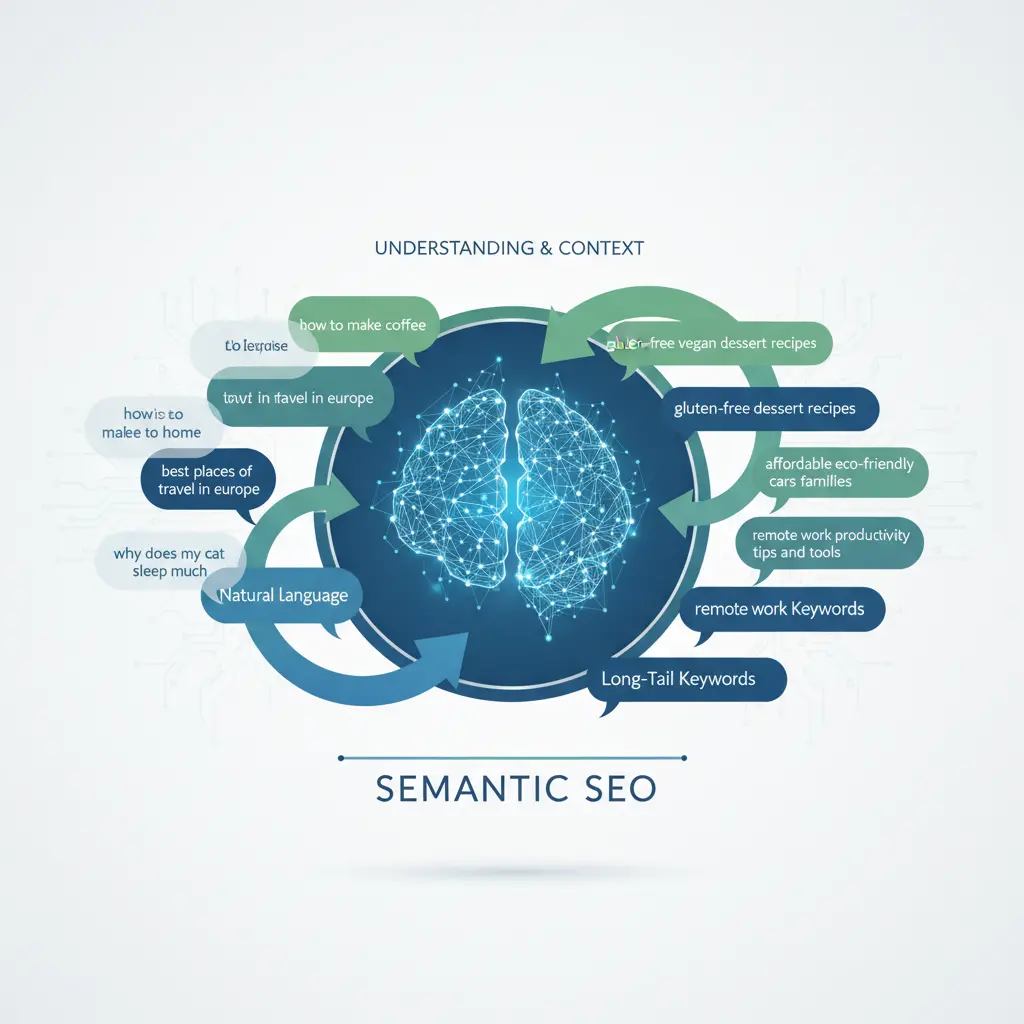
Before we get into the 'how,' let's clarify 'what.' Semantic SEO is a strategy focused on understanding the meaning and context behind search queries, rather than just matching exact keywords. It's about building a web of related concepts and topics around your core subject matter. Think of it like a conversation. When you ask a question, you expect a thorough, contextual answer, not just a robotic response to a single word. Search engines are increasingly aiming for that same conversational understanding.
Entity-focused content is a cornerstone of semantic SEO. Instead of just focusing on a single keyword like 'shoes,' semantic SEO considers the entities associated with it: 'running shoes,' 'women's running shoes,' 'best running shoes for beginners,' 'Nike running shoes,' and their attributes like 'cushioning,' 'support,' and 'mileage.' By understanding these relationships, search engines can better determine the relevance and authority of your content.
The Power of Natural Language
Natural language processing (NLP), the technology that allows computers to understand and interpret human language, is at the heart of semantic search. Google's algorithms, like BERT and MUM, are designed to grasp nuances, synonyms, prepositions, and the overall intent of a search query. This means you should write your content as if you're explaining a topic to another human, using clear, conversational language.
Why Natural Language Matters for SEO
- User Experience: Content written in a natural, conversational tone is more engaging and easier for users to understand. This leads to longer dwell times and lower bounce rates, positive signals for search engines.
- Intent Matching: Natural language helps search engines better understand the user's intent. Are they looking for information, a product, a local service, or a specific answer?
- Comprehensive Answers: By using natural language, you're more likely to cover all aspects of a topic, providing a more complete and satisfying answer to the searcher's query.
Unlocking Potential with Long-Tail Keywords
While broad, high-volume keywords are tempting, long-tail keywords are the secret weapon for semantic SEO success. These are longer, more specific search phrases, typically consisting of three or more words. For example, instead of 'SEO,' a long-tail keyword might be 'how to use long-tail keywords for local SEO.'
The Significance of Long-Tail Keywords
- Higher Conversion Rates: Users searching with long-tail keywords are often further down the sales funnel and have a clearer idea of what they want. This means they are more likely to convert.
- Less Competition: These specific phrases generally have lower search volume and, consequently, less competition, making them easier to rank for.
- Reflect User Intent: Long-tail keywords are incredibly effective at capturing specific user intent. Someone searching for 'best waterproof hiking boots for wide feet' has a very precise need that broad terms like 'boots' can't address.
- Build Topical Authority: Consistently targeting long-tail keywords related to your niche helps establish your website as an authority on those specific sub-topics.
Integrating Natural Language and Long-Tail Keywords: A Practical Guide
Now, let's get down to the actionable steps. How do you weave these elements together effectively?
1. Understand Your Audience and Their Queries
This is the foundational step. You need to get inside the heads of your target audience. What questions are they asking? What problems are they trying to solve? What language do they use when discussing your products or services?
- Tools for Research: Utilize tools like Google Search Console, AnswerThePublic, AlsoAsked.com, and keyword research tools (e.g., SEMrush, Ahrefs) to uncover common questions and long-tail phrases.
- Analyze Competitors: See what kind of long-tail keywords your competitors are ranking for. This can provide valuable insights.
- Customer Feedback: Pay attention to customer service logs, reviews, and social media comments. These are goldmines for natural language queries.
2. Map Keywords to User Intent
Once you have a list of potential long-tail keywords, it's crucial to map them to the underlying user intent. Are they informational, navigational, transactional, or commercial investigation?
- Informational: User seeks knowledge (e.g., 'what is semantic SEO').
- Navigational: User wants to find a specific website (e.g., 'BK Themes blog').
- Transactional: User wants to buy something (e.g., 'buy WordPress themes with semantic SEO features').
- Commercial Investigation: User is comparing options before buying (e.g., 'best semantic SEO WordPress themes').
Understanding intent allows you to create content that precisely meets the user's needs.
3. Craft Comprehensive, Conversational Content
This is where natural language truly shines. Write as you would speak, but with clarity and structure. Aim to answer the 'who, what, when, where, why, and how' of your topic.
- Use Synonyms and Related Terms: Don't just repeat the same keyword. Employ variations and related terms that search engines understand as part of the broader topic.
- Answer Questions Directly: Structure your content to directly address the questions identified in your keyword research. Headings and subheadings are your friends here.
- Focus on Readability: Use short sentences, clear paragraphs, and bullet points. Aim for a reading level that's accessible to your target audience (often around a 7th-grade level for broad appeal).
- Internal Linking: Connect related content on your site using natural anchor text. For example, on a page discussing 'semantic SEO WordPress themes,' you might link to a blog post about 'on-page SEO best practices' using anchor text like 'learn more about on-page SEO.' This helps search engines understand the relationship between your pages. Check out our collection of semantic-friendly WordPress themes designed to support your SEO efforts.
4. Optimize for Entities and Relationships
Semantic SEO goes beyond keywords to consider entities – real-world objects, concepts, and people. Think about the key entities related to your topic and ensure your content discusses them.
- Identify Key Entities: For a post about 'semantic SEO,' key entities might include 'Google,' 'NLP,' 'keywords,' 'search intent,' 'user experience,' 'content optimization,' and specific algorithms like 'BERT.'
- Define Relationships: Clearly explain how these entities relate to each other and to your main topic.
- Structured Data: Implementing Schema markup (structured data) can explicitly tell search engines about the entities on your page and their relationships, further enhancing semantic understanding.
5. Leverage Natural Language in Technical SEO
Don't forget that natural language principles can also apply to technical aspects of your website.
- URL Structure: Keep URLs clean, descriptive, and ideally, include relevant keywords naturally (e.g.,
/semantic-seo/natural-language-keywords). - Meta Descriptions: Write compelling meta descriptions that accurately reflect the content and entice users to click, using natural language.
- Image Alt Text: Describe images accurately and naturally, incorporating relevant keywords where appropriate.
Real-World Examples of Semantic SEO in Action
Let's look at how this plays out.
Scenario 1: A Baker
- Traditional: Keyword: 'cakes'. Content: A page listing different types of cakes.
- Semantic: Long-tail keywords: 'best chocolate birthday cake recipe for beginners,' 'how to make a gluten-free vanilla cake without eggs,' 'where to buy custom wedding cakes in [city].' Content: Detailed recipes, step-by-step guides, ingredient explanations, local service pages, and blog posts addressing common baking questions in a conversational tone.
Scenario 2: A SaaS Company
- Traditional: Keyword: 'CRM software'. Content: A feature list of their CRM.
- Semantic: Long-tail keywords: 'how to choose a CRM for small business sales teams,' 'best CRM for managing client relationships in real estate,' 'integrating CRM with email marketing platforms.' Content: In-depth guides comparing CRM options, case studies, tutorials on specific CRM functions, articles explaining the benefits of CRM for different industries, all written in a helpful, informative style.
Measuring Semantic SEO Success
How do you know if your semantic SEO efforts are paying off? Track these metrics:
- Organic Traffic: An increase in overall organic traffic, particularly from long-tail queries.
- Keyword Rankings: Improvement in rankings for your target long-tail keywords and related terms.
- User Engagement: Lower bounce rates, higher time on page, and more pages per session.
- Conversion Rates: An increase in conversions (sales, leads, sign-ups) from organic search traffic.
- Featured Snippets & Rich Results: Gaining visibility in these coveted spots often indicates strong semantic relevance.
The Evolving Landscape of Search
Search engines are constantly evolving. Technologies like voice search and AI-powered assistants are becoming more prevalent, further emphasizing the importance of natural language. Users are speaking their queries more often, making it imperative for your content to be discoverable through conversational search phrases.
Google's mission is to organize the world's information and make it universally accessible and useful. Semantic SEO aligns perfectly with this mission by prioritizing comprehensive, contextually relevant content that genuinely helps users find the answers they need. As noted by Google's own Search Central documentation, understanding user intent is paramount for effective SEO.
Conclusion
Embracing semantic SEO by integrating natural language and long-tail keywords isn't just a trend; it's the future of search engine optimization. It's about moving beyond keyword stuffing to building a deep, contextual understanding of your topics. By focusing on user intent, crafting comprehensive and conversational content, and understanding the relationships between entities, you can significantly improve your website's visibility, attract more qualified traffic, and ultimately achieve your online goals. Start implementing these strategies today and watch your website flourish in the ever-evolving world of search.
Frequently Asked Questions (FAQs)
Learn more about my Best (and Most Powerful) Long-Tail SEO Strategies for 2026 in my comprehensive guide.
Credible Sources & Further Reading
- Google Search Central: How search works
- Semrush Blog: What is Semantic SEO?
- Ahrefs Blog: Long-Tail Keywords: The Ultimate Guide
About the Author

Brian Keary
Founder & Lead Developer
Brian is the founder of BKThemes with over 20 years of experience in web development. He specializes in WordPress, Shopify, and SEO optimization. A proud alumnus of the University of Wisconsin-Green Bay, Brian has been creating exceptional digital solutions since 2003.
Expertise
Writing since 2003