Roughly 92% of all search queries in 2026 involve complex intent that goes far beyond simple keyword matching Search Engine Journal 2026. If you are still obsessing over keyword density like it is 2010, you are essentially trying to win a modern marathon by hopping on one leg. The digital landscape has shifted under our feet, moving from a system of strings to a system of things. Understanding traditional seo vs semantic seo is no longer a luxury for tech enthusiasts; it is a fundamental survival requirement for any website owner operating in our current search climate. Semantic SEO is the future of SEO
Who this is for
This guide is for content creators, small business owners, and digital marketers who feel like their current traffic is hitting a glass ceiling. If you have spent months stuffing keywords into articles only to see your rankings plateau, this is your wake-up call. It is also for developers who want to understand why their clean, structured code isn't translating into the search engine visibility they expected. If you are tired of playing cat and mouse with algorithm updates, you are in the right place.
Who this is NOT for
This article is likely not for you if you are looking for "black hat" shortcuts or secret backlink schemes that promise instant top-page rankings. If you believe that SEO is purely a game of technical manipulation rather than providing genuine value to human users, you will find this perspective frustrating. This content is also not for those who refuse to adapt their writing process to include structured data or entity-based optimization. We are here to talk about long-term growth, not short-term tricks.
What is traditional SEO?
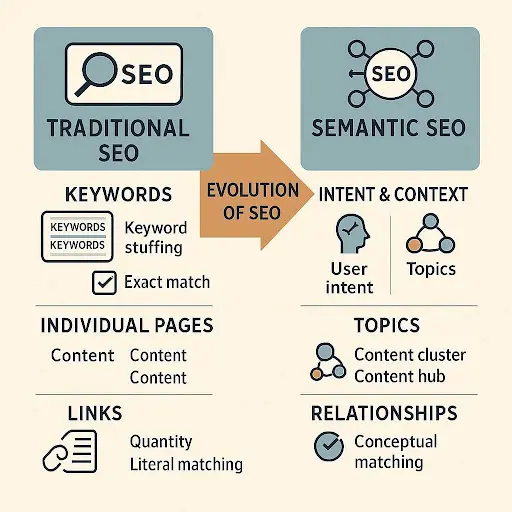
Traditional SEO is the practice of optimizing content based on specific keywords and individual search terms to rank for those exact phrases. For years, this meant finding a high-volume keyword, repeating it a specific number of times in your H1, body copy, and meta description, and building backlinks with exact-match anchor text. It treats search engines like a giant library index where the most frequent mention of a term wins the top spot. While it served its purpose during the early stages of the internet, it often leads to robotic, unreadable content that bores your readers to tears.
What is semantic SEO?
Semantic SEO is the process of optimizing content to satisfy the intent behind a search query by building topical authority and focusing on entities rather than just keywords. Instead of asking "what words should I use," semantic SEO asks "what questions does my reader have and how can I answer them comprehensively?" By leveraging the role of structured data in semantic seo, you help search engines understand the relationships between different concepts, people, and places. It is like moving from a simple dictionary to an intelligent encyclopedia that understands context, nuance, and user motivation.
Mistakes to avoid
The most common error is falling back into the habit of keyword stuffing while pretending to do semantic research. You must avoid creating content that is thin or lacks depth; search engines in 2026 are exceptionally good at identifying "fluff" that doesn't actually solve a problem. Another frequent mistake is ignoring the technical foundation of your site. Even the best content will fail if your site speed is lagging or if your internal linking strategy is a chaotic mess. Don't forget that essential plugins for wp: seo, security, performance, growth can help you automate the technical heavy lifting so you can focus on writing.
Comparison table: Traditional vs Semantic SEO
| Feature | Traditional SEO | Semantic SEO |
|---|---|---|
| Primary Focus | Keywords and volume | Intent and entities |
| Content Style | Keyword-centric, rigid | Topic-centric, comprehensive |
| Success Metric | Ranking for specific terms | Topical authority and engagement |
| Technical Need | Meta tags and link building | Structured data and schema |
| User Experience | Often secondary | Central to strategy |
Actionable checklist for your next post
- Identify the core entity of your topic rather than just the target keyword.
- Conduct a "people also ask" search to map out the sub-topics your audience cares about.
- Implement relevant schema markup to help crawlers connect the dots.
- Ensure your internal linking structure connects related topics to build topical authority.
- Write for the human reader first, ensuring your tone addresses their specific pain points.
- Review your page speed and mobile responsiveness to ensure a frictionless experience.
Why context matters more than ever
Context is the missing link that turns a good article into a ranking powerhouse. When you write about "apples," a traditional approach might force the word "apple" into every paragraph to rank for the fruit. A semantic approach looks at the context: are we talking about the tech company, the fruit, or perhaps the record label? By providing clear definitions, related entities, and comprehensive answers, you tell the search engine exactly what your content is about. This reduces the ambiguity that search engines hate and rewards you with better placement in the results.
How to build topical authority
Building topical authority requires a deliberate shift toward creating "clusters" of content. Imagine your website is a map. If you only write one article about a topic, you are just dropping a single pin. If you write twenty interconnected articles that cover every aspect of a subject, you are building an entire city. This structure allows search engines to view your site as a trusted expert in your niche. When you establish this depth, you stop competing for single keywords and start winning entire segments of the market.
The impact of user behavior
Search engines in 2026 are heavily influenced by how users interact with your pages. If a user clicks your link but bounces immediately, the algorithm takes that as a signal that your content didn't satisfy the intent. Semantic SEO naturally improves these metrics because the content is usually more relevant and helpful. When your answers are direct and your structure is logical, users stay longer, click more, and are more likely to return. This is the ultimate feedback loop for sustainable growth.
Integrating technical SEO with content
You cannot separate content from the technical environment it lives in. While semantic SEO is largely about meaning, it requires the right technical vehicle to reach the finish line. Using breadcrumbs, proper header hierarchies, and clean URL structures ensures that Google's crawlers can navigate your content without getting lost. If you are struggling with these technical foundations, it is worth looking into how breadcrumb schema position order: does it actually impact seo? to ensure you aren't leaving easy wins on the table.
Key Takeaways
- Traditional SEO relies on keyword frequency, while semantic SEO focuses on intent and meaning.
- Building topical authority is far more sustainable than chasing individual keyword rankings.
- Structured data is the bridge that allows search engines to understand the relationships in your content.
- User experience and engagement signals are now primary drivers of search performance.
- Content clusters help search engines view your site as a comprehensive resource for specific niches.
What is the biggest difference in content creation?
The biggest difference is the shift from writing for machines to writing for humans while using metadata to inform the machines. In the old days, you wrote to please the crawler. Today, you write to please the person, and you use semantic markers to ensure the crawler understands exactly what you provided.
Do I need to stop using keywords entirely?
Not at all, as keywords are still the signposts that users type into the search bar. You should use them to understand what people are looking for, but stop using them as a template for how to write your sentences. Treat them as a starting point for your research, not the final destination.
How does structured data improve SEO?
Structured data provides a standardized format for classifying information on your page. By adding schema, you give search engines a clear map of your content, which increases the likelihood of appearing in rich snippets and other enhanced search features that grab user attention.
Can small websites compete with big brands?
Yes, because semantic SEO rewards depth and topical authority over raw backlink volume. If you cover a specific niche with more nuance and helpfulness than a massive, generic site, you can win the top spot for your specific audience.
How do I measure semantic SEO success?
Look beyond individual keyword rankings. Focus on organic traffic growth, time on page, and your site's performance across entire topic clusters. When your site starts ranking for hundreds of long-tail variations of a topic, you know your semantic strategy is working.
Final thoughts
The evolution from traditional to semantic SEO is not about abandoning the past, but about embracing the future of how information is processed. We have moved into an era where "helpful content" is the only metric that truly sustains a business over the long haul. By focusing on the intent behind the search and providing structured, comprehensive answers, you align your goals with those of the search engine providers. It is time to stop worrying about the number of times you mention a word and start worrying about the depth of the value you offer. If you commit to this shift, your audience will reward you, and the algorithms will follow suit. Stay curious, keep your data clean, and always prioritize the person reading your words.
About the Author

Brian Keary
Founder & Lead Developer
Brian is the founder of BKThemes with over 20 years of experience in web development. He specializes in WordPress, Shopify, and SEO optimization. A proud alumnus of the University of Wisconsin-Green Bay, Brian has been creating exceptional digital solutions since 2003.
Expertise
Writing since 2003