
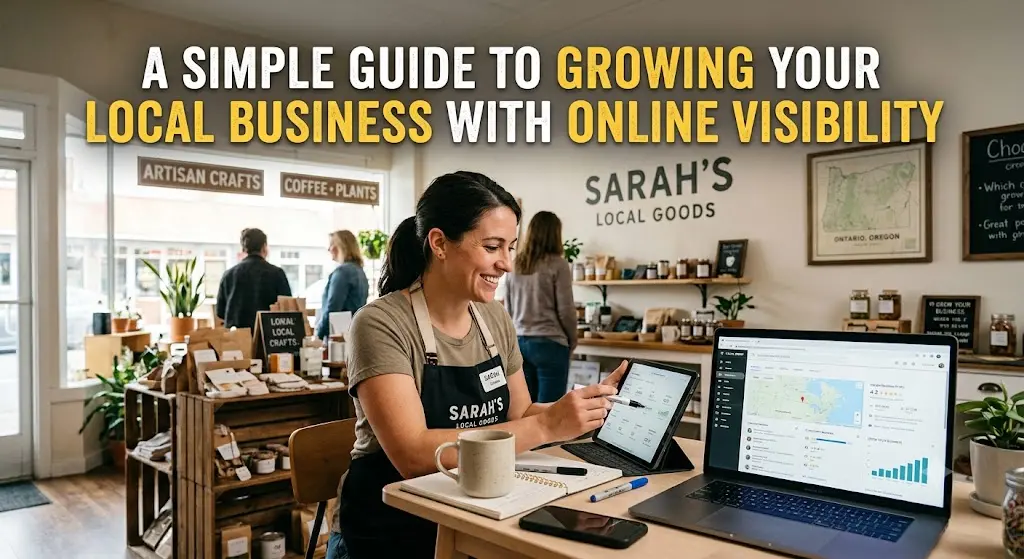
You have a storefront, a service truck, or a studio that people love once they find it. The problem is that finding it has become a search bar instead of a drive down Main Street. I've watched plenty of good local businesses lose customers to competitors with worse products but better online visibility, and it stings every time. This guide walks you through the exact steps I'd take to fix that, from claiming your profile to building a website that ranks and converts.
Key Takeaways
- Your Google Business Profile is the foundation. Claim it, verify it, and keep every field accurate and current.
- Local ranking rests on relevance, distance, and prominence. You can't change distance, but reviews, links, and content build prominence.
- Mobile is your primary storefront. Google indexes the mobile version of your site, so a weak mobile experience caps your visibility.
- Reviews are both a ranking signal and a conversion tool. Ask consistently, respond to everything, and never buy them.
- Consistency beats intensity. Weekly profile posts and steady review requests outperform occasional bursts of effort.
- Track calls and direction requests. Those are the numbers that map to revenue.
Why Does Online Visibility Matter More Than Ever for Local Businesses?
Online visibility matters because your next customer checks their phone before they check your sign. The research backs this up: a 2023 report from the SBA Office of Advocacy found that small businesses increasingly rely on digital tools to reach customers and compete. That shift isn't coming. It already arrived.
Here's what that means in practice. Someone searches "plumber near me" at 7 a.m. with a burst pipe. They tap the first listing with good reviews and clear hours. They don't call three others to compare. Your visibility, or lack of it, decides whether that call is yours.
The good news? Local search is one of the few channels where a small operation can genuinely beat a bigger competitor. You're not fighting for global rankings. You're fighting for a five-mile radius, and that's a fight you can win with steady effort.
How Do You Set Up a Google Business Profile That Gets Found?
Setting up your Google Business Profile is the single highest-return action you can take, and it costs nothing. Google lets you add or claim your business listing at no charge, and it's what puts you on Search and Maps. If you haven't done it, stop reading and do it today. (support.google.com)
Claim and Verify First
Head to Google's official process for adding or claiming your business, which walks you through verification step by step. Verification usually involves a postcard, phone, or video, and it can take a few days. Don't skip it. An unverified profile is a ghost.
Fill Every Field Like It Matters
Google recommends keeping details current: your address, hours, category, and relevant attributes. Complete, accurate information helps you appear in relevant local results. That's not a suggestion. It's the difference between showing up and disappearing.
- Business category: Pick the most specific one available. "Italian restaurant" beats "restaurant."
- Hours: Update them for holidays. Nothing kills trust like a customer arriving to a locked door.
- Attributes: Check every box that applies, from wheelchair access to outdoor seating.
- Photos: Add real ones. Storefront, interior, team, and finished work. Update monthly.
- Services and products: List them with plain descriptions and prices where sensible.
Understand How Local Ranking Actually Works
Google says local ranking is shaped mainly by relevance, distance, and prominence, and businesses can't pay for a better local ranking. Prominence can reflect things like links to your business and its reviews. That last part is your lever. You can't move your address closer to a searcher, but you can absolutely build prominence.
If you want a deeper walkthrough of profile optimization, our guide to optimizing your Google Business Profile for local SEO covers the finer points.
What Should Your Website Do for Local Search?
Your website should make it effortless for both search engines and humans to confirm you're the right local choice. That means clear contact details, location signals, and content that answers real questions. A pretty homepage that hides your phone number is a conversion killer.
Build Mobile First, Not Mobile Last
Google uses the mobile version of your site's content for indexing and ranking, and it recommends responsive design as one implementation option. Read that again. If your mobile site is a stripped-down afterthought, you're being judged on the weakest version of your business.
Test yours right now. Load it on your phone, tap your own phone number, and try to find your hours in under ten seconds. If you can't, neither can your customers.
Structure Your Pages Around Local Intent
Every service you offer deserves its own page, and that page should mention the areas you serve. Not stuffed with city names like a phone book, but naturally written. "We install heat pumps across the north side, including [neighborhood] and [neighborhood]" reads fine. "Heat pump [city] [city] [city]" reads like spam.
Google's own guidance on establishing business details explains how to present your name, address, and contact information consistently across the web. Consistency is the thread here. Your name, address, and phone number should match everywhere they appear.
Publish Content That Answers Real Questions
Google's SEO starter guide emphasizes helpful, reliable, people-first content with clear, well-organized writing. That's the standard. Not word count. Not keyword density. Usefulness.
Write the posts your customers actually ask about. "What does a furnace tune-up include?" "How long does a bathroom remodel take?" Those pages pull in searches, build trust, and feed your profile with fresh signals. If you're running a BigCommerce storefront alongside a physical location, the same principle applies: product pages and local pages should each serve a distinct purpose, and a scalable, structured approach to store visibility keeps both working together instead of competing.
How Do You Build Local Citations and Consistency?
Local citations are mentions of your business name, address, and phone number across the web, and consistency across them builds trust with search engines. Think of them as a chorus singing the same note. One voice off-key and the whole thing sounds wrong.
Start with the essentials:
- Google Business Profile: Your anchor listing.
- Apple Maps: A growing share of local searches happen here.
- Bing Places: Easy setup, often overlooked.
- Industry directories: Trade associations, chambers of commerce, licensing boards.
- Review platforms: Yelp, Trustpilot, and niche sites your customers actually use.
Audit these quarterly. A moved office or a changed phone number that only gets updated in half your listings creates confusion for customers and search engines alike. If you want a broader playbook on building local signals, this guide to growing your local business with online visibility expands on the citation side.
How Do Reviews Shape Local Visibility and Trust?
Reviews shape local visibility because they feed prominence, and they shape conversions because people read them before they call. Both matter. A business with 200 reviews at 4.6 stars will beat a competitor with 12 reviews at 5.0 stars almost every time.
Ask at the Right Moment
The best time to ask is right after you've delivered the result. The repaired boiler. The finished haircut. The successful delivery. Ask in person, then follow up with a short text containing a direct link to your review page. Make it one tap, not a scavenger hunt.
Respond to Everything
Respond to the good ones with specifics, not copy-paste. "Thanks for mentioning the same-day turnaround, Marcus" beats "Thanks for your review!" every time. Respond to the bad ones calmly and factually. Future customers are watching how you handle criticism more than they're reading the criticism itself.
Know the Rules on Reviews
Here's where I get blunt. The FTC finalized a rule in 2024 banning fake reviews and testimonials, and in December 2025 it sent warning letters to ten companies about possible violations of its new consumer review rule. Buying reviews, writing them yourself, or suppressing negative ones with shady tactics isn't just unethical. It's illegal. The FTC publishes guidance on soliciting and paying for online reviews that every owner should skim once. (www.ftc.gov)
What Local SEO Tactics Actually Move the Needle?
Local SEO tactics move the needle when they compound: each one makes the next easier. There's no single switch. There's a flywheel, and your job is to keep pushing it.
| Tactic | Effort | Typical Impact | How Often |
|---|---|---|---|
| Google Business Profile posts | Low | Medium | Weekly |
| New reviews | Low | High | Ongoing |
| Service page content | Medium | High | Quarterly |
| Local link building | High | High | Monthly |
| Citation cleanup | Medium | Medium | Quarterly |
| Photo updates | Low | Low to medium | Weekly |
Build Local Links Without Begging
Local links come from relationships, not cold emails. Sponsor the youth team. Join the chamber. Host a workshop. Donate to the food bank and make sure they mention you. Each of these produces a genuine mention on a real local site, and those links carry weight that a generic directory never will. Our breakdown of mastering local SEO link building for visibility goes deeper on which links are worth your time.
Structured data is code that labels your business details for search engines, and Google's LocalBusiness structured data documentation explains exactly how to implement it. You don't need to be a developer to ask for it. You just need to know it exists and confirm your web person added it. It's one of those quiet wins that pays off in rich results.
Track What Matters
Track calls, direction requests, and form submissions, not vanity metrics. Your Google Business Profile dashboard shows calls and direction requests directly. Compare month over month. If direction requests climb but calls don't, your hours or phone number may be wrong somewhere. If calls climb but sales don't, the problem is downstream.
Mistakes to Avoid
I've seen these derail otherwise solid local businesses. Avoid them and you're ahead of most of your competition.
- Chasing keywords over customers. Writing for algorithms instead of people produces pages nobody reads and search engines eventually ignore.
- Letting listings drift. Old hours, disconnected numbers, and outdated addresses quietly bleed trust.
- Ignoring negative reviews. Silence reads as guilt. A calm, factual reply reads as competence.
- Buying reviews. The FTC's 2024 rule banning fake reviews makes this a legal risk and a reputational one.
- Treating your website as a brochure. A site with no service pages, no location signals, and no fresh content has nothing to rank.
- Neglecting mobile. Since Google indexes the mobile version of your site, a poor mobile experience caps your ceiling.
- Going quiet. Local visibility rewards consistency. Two posts in January and nothing until June won't cut it.
Your 30-Day Visibility Checklist
Here's the checklist I'd hand a client on day one. Work through it in order. Don't skip ahead.
- Claim or verify your Google Business Profile
- Complete every profile field: category, hours, attributes, services
- Upload 10 real photos, including storefront and team
- Confirm your name, address, and phone number match across your site and top directories
- Test your website on a phone: load speed, tap-to-call, hours visibility
- Create or refresh one service page with local language
- Set up a review request text with a direct link
- Ask your last ten customers for reviews
- Respond to every existing review
- Add LocalBusiness structured data to your site
- Join one local organization and ask about a website mention
- Write one FAQ post answering a real customer question
- Set a recurring 30-minute weekly slot for profile posts and review replies
Print it. Tape it to the wall. Tick boxes.
What to Do Next Week, and the Week After
Momentum dies when the checklist becomes a one-time event. The businesses that compound visibility are the ones that turned the items above into a rhythm. A simple weekly rhythm beats a heroic overhaul every quarter.
Here's what that rhythm looks like in practice: Monday, spend fifteen minutes posting to your Google Business Profile and uploading one fresh photo. Wednesday, send review requests to the customers you served that week. Friday, reply to any new reviews and check your calls and direction requests against last month. That's under an hour a week. Do it for a year and you'll have fifty profile posts, a steady stream of reviews, and a clear picture of which months drive the most calls.
Quarterly, block two hours to audit your listings, refresh a service page, and check that your hours and phone number are still correct everywhere. Annually, review your categories and structured data. Businesses evolve, and a profile that described you two years ago may not describe you now.
One more thing: write down what you changed and when. When the phone rings more in March, you'll want to know it was the February review push and not a mystery. A simple notes file turns guesswork into knowledge, and knowledge is what lets you double down on what's working.
You don't need a big budget or a marketing team. You need the discipline to keep showing up in small ways. That's the whole secret, and it's available to any local business willing to do it.
Conclusion
Growing your local business with online visibility isn't a mystery. It's a series of small, unglamorous actions repeated until they compound. Claim the profile. Fix the mobile site. Ask for reviews. Answer the questions your customers actually ask. Build a few real local relationships. Do that for six months and you'll notice something shift: the phone rings more, the map pin gets tapped more, and the customers who walk in already trust you before you say a word.
Start with the checklist above. Pick three items and finish them this week. Your competition is probably still putting it off.
Frequently Asked Questions
How long does it take to see results from local SEO?
Most local businesses see early movement in three to six months, with meaningful gains by month nine. Google Business Profile improvements can show up faster, sometimes within weeks. Content and link building take longer because they compound. The businesses that quit at month two never find out what month six looks like.
Do I need a website if I already have a Google Business Profile?
Yes, you do. Your profile gets you found, but your website closes the sale. It's where you answer detailed questions, showcase work, and control the narrative. Google also uses your site's content for indexing and ranking, and the mobile version is what gets evaluated. A profile without a solid site is a signpost pointing at an empty lot.
How many reviews do I need to rank locally?
There's no magic number, and anyone who gives you one is guessing. What matters is a steady flow of recent, honest reviews and how you respond to them. A business with 40 recent reviews often outranks one with 200 old ones. Focus on consistency and authenticity rather than a target count.
Can I pay to rank higher in local search results?
No. Google states plainly that businesses can't request or pay for a better local ranking. Prominence can reflect links and reviews, but those come from real relationships and real customers. Anyone selling you a guaranteed local ranking is selling you something Google says doesn't exist.
What should I do about a negative review?
Respond calmly, factually, and publicly. Acknowledge the issue, state what you've done to fix it, and invite the customer to continue the conversation offline. Future customers are reading your response as much as the complaint. Whatever you do, don't argue, and never offer incentives to remove it, which runs afoul of consumer review rules. (consumer.ftc.gov)
Is social media part of local visibility?
It can be, but it's secondary for most local businesses. Social platforms help with discovery and community, yet they rarely drive the same intent as a search for "near me." Spend your first effort on your profile, website, and reviews. Add social once those fundamentals hum along.
About the Author

Brian Keary
Founder & Lead Developer
Brian is the founder of BKThemes with over 20 years of experience in web development. He specializes in WordPress, Shopify, and SEO optimization. A proud alumnus of the University of Wisconsin-Green Bay, Brian has been creating exceptional digital solutions since 2003.
Expertise
Writing since 2003