Why Does Readability Matter for Your SEO Success?
Readability is the ease with which a person can process written content. It involves linguistic features, structure, and design. When your text is clear, readers process information with less cognitive load. Search engines prioritize user-centric content, making readability a factor in your overall digital strategy.
What Is Readability and How Does It Impact Search Engines?
Readability describes how accessible your writing is to your target audience. It is not synonymous with literacy; rather, it measures how effectively a reader extracts information. Google uses Natural Language Processing (NLP) to understand content quality. While Google does not use a specific readability score as a direct ranking factor, readable content improves user engagement metrics like bounce rate and average time on page. High-quality content that is scannable and clear often leads to better search performance. According to the CDC, plain language is communication that the audience understands the first time they read or hear it.
What Is the Flesch Reading Ease Score?
Rudolf Flesch developed the Flesch Reading Ease score to measure text complexity. This formula calculates the ratio of sentence length to syllable count. A higher score signifies that a text is easier to comprehend.
Decoding the 0-100 Scale for Better Content
The 0-100 scale provides a screening signal for writers. Readability scores between 60 and 70 are typically considered standard for web content. Scores below 30 indicate high complexity, often requiring advanced education to process quickly.
What a 90-100 Score Means for Your Site Visitors
A 90-100 readability score represents content that is very easy to read, often accessible to a fifth-grade student. This level is ideal for general audiences, including those with limited health literacy or non-native language speakers. By aiming for this range, you reduce cognitive friction and encourage longer dwell time.
Optimizing Your Content with Yoast SEO Tools
Yoast SEO provides a readability analysis tool to guide your writing. This tool evaluates sentence length, paragraph structure, and the presence of transition words. Using Yoast SEO Premium allows you to refine your content based on real-time feedback.
Using Yoast AI for Natural Flow
Yoast AI suggests ways to balance your text and maintain a natural flow. These features help you avoid over-simplifying your writing. The goal is to provide clear content architecture that respects the user's intelligence while minimizing unnecessary jargon. SEO copywriting training teaches that tools are aids, not final arbiters of quality.
Mastering Sentence Length and Structure
Sentence length directly influences readability. The CDC recommends an average sentence length of approximately 20 words. Longer sentences often contain multiple clauses, which increase cognitive load.
Avoiding Passive Voice and Consecutive Sentences
Passive voice makes sentences feel distant and complex. Active voice makes your writing direct. Avoid starting consecutive sentences with the same word to prevent a repetitive rhythm that hinders skimming. Meade & Smith state that readability formulas are diagnostic, not absolute.
The Role of Transition Words in Quality Content
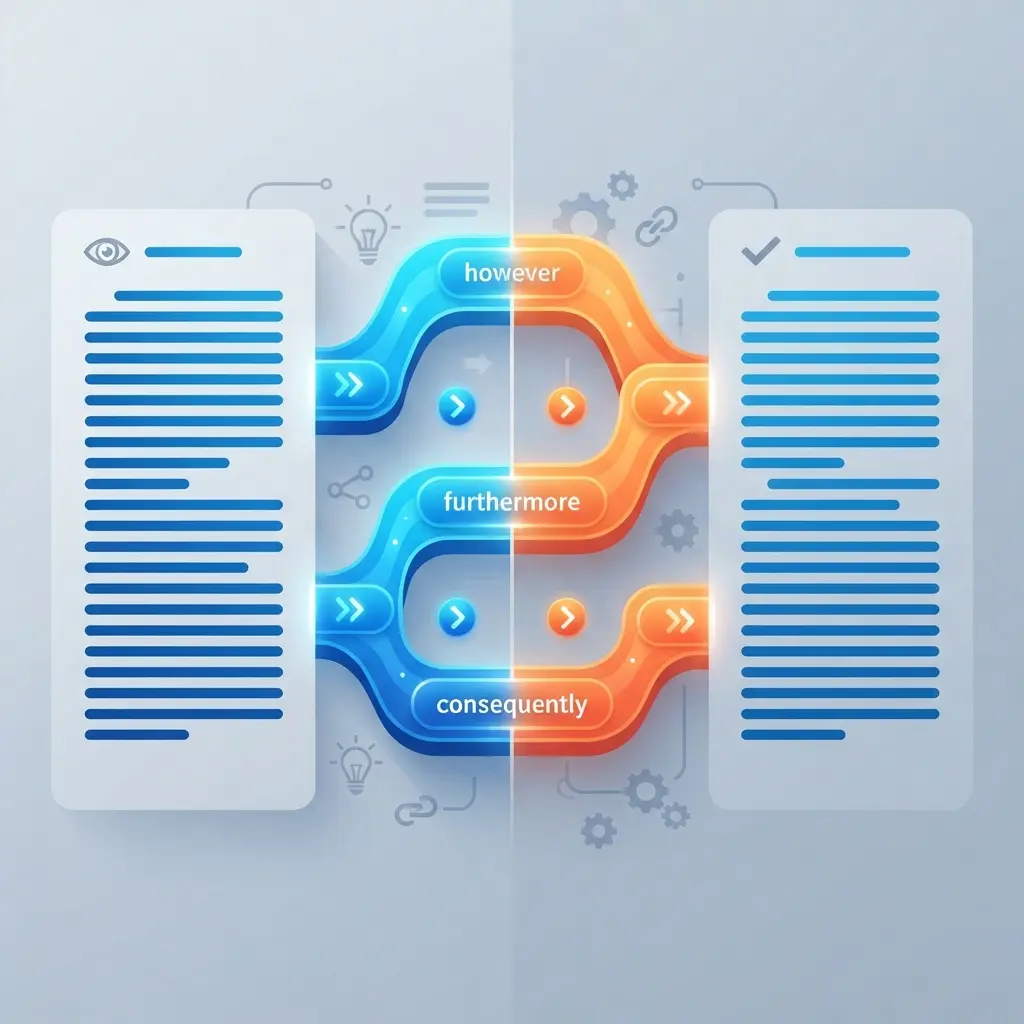
Transition words act as signposts for the reader. Words like "furthermore," "however," and "consequently" guide the flow of logic. Including these improves the readability score and clarifies the relationship between ideas. Use them to link paragraphs and maintain a cohesive narrative path.
Professional SEO Copywriting Training Techniques
Expert writers develop a specific tone of voice that aligns with their brand. Whether you are writing for a technical audience or a general blog, clarity remains the priority. Adopting the principles from "The Elements of Style" or "On Writing Well" helps maintain high standards. Professional SEO copywriting training includes learning how to structure headings (H1-H6) effectively to create visual hierarchy.
Establishing a Consistent Tone of Voice
Consistency builds trust. If your brand is authoritative yet approachable, your writing should reflect that balance across all platforms. Use plain language to reach a wider audience, ensuring your brand equity is accessible to everyone.
How to Improve Readability for Social Sharing
Social platforms like X, LinkedIn, and WhatsApp favor concise messaging. Adapting your content for these channels requires attention to the first few lines, often called the hook. Use bullet points and emojis to break up text and increase scannability.
Adapting Your Message for X, LinkedIn, and WhatsApp
On X, brevity is paramount due to character limits. On LinkedIn, you can provide more detail, but you should still use short paragraphs to avoid the 'wall of text' effect. WhatsApp messages should be direct and call-to-action oriented. Always prioritize visual hierarchy clarity in your social posts.
Is Your Writing Costing You Search Rankings?
Discover Your True Potential
Discover how optimizing your Flesch Reading Ease score and content hierarchy can skyrocket your site’s visibility in 2026.
Explore Our SEO ServicesFrequently Asked Questions About Readability Analysis
Does readability directly affect SEO rankings?
Readability is not a direct ranking signal. It influences user experience metrics, which search engines use to evaluate content quality. Improved clarity often results in lower bounce rates and higher engagement.
What is the ideal readability score for a blog post?
A score of 60-70 on the Flesch Reading Ease scale is generally recommended for online content. Always consider your target audience when selecting a target score.
Can I rely entirely on readability software?
No. Formulas like Flesch-Kincaid or Gunning Fog are proxies. Always conduct a human review to ensure your content is accurate, useful, and emotionally resonant.
How does active voice improve content?
Active voice places the subject at the start of the sentence, performing the action. This creates a stronger, clearer, and more direct narrative, which reduces cognitive load for the reader.
Are transition words necessary for SEO?
Yes, they improve the structure of your arguments and make the text easier to scan. They help readers process information, contributing to a better user experience.
What is the best way to structure content for readability?
Use short paragraphs, descriptive headings (H1-H6), and bullet points to break up text. This layout encourages skimming and makes it easier for users to find the information they need quickly.
How does the CDC approach readability?
The CDC advocates for plain language, which focuses on putting the main point first, using simple words, and providing clear, actionable information to improve public understanding.
About the Author

Brian Keary
Founder & Lead Developer
Brian is the founder of BKThemes with over 20 years of experience in web development. He specializes in WordPress, Shopify, and SEO optimization. A proud alumnus of the University of Wisconsin-Green Bay, Brian has been creating exceptional digital solutions since 2003.
Expertise
Writing since 2003