The Modern Web Framework Arena: Next.js Takes the Crown
From Humble Blogging Roots to Powerful Web Applications
The digital landscape has transformed dramatically. What was once dominated by content management systems (CMS) like WordPress is now rapidly embracing frameworks such as Next.js —engineered for unparalleled speed, scalability, and user delight .
Why Developers Are Ditching WordPress for Next.js
While WordPress still powers a massive chunk of the internet, its architecture is showing its age. Developers are craving quicker build cycles , flexible API-driven solutions , and streamlined codebases —all areas where Next.js excels .
WordPress Unpacked: Its Strengths and Stumbling Blocks
The Enduring Appeal of WordPress
WordPress's popularity stems from its user-friendly interface, vast plugin library, and accessibility for those without deep technical skills. It's a solid choice for blogs, small business sites, and content-rich platforms.
WordPress's Core Weaknesses in 2025
Performance Hurdles
WordPress's PHP foundation, coupled with extensive plugin usage and database calls, often leads to sluggish load times, especially as traffic grows.
Security Risks and Plugin Dependencies
Data from Sucuri consistently shows that WordPress plugins are a primary source of security breaches, demanding continuous vigilance and updates.
Enterprise-Level Scalability Challenges
Scaling WordPress for large-scale projects typically involves intricate caching strategies, load balancing, and frequent patching—complexities Next.js sidesteps with its inherent static generation and serverless deployment capabilities .
Introducing Next.js: The Future of Web Development
The Ascent of Next.js and the JAMstack Movement
Developed on React and championed by Vercel , Next.js is a sophisticated hybrid framework offering server-side rendering (SSR) , static site generation (SSG) , and incremental static regeneration (ISR) . This versatility makes it perfect for everything from personal blogs to massive enterprise applications .
Next.js: Mastering Static and Dynamic Content Delivery
Next.js intelligently pre-renders pages for peak performance while seamlessly supporting dynamic rendering for personalized or real-time content updates.
Key Innovations That Distinguish Next.js
Hybrid Rendering and ISR for Dynamic Content
ISR empowers developers to refresh static pages on the fly without a full site rebuild—a capability WordPress lacks natively.
Integrated API Routes and Serverless Power
Next.js streamlines backend functionality through API routes , eliminating the need for separate server infrastructure or plugins.
Native SEO and Image Optimization
With built-in components like <Image /> and robust metadata APIs, performance and SEO are core to the framework , not afterthoughts.
Why Next.js Outperforms WordPress
1. Blazing-Fast Speed and Performance
Next.js sites deliver lightning-fast load times, optimized out-of-the-box with pre-rendering and minification, giving them a significant advantage in Core Web Vitals .
2. Effortless Scalability and Developer Autonomy
Next.js scales seamlessly through its serverless architecture and edge deployments , enabling limitless growth without taxing databases.
3. A Superior Modern Development Experience
Developers rave about the React ecosystem , TypeScript integration , and streamlined deployments via Vercel —a world away from traditional FTP and plugin management.
4. SEO Dominance and Core Web Vitals Excellence
Next.js natively supports structured data , canonical tags , and lazy loading , surpassing traditional CMS setups that rely on external plugins for these features.
5. Enhanced Security and Reduced Vulnerability
By eliminating PHP, admin panels, and plugin dependencies, Next.js significantly minimizes common attack vectors, offering unparalleled peace of mind .
6. Ultimate Flexibility with Headless CMS Integration
Next.js integrates flawlessly with Sanity, Strapi, Contentful , and even headless WordPress , granting teams complete control over their content management.
7. Long-Term Cost Savings and Simplified Maintenance
Next.js eliminates the constant cycle of plugin updates, version conflicts, and server maintenance, leading to substantial long-term savings in both time and resources.
SEO Comparison: Next.js vs. WordPress
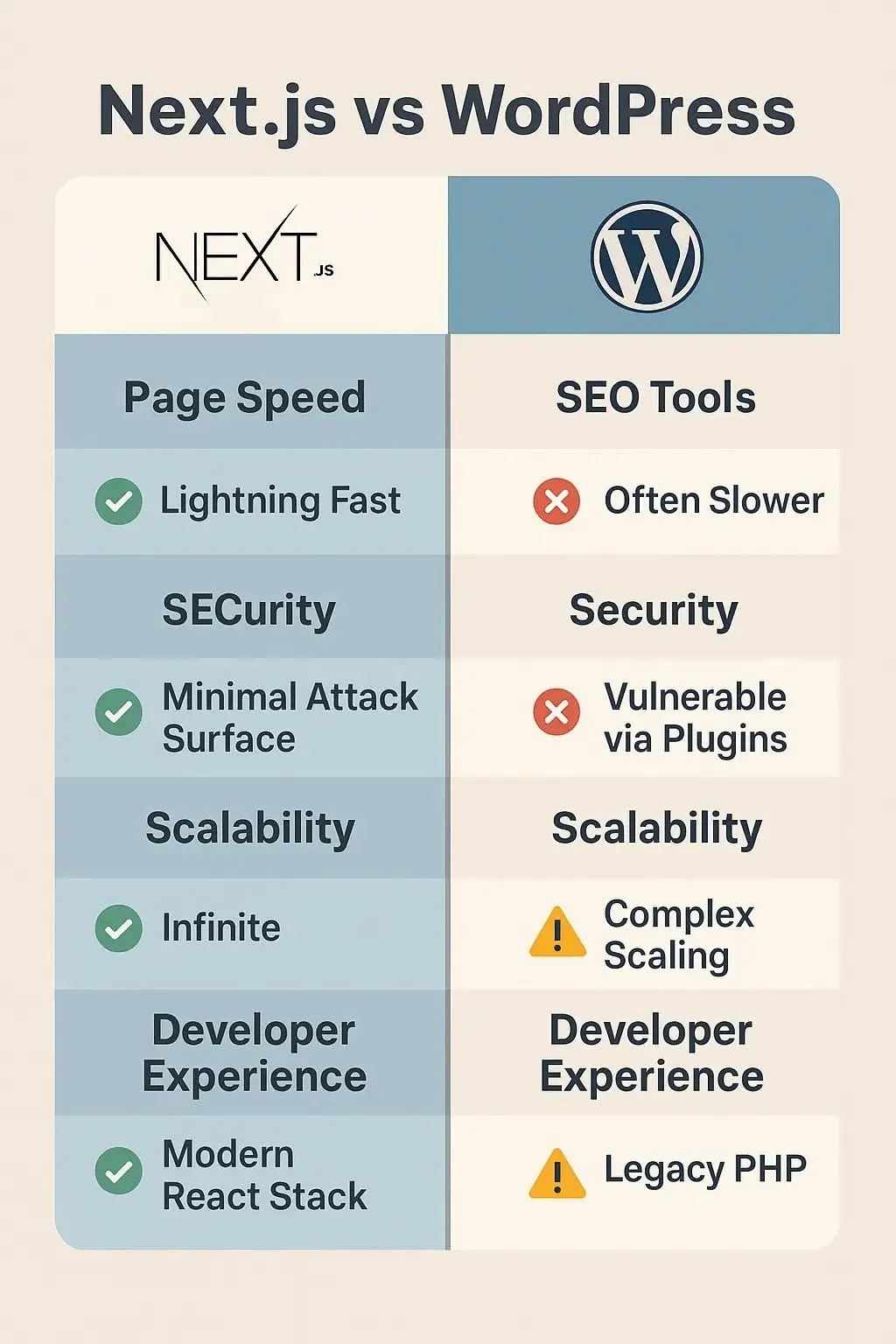
| Feature | Next.js | WordPress |
|---|---|---|
| Page Speed | ✅ Blazing Fast | ❌ Often Sluggish |
| SEO Capabilities | ✅ Built-in Excellence | ✅ Plugin Dependent |
| Security Posture | ✅ Minimal Risk | ❌ Plugin Vulnerabilities |
| Scalability Potential | ✅ Virtually Limitless | ⚠️ Requires Complex Solutions |
| Developer Workflow | ✅ Modern & Efficient | ⚠️ Legacy & Cumbersome |
Next.js provides superior technical SEO through its rapid rendering , native structured data support , and performance-first design .
Leveraging Headless WordPress with Next.js
The ultimate synergy: using Next.js for the frontend and WordPress as the headless CMS . Content teams can leverage the familiar WordPress interface while developers build incredibly fast Next.js frontends .
Debunking Common Next.js Myths
“Next.js is Exclusively for Developers”
While developer-centric, modern tools like Sanity Studio or Headless WP offer intuitive content editing experiences for non-technical users.
“Next.js Isn't Suited for Blogs”
Incorrect. With native Markdown support , seamless CMS integrations , and efficient static regeneration , Next.js blogs significantly outperform traditional WordPress blogs in SEO and speed .
Real-World Success Stories: Next.js in Action
Industry Leaders: Vercel, Hulu, and Notion
Giants like Netflix, TikTok, and Notion trust Next.js for its exceptional performance and scalability—a testament to its robust, production-ready capabilities.
Brands Making the Switch from WordPress to Next.js
Numerous forward-thinking startups and content platforms have migrated to Next.js to slash hosting expenses, bolster security, and accelerate their site's performance.
The Future of Web Development: Next.js Leads the Charge
Pioneering AI and Edge Computing Integration
Next.js is built to embrace edge rendering and AI capabilities , paving the way for the next wave of dynamic, personalized web experiences .
Sustainable, Performance-Optimized Architecture
By minimizing server load and maximizing efficiency, Next.js champions eco-conscious web development .
Frequently Asked Questions: Next.js vs. WordPress
Conclusion: Next.js – Architecting the Future of Scalable Web Experiences
In 2025, the distinction between Next.js and WordPress transcends mere technical differences; it's a divergence in philosophy. Where WordPress often relies on a patchwork of plugins, Next.js is built on a foundation of performance, scalability, and developer freedom . For both developers and businesses, Next.js represents the smarter, faster, and unequivocally future-proof decision.
🔗 Dive Deeper: Explore the Official Next.js Documentation
Looking for implementation support? Visit our web development services page for the full service overview.
About the Author

Brian Keary
Founder & Lead Developer
Brian is the founder of BKThemes with over 20 years of experience in web development. He specializes in WordPress, Shopify, and SEO optimization. A proud alumnus of the University of Wisconsin-Green Bay, Brian has been creating exceptional digital solutions since 2003.
Expertise
Writing since 2003