
Custom website development pricing is determined by project scope, feature complexity, platform selection, content requirements, and ongoing maintenance needs. Understanding these variables allows for accurate budget forecasting and effective vendor selection.
What are the main factors affecting custom website development Pricing?
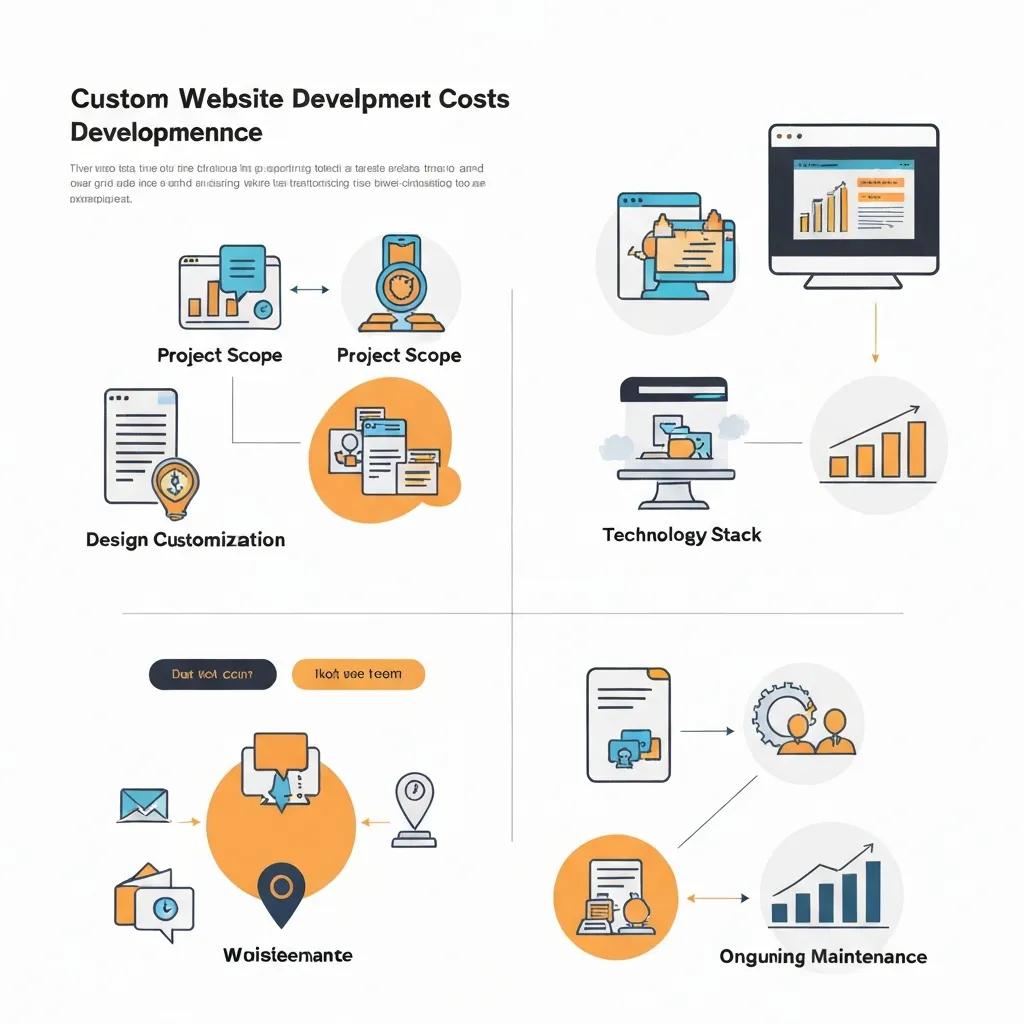
Cost comes from a connected set of drivers that raise or lower the hours and specialist roles on your proposal. Defining these categories early — project scope, design fidelity, required features, technology stack, content volume and migration complexity, maintenance expectations, and team makeup/timeline — shortens discovery and reduces estimate variance. The list below highlights the primary drivers so you can quickly place your project on the cost spectrum and see which choices make the biggest difference. Understanding this priority helps you protect high-value features when the budget is tight and spot trade-offs that affect short-term spend versus long-term TCO.
What is TCO?
Total Cost of Ownership (TCO) in web development is the complete financial estimate of building, running, and maintaining a website over its entire lifecycle. It combines initial design work with long-term hosting, updates, and security expenses.
Upfront Costs
- Design and build: Initial coding, visual layout, and setup.
- Content and branding: Writing, logos, and media asset creation.
- Setup fees: Initial database configuration and system integrations.
Ongoing Operational Costs
- Hosting and domain: Yearly fees for web servers and web address renewals.
- Software licenses: Fees for premium plugins, themes, or enterprise tools.
- Security and backups: SSL certificates, malware scanning, and data backup services.
Maintenance and Growth Costs
- Updates: Regular code patches and platform upgrades.
- Support staff: Developer hours for troubleshooting or adding new features.
- Downtime loss: Productivity or sales lost when the site goes offline.
These factors compound: a tight deadline plus complex integration costs more than either factor alone. Transparent scoping reduces surprises and improves estimate accuracy.
How does project scope and complexity impact website pricing?
Scope is your list of deliverables — page templates, user roles, content types, integrations, and custom workflows — and each item maps to development and QA hours. A basic brochure site with a few templates and no integrations grows roughly in line with page count, while applications with multi-role permissions, conditional logic, and complex business rules drive exponential increases in engineering and testing effort. For example, adding multi-location inventory sync and per-location pricing requires backend services, API mapping, and extensive cross-locale QA, which multiplies work far beyond simple page additions. Clear requirements, prioritized features, and acceptance criteria enable fixed-scope quotes and reduce change orders, stabilizing cost and timelines for stakeholders.
Why is design customization and UI/UX important for pricing?
Design customization adds hours for research, wireframes, interactive prototypes, visual design, and accessibility testing — and each stage uses different specialists (UX researcher, UI designer, front-end developer), which raises estimates versus template builds. Custom interactions, animations, and tight microcopy increase front-end complexity and cross-browser QA, while brand-driven visual systems often need multiple review rounds. Investing in UX research and usability testing raises upfront cost but improves conversion and reduces rework, increasing long-term ROI. Teams that pair reusable component libraries with a few prioritized custom screens can control cost while delivering a distinct, goal-focused experience.
How do functionality and features influence custom web development pricing?
Features are one of the clearest levers on a quote: each capability brings design, development, security, and testing work. Simple items like contact forms or a static booking widget need minimal backend effort, while complex systems — multi-vendor marketplaces, subscription billing, or dynamic personalization — require significant architecture, integrations, and compliance work. When estimating, classify features as basic, intermediate, or advanced and assign resources accordingly; that makes it obvious how adding or removing functionality shifts the total. The table below maps common feature types to their main cost drivers and typical schedule impact, so non-technical stakeholders can weigh trade-offs.
The following table compares feature types and their typical cost impact:
| Feature Type | Primary Cost Driver | Typical Impact |
|---|---|---|
| Contact forms & content pages | Implementation time and templating | Low — quick to implement and test |
| User accounts & basic auth | Security and session management | Medium — requires data models and testing |
| E-commerce (catalog + checkout) | Payment, inventory, tax rules, PCI considerations | High — significant backend and QA |
| API/CRM integrations | Data mapping and error handling | Medium–High — varies with API complexity |
| Personalized experiences | Data modeling and runtime logic | High — adds runtime and privacy concerns |
Use this breakdown to define an MVP and phase additional features, while flagging integration points that need deeper scoping and contingency.
See Next.js vs WordPress to learn more about the differences and what might be right for you.
What is the cost impact of e-commerce and payment integrations?

E-commerce adds catalog management, product variants, cart and checkout flows, order processing, tax and shipping rules, and payment security — all of which increase development and validation time. Hosted platforms shorten initial build hours but may require premium apps or custom apps for marketplace or multi-location inventory needs; custom carts built with frameworks like React/Next.js raise initial engineering cost but offer greater flexibility for complex rules. Payment integrations bring extra work for PCI considerations, tokenization, and fraud prevention, and gateway choice (global processor versus platform-native) affects fees and integration complexity. Budget for testing, refund flows, and operational monitoring so the store works reliably and minimizes revenue risk after launch.
How do user authentication and API integrations affect the Custom Website Development Pricing?
Authentication ranges from simple email/password to SSO, and enterprise SAML/OAuth, and each level increases security architecture, testing, and documentation effort. Integrating CRMs, ERPs, or analytics systems requires careful data mapping, rate-limit handling, error recovery, and monitoring — actions that add both build time and ongoing maintenance. API integrations also carry hidden costs: staging, mock data, end-to-end tests, and monitoring pipelines — all needed for reliability across distributed systems. When scoping integrations, include reconciliation, data validation, and performance testing to avoid operational surprises that can balloon post-launch costs.
In what ways do technology stacks and third-party integrations affect website development costs?
Your technology stack shapes development speed, licensing, hosting, and long-term maintenance costs. Off-the-shelf CMS platforms reduce initial spend for content-heavy sites, while custom frameworks like React/Next.js require more engineering but deliver performance and scalability that can lower TCO for complex apps. Third-party services — CDNs, email providers, analytics, and SaaS tools — add recurring fees and integration work that must be included in initial estimates and multi-year plans. The table below compares common stacks by development time, customization cost, and maintenance implications so you can weigh trade-offs against business needs.
Technology choices and trade-offs:
| Technology | Development Time | Cost & Long-term Trade-off |
|---|---|---|
| WordPress (custom theme) | Lower for content sites | Lower initial cost; plugins increase maintenance |
| Shopify (custom theme/app) | Moderate for commerce | Predictable hosting; app fees can accumulate |
| React / Next.js (custom) | Higher initial engineering time | Higher up front, more scalable and flexible long-term |
Pick a stack based on required features, expected growth, and available engineering resources — and include third-party costs in your multi-year budget.
How do WordPress, Shopify, and custom frameworks differ in pricing?
WordPress is cost-effective for marketing and content sites because themes and plugins speed delivery, but heavy customization or many plugins raise maintenance and security overhead. Shopify removes much of the e-commerce infrastructure burden, but custom checkout flows, or complex multi-location inventory rules, may require paid apps or custom apps. Custom frameworks like React/Next.js demand more upfront architecture, API design, and deployment work, but enable performance and integrations tailored to scale. The right platform matches business goal, operational capacity, and three-year TCO expectations.
What are the cost implications of third-party software and cloud services?
Third-party services — CDNs, email, payment processors, analytics — add monthly or annual fees and integration work that affects both initial budgets and recurring costs. Some services charge per user or per event and can scale quickly with traffic, so include growth assumptions when estimating ongoing spend. Hosting options vary: managed hosting simplifies ops but costs more, while self-managed cloud lowers hosting fees at the expense of DevOps effort. Evaluate vendors for pricing transparency, SLAs, and exit strategies to avoid vendor lock-in and unexpected cost spikes as usage grows.
How does content creation and migration influence custom website pricing?
Content — copy, SEO, images, video, and structured data — is often underestimated despite its direct impact on launch readiness and development time. Producing optimized copy and media requires content strategy, wireframes tied to content types, and close collaboration between writers, designers, and developers so CMS templates match real content. Large migrations from legacy systems involve mapping content types, transforming structures, cleaning data, and verification checks, which can be labor-intensive and may need migration scripts or middleware. A clear content inventory and prioritized migration plan reduce rework and speed launch; a content-first approach typically shortens build cycles and limits budget overruns.
Use this checklist to plan content and migration scope:
- Conduct a content inventory and audit to identify pages to keep, consolidate, or retire.
- Define content templates and required metadata for each content type before development begins.
- Plan localization and multi-location content workflows, including translation and regional compliance.
- Establish a review and approval process to maintain content quality and consistency across locations.
- Implement a content governance framework to define ownership, update cadence, and compliance rules.
- Define content templates and required metadata for each content type before development begins.
- Plan localization and multi-location content workflows, including translation and regional compliance.
A deliberate content strategy aligns editorial work with technical templates, reduces design iterations, and minimizes migration surprises that inflate quotes.
What are the costs of copywriting, multimedia, and data migration?
Copywriting and multimedia scale with volume, complexity, and localization: per-page writing fees, per-minute video production, and image licensing should be estimated early and included in project budgets. Migration costs depend on the source system — structured CMS exports are easier to map than legacy HTML dumps — and may require scripting or manual reconciliation. Post-migration testing and QA, including link checks and SEO preservation (redirects, metadata), use additional hours that must be budgeted to protect organic traffic. For multi-location organizations, consolidated content models and centralized templates lower per-site content costs and simplify maintenance.
How can content strategy affect the overall project budget?
A coordinated content cluster strategy reduces back-and-forth by delivering final copy and assets aligned to templates before engineering starts, which shortens build time and cuts change requests. Content-first approaches create predictable data models that simplify CMS setup and reduce custom fields, lowering initial and maintenance costs. For multi-location businesses, centralized taxonomies and translation workflows deliver economies of scale; templated content and automation reduce per-location spend. Investing in content governance — ownership, update cadence, and localization rules — prevents scope creep and keeps budgets predictable.
Why are ongoing maintenance and support essential cost factors?
Maintenance turns a one-time build into an operational service and covers security updates, backups, uptime monitoring, dependency upgrades, and content or feature changes — all contributors to total cost of ownership. Skipping maintenance increases the risk of security incidents, technical debt, and downtime that are far more expensive to fix than routine care. Maintenance planning should define patch cadence, backup policies, monitoring thresholds, and an SLA that matches your risk tolerance; predictable retainers or tiered support plans make budgeting easier and reduce emergency fees. The table below lists common maintenance categories, recommended frequency, and budgeting guidance to set realistic expectations.
Typical maintenance plans, frequency, and budget guidance:
| Maintenance Item | Frequency | Typical Budget Estimate |
|---|---|---|
| Security updates & patching | Monthly/Quarterly | Low–Medium monthly retainer |
| Backups & restore testing | Weekly/Monthly | Included in managed plans; small incremental fee |
| Performance monitoring & alerting | Continuous | Medium — Varies by traffic and SLAs |
| Plugin/third-party updates | Monthly/Quarterly | Medium — increases with number of integrations |
Regular maintenance preserves uptime and reduces the likelihood of expensive incidents, making it a predictable and essential part of multi-year budgeting.
What are typical website maintenance and security update costs?
Maintenance models include hourly support, monthly retainers, and tiered SLA packages. Small business sites often fit modest monthly retainers, while high-traffic e-commerce or enterprise platforms need higher tiers with guaranteed response times and incident management. Security costs cover patching, periodic vulnerability scans, and occasional penetration tests — all weighed against the potential cost of downtime or breaches. Hosting and platform SLAs affect cost: premium hosting with stronger uptime guarantees costs more but lowers business risk. Treat maintenance as an ongoing operational line item to avoid surprise expenses and keep the site healthy.
How do technical support plans influence total website budget?
Support plans vary by response SLA, included hours, and scope — from basic content updates to full incident response. Picking the wrong level either wastes budget or exposes you to unacceptable risk. Typical tiers are basic (self-service + limited hours), pro (faster response + moderate hours), and enterprise (dedicated support, proactive monitoring, SLA-backed uptime). When comparing plans, check response times, included remediation hours, escalation paths, and rates for out-of-scope work to avoid bill shock. For multi-location rollouts, centralized support and repeatable procedures reduce per-site support costs and keep experiences consistent.
BKThemes offers maintenance and support packages designed to lower total cost of ownership through proactive updates, robust monitoring, and streamlined processes for multi-location deployments. Our approach emphasizes scalable, secure plans that help multi-site organizations reduce operational friction, maintain regional compliance, and deliver consistent user experiences across locations — all while keeping long-term costs predictable.
How do developer expertise and project timeline affect custom website pricing?
Developer experience, team composition, and geographic rates directly affect hourly costs and total estimates, and compressed timelines require parallel resourcing that raises labor fees. Senior engineers and specialists (security, DevOps, UX researchers) command higher rates but can cut total hours by delivering faster and cleaner work with fewer revisions. Lower-cost resources may extend timelines and increase rework, shifting expenses downstream. Knowing the trade-off between skill level and speed helps you decide whether to invest up front for faster, more reliable delivery or to phase work to spread cost.
How does developer experience and location influence rates?
Rates vary by role and region: senior full-stack engineers and specialized architects bill more than junior developers, and agencies typically deliver multidisciplinary teams that include project management, QA, and design. An experienced partner with proven processes and certifications can justify higher rates by lowering risk, improving documentation, and streamlining communication — which often reduces effective cost over the project lifecycle. BKThemes highlights platform expertise across WordPress, Shopify, and custom frameworks as part of our value proposition for organizations that need predictable delivery and scalable systems, especially where multi-site consistency and integration complexity matter.
What is the cost impact of project deadlines and urgency fees?
Compressed timelines force parallel workstreams, extra QA cycles, and potential overtime, all of which raise personnel costs and reduce time for iterative feedback. Urgency fees cover the extra resources needed to meet a deadline, such as adding developers or extending QA windows. You can control these fees with phased delivery, prioritizing an MVP for launch and scheduling lower-priority features for later sprints. Early, realistic timeline planning and clear prioritization minimize urgency charges while protecting quality and lowering the chance of costly post-launch fixes.
Frequently asked questions
Conclusion
Knowing the factors that drive custom website costs helps you make clearer decisions that align with budget and goals. By understanding how scope, design, features, technology, content, and maintenance interact, you can prioritize work that delivers the most value and avoid costly surprises. Use this insight to plan your project deliberately — and to choose a web development partner who keeps both short-term budgets and long-term TCO in view.
About the Author

Brian Keary
Founder & Lead Developer
Brian is the founder of BKThemes with over 20 years of experience in web development. He specializes in WordPress, Shopify, and SEO optimization. A proud alumnus of the University of Wisconsin-Green Bay, Brian has been creating exceptional digital solutions since 2003.
Expertise
Writing since 2003