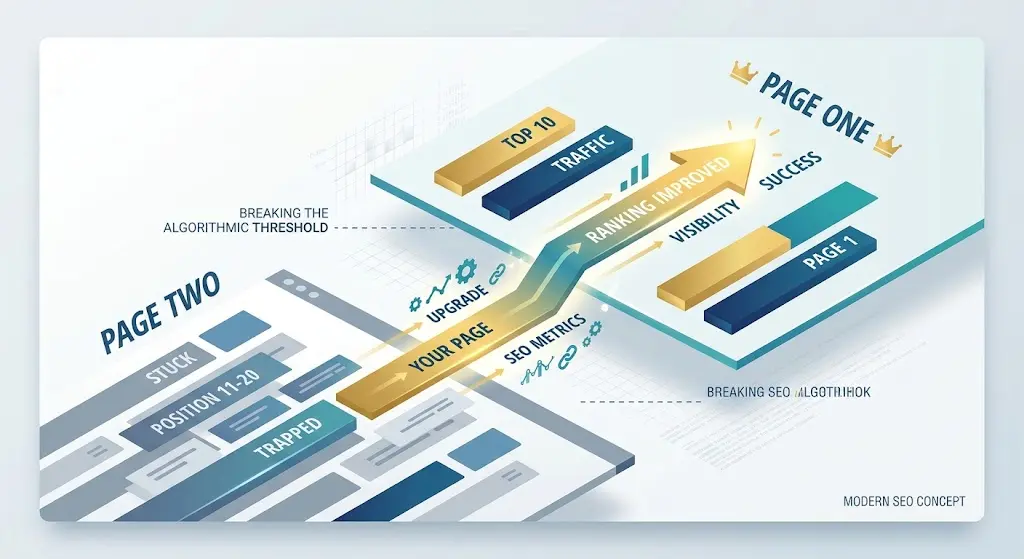
Introduction: The Page-Two Trap and Algorithmic Thresholds
Few scenarios in search engine optimization are as frustrating as watching a high-value URL crawl up from obscurity, breach the top 20, and then freeze indefinitely on page two of Google's search results. Often referred to as "page-two limbo" or the "striking distance trap," positions 11 through 20 represent a unique state in modern search architecture. Reaching page two proves that search engine algorithms—specifically Google's core ranking systems—have evaluated your domain, deemed your website authoritative, and determined that your content is topically relevant to the search query. However, failing to break into the top 10 indicates that your page has triggered an algorithmic threshold or failed to meet specific search quality signals required for primary search engine results page (SERP) real estate.
To understand why pages get stuck on page two, one must examine how modern Natural Language Processing (NLP) models, vector embeddings, and search quality filters interact. Modern search engines do not merely count keyword instances or tally incoming hyperlinks; they evaluate semantic context, topical completeness, user interaction metrics, and link profile naturalness. Page two is frequently used as a holding ground for pages undergoing algorithmic re-evaluation, pages suffering from mild over-optimization penalties, or URLs exhibiting subtle relevance gaps compared to page-one competitors.
Moving a URL from position 15 to position 4 requires a deliberate, diagnostic approach rather than random content additions or uncalibrated link acquisition. You must isolate the precise bottleneck holding your page back—whether it stems from off-page anchor text over-optimization, missing semantic entities, architectural internal linking deficits, or user intent mismatch.
The following blueprint provides a systematic framework to diagnose, optimize, and elevate page-two content onto the first page of Google.
Step 1: Diagnose Your Page-Two Anchor Profile
Before making changes, run your page and its top three competitors through a backlink tool (like Ahrefs or Semrush). Calculate your exact-match and anchor text ratios.
- Scenario A (Over-Optimized): If your exact-match anchor percentage is significantly higher than the top 3 ranking competitors, your page is likely being suppressed by a spam filter.
- Scenario B (Under-Optimized): If your exact-match anchors are lower than competitors, or your anchors are purely generic ("click here"), your page lacks the topical signals needed to rank.
SEO that moves rankings
Want help turning SEO traffic into leads, not just pretty reports?
This post is in SEO, so here’s the most relevant next step if you want help applying it.
We build practical SEO systems around content, technical fixes, internal links, and conversion intent so rankings actually help the business.
- Technical SEO, on-page improvements, and content strategy
- Local SEO, link building, and entity-focused optimization
- Clear execution instead of vague SEO theater
Step 2: Dilute an Over-Optimized Profile
If your page is suppressed due to aggressive, exact-match commercial anchors, you must dilute the ratio. Do not try to delete good backlinks. Instead, build a "cushion" of safe anchors:
- Build Pillow Links: Acquire high-authority, low-risk links using naked URLs or branded text. Safe sources include high-quality directory listings, profile links, and foundational press releases.
- Leverage Internal Linking: You have 100% control over your internal site links. Build links from other relevant blog posts on your site using descriptive partial-match phrases or your brand name to naturally bring down the exact-match ratio.
- Request Anchor Edits: If you have a direct relationship with webmasters who gave you guest posts, ask them to change a commercial anchor (e.g., "cheap car insurance") to a branded or partial variant (e.g., "the latest plans from [BrandName]").
Step 3: Audit "Phantom" Anchors
Spam filters look at the entire footprint of a page. A common reason pages get stuck on page two is a hidden accumulation of low-quality or automated exact-match anchors.
- Check Image Alt Text: Images act as links if they point to another page. Ensure your image alt tags are descriptive sentences, not stuffed with raw target keywords.
- Audit Historical Spikes: Look at your link velocity history. If a previous SEO campaign built 50 exact-match forum links in a single week, search filters may flag the page even if your current link-building looks natural.
Step 4: Fix Content and "On-Serp" Signals
If your anchor ratios perfectly match the competition but you are still stuck on page two, the problem is likely user intent or content optimization:
- Match Intent Types: Look closely at page one. If the top results are listicles ("Top 10 Tools") and your page is a direct product checkout page, a link profile won't save you. You must rewrite the page format to match what users expect.
- Pass the "Surrounding Text" Test: Ensure your target keywords appear naturally in the text immediately preceding and following your main external links. Google uses this semantic context to verify link relevance.
Step 5: Semantic Content Expansion with NLP and Topic Modeling
To displace established page-one competitors, your content must demonstrate comprehensive topical coverage. Natural Language Processing (NLP) models evaluate content depth by identifying named entities, core concepts, and contextual co-occurrence terms associated with a given topic micro-universe.
Entity Extraction and Salience Score Optimization
Modern search engines break down written content into distinct semantic entities (people, places, concepts, technologies, and methodologies) and assign them salience scores based on their relative importance within the text. Analyze the top-ranking page-one URLs using NLP content optimization tools (such as Google Cloud Natural Language API, Surfer SEO, or Clearscope) to identify missing entities and LSI (Latent Semantic Indexing) keywords:
- Primary Entities: Central concepts that must be defined and explored thoroughly within main content sections.
- Secondary Entities: Supporting sub-topics, tools, frameworks, and industry terminology that reinforce main arguments.
- Attribute Terms: Descriptive adjectives, metrics, and technical specifications that ground the topic in authoritative context.
Structuring Semantic Content Depth
Integrate missing semantic entities naturally by expanding existing sections or creating dedicated sub-headings. Avoid arbitrary word count expansion or keyword stuffing, which harms readability and dilutes topical focus. Ensure every added paragraph answers a specific user query or clarifies a technical nuance.
Step 6: Optimize Technical On-Page Structure and HTML Architecture
A well-structured document allows search engine crawlers to parse, index, and weigh your content efficiently. Poor structural hierarchy creates crawling friction and reduces the semantic weight of key content blocks.
Heading Tag Hierarchy
Ensure your page follows a single, logical document tree. Your primary H1 heading must represent the main topic and include your target subject naturally. Sub-headings should divide the content into core structural themes, while secondary headings should be reserved for nested sub-points, examples, or specific steps.
Structured Data and Schema Markup Implementation
Enhance visibility with Schema markup to help search engine crawlers interpret your content's structural context without relying solely on heuristic text processing:
- Article / TechArticle: Declares publication metadata, author entities, and publisher information.
- FAQPage: Explicitly maps common questions and concise answers for eligibility in rich snippet search results.
- HowTo: Structures sequential step-by-step instructions for actionable process guides.
- Product / ItemPage: Categorizes transactional assets with precise pricing, availability, and review metrics.
See Schema.org for more information on proper implementation.
Step 7: Improve User Engagement Signals and On-Page Experience
Search engines continually evaluate implicit user feedback metrics to verify whether a page satisfies user query demands. High bounce rates, low dwell times, and frequent "pogo-sticking" (where a user clicks your result, immediately hits the back button, and selects a competing URL) send negative quality signals that keep pages locked on page two.
Optimizing Above-the-Fold Real Estate
The top portion of your web page must immediately confirm to the visitor that they have found the correct resource. Minimize aggressive ads, large decorative banners, or intrusive pop-ups that push primary text content below the viewport. Ensure that a clear title, brief intro paragraph, and primary table of contents are immediately visible upon landing.
Enhancing Readability and Visual Scannability
Format dense text blocks into digestible visual units to increase reader retention and time-on-page metrics:
- Limit paragraph lengths to 2–4 sentences to reduce cognitive load.
- Utilize bulleted lists, numbered steps, and callout boxes for complex data.
- Incorporate relevant tables for structured data comparisons.
- Bold key technical concepts and takeaway summary phrases to facilitate rapid skimming.
Step 8: Re-Evaluate Internal PageRank Distribution
Internal PageRank serves as the primary currency through which authority is distributed across your site architecture. Pages stuck on position 11 through 20 often suffer from insufficient internal authority flow.
Internal Link Auditing and Contextual Insertion
Identify your domain's top "power pages"—URLs with the highest number of external backlinks and domain authority—using site crawl and backlink tools. Add contextual internal links from these high-authority pages directly to your struggling page-two URL within the main body text, utilizing descriptive, entity-rich partial-match anchor text.
Example:
“Proper link text management is critical. Check out these mastering SEO links strategies. “
Elimination of Internal Link Bottlenecks
Ensure your target page is not buried deep within your website's folder structure or pagination depth. A page required to rank for competitive commercial queries should ideally be accessible within 2 to 3 clicks from the homepage. Update your XML sitemap, clean up internal redirect chains, and remove broken internal links pointing to or from the target URL.
Systematic Page-Two Troubleshooting Matrix
| Identified Symptom | Primary Root Cause | Diagnostic Tool | Corrective Optimization Action |
|---|---|---|---|
| Exact-match anchor ratio > 25% over competitor average | Off-page over-optimization filter (Link Spam) | Ahrefs / Semrush Anchor Reports | Build pillow links (branded/naked URLs); re-anchor internal links; request anchor edits. |
| Low TF-IDF / NLP entity density vs page-one competitors | Topical under-optimization and relevance gap | Surfer SEO / Clearscope / Google NLP API | Perform semantic expansion; integrate missing entities, attributes, and secondary topics. |
| Page format differs from top 5 SERP results | Search intent mismatch | Manual SERP Inspection | Re-architect layout (e.g., convert informational blog to commercial guide or product page). |
| High bounce rate & short dwell time (< 30 seconds) | Poor user experience / Above-the-fold friction | Google Analytics 4 / Microsoft Clarity | Remove intrusive pop-ups; push main content above fold; improve formatting and readability. |
| Inbound internal links < 5 total site-wide links | Insufficient internal PageRank allocation | Screaming Frog / Site Audit Tools | Add contextual internal body links from high-authority "power pages" across your domain. |
Conclusion
Breaking out of page two requires a disciplined, step-by-step diagnostic process rather than uncalibrated site updates. By systematically analyzing your anchor profile, diluting commercial over-optimization, expanding semantic NLP entity coverage, re-architecting internal PageRank flows, and satisfying core search intent, you transform a page-two URL into an authoritative page-one search result.
📧 Want to Stay Updated?
Get the latest web development tips and insights delivered to your inbox.
🚀 What Services do you Offer?
About the Author

Brian Keary
Founder & Lead Developer
Brian is the founder of BKThemes with over 20 years of experience in web development. He specializes in WordPress, Shopify, and SEO optimization. A proud alumnus of the University of Wisconsin-Green Bay, Brian has been creating exceptional digital solutions since 2003.
Expertise
Writing since 2003