
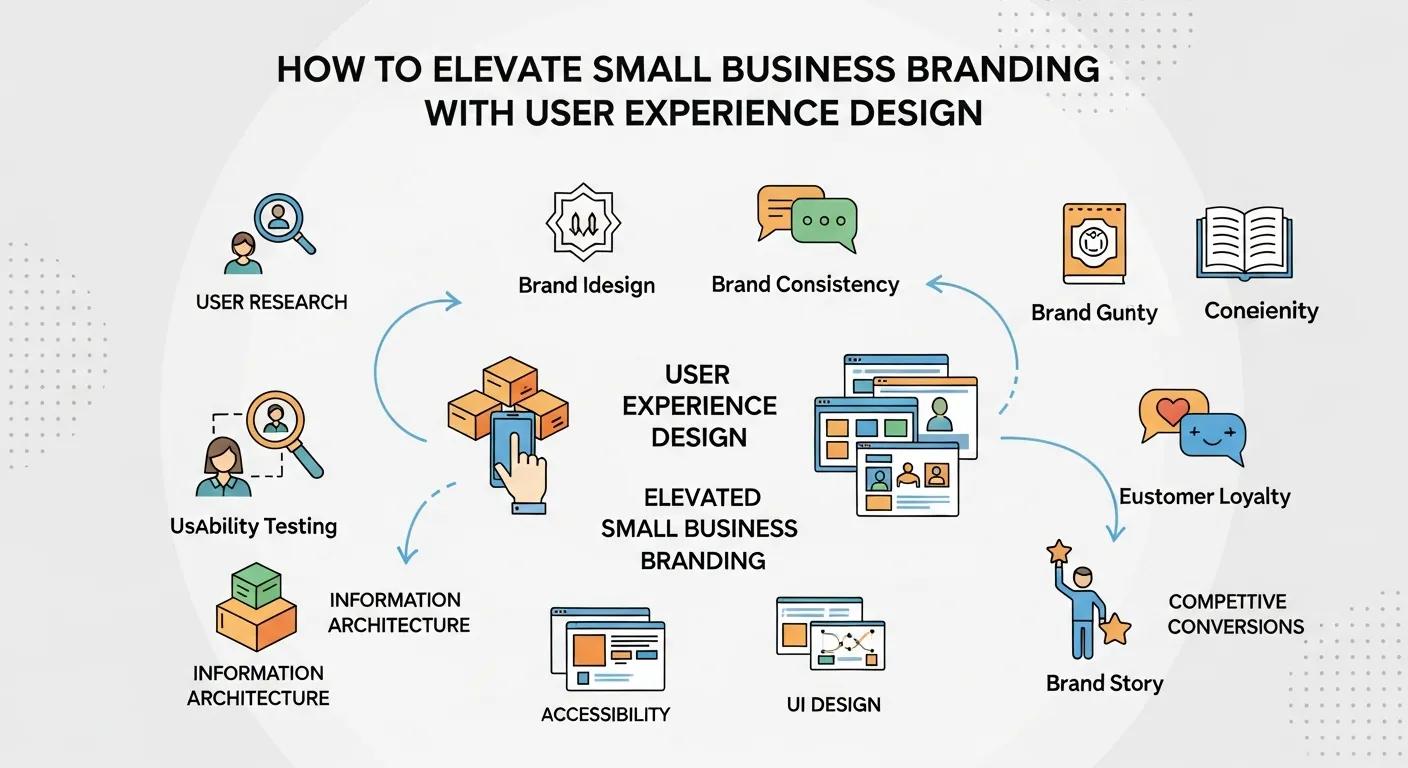
Discover creative strategies to enhance your brand's user experience and stand out in the market.
Learn how to integrate creativity into user experience design to strengthen your small business brand. This guide offers practical methods for making memorable design choices that differentiate your brand from competitors, focusing on actionable insights for immediate implementation.
- Creativity in design means problem-solving, not decoration - Focus on finding unexpected solutions to real user challenges that reflect your brand's unique perspective.
- User experience design drives small business branding - Your brand is how people feel when they interact with your business, and UX design delivers that impression at scale.
- Follow the five-stage framework - Discover (understand users and brand), Define (prioritize problems), Ideate (generate solutions), Implement (build with UX priorities), Iterate (refine based on feedback).
- Constraints fuel better creativity - Limited budget and time force focused problem-solving rather than endless exploration, leading to more effective solutions.
- Start small and iterate - Identify one friction point that, if solved creatively, would make visitors remember your brand, then build from there through continuous refinement.
Guide Orientation: What This Guide Covers
This guide shows you how to use creativity in the design process to build user experiences that strengthen your small business brand. You will learn a practical framework for integrating creative thinking into every design decision, from initial concept to final implementation.
This guide is for small business owners, founders, and marketing managers who want their websites and digital presence to feel distinctive rather than templated. By the end, you will understand how to evaluate design choices through a user experience lens and apply creative problem-solving to common branding challenges.
We focus on actionable methods you can implement immediately. We do not cover advanced design theory or enterprise-level systems. If you need a working approach to make your brand memorable through better design, keep reading.
Why Creativity in User Experience Design Matters for Small Businesses
Small business branding lives or dies on differentiation. When your competitors use the same templates and follow identical design trends, creativity becomes your competitive advantage. User experience design is where that creativity translates into measurable business outcomes.
Consider the cost of blending in. Visitors land on your site, see something familiar, and leave without remembering your brand. They cannot distinguish you from three other options they viewed that morning. This happens because most small businesses treat design as decoration rather than strategic communication.
The shift happening now favors businesses that prioritize experience over aesthetics alone. Research from Nielsen Norman Group consistently shows that users form judgments about credibility within seconds. Those judgments come from how a site feels to use, not just how it looks.
Creative user experience design addresses this directly. It means solving real user problems in ways that reflect your brand's unique perspective. When done well, visitors remember you because interacting with your business felt different, better, and more aligned with their needs.
Core Concepts: Understanding the Creative Design Relationship
Creativity Is Problem-Solving, Not Decoration
Creativity in the design process means finding unexpected solutions to user challenges. It does not mean adding visual flourishes or following design trends. A creative approach asks: what does our specific audience need, and how can we deliver it in a way only our brand would?
User Experience Design Defined
User experience design (UX design) encompasses every interaction someone has with your business digitally. This includes how quickly pages load, how easily visitors find information, how forms feel to complete, and how the overall journey matches their expectations. The Interaction Design Foundation defines it as designing for the entire relationship between user and product.
Small Business Branding Through Experience
Your brand is not your logo or color palette. Your brand is how people feel when they interact with your business. Small business branding succeeds when every touchpoint reinforces a consistent, memorable impression. User experience design is the vehicle that delivers that impression at scale.
The Misconception to Avoid
Many business owners believe creativity and usability oppose each other. They think creative designs confuse users, while usable designs are boring. This is false. The most effective designs are creative precisely because they solve usability problems in fresh ways. Creativity serves the user, not the designer's ego.
The Creative UX Framework for Small Business Branding
This framework has five interconnected stages. Each stage builds on the previous one, but you will cycle back through them as you refine your approach. Think of it as a spiral rather than a straight line.
The stages are: Discover (understand your users and brand), Define (clarify the problems worth solving), Ideate (generate creative solutions), Implement (build and test), and Iterate (refine based on real feedback). This structure ensures creativity serves strategy rather than operating randomly.
What makes this framework effective for small businesses is its emphasis on constraints. You likely have a limited budget, time, and team capacity. These constraints actually fuel better creativity because they force focused problem-solving rather than endless exploration.
Step-by-Step Breakdown
Step 1: Discover Your Users and Brand Position
Objective: Build a clear picture of who you serve and what makes your business distinct before making any design decisions.
Start by documenting your three most valuable customer types. Write down what they need when they arrive at your site, what frustrates them about alternatives, and what would make them remember you. Talk to actual customers if possible. Review support emails and sales conversations for patterns.
Next, articulate your brand position in one sentence. What do you do, for whom, and why should they choose you? This sentence guides every creative decision that follows. If you cannot state it clearly, your design will lack focus.
What to avoid: Do not skip this step because you think you already know your customers. Do not create fictional personas without grounding them in real conversations. Do not define your brand by what you sell, but rather by the problem you solve.
Success indicators: You can describe three distinct user needs without hesitation. Your brand position statement passes the "so what" test, meaning it would not apply equally to your competitors.
Step 2: Define the Problems Worth Solving Creatively
Objective: Identify specific user experience problems where creative solutions will differentiate your brand.
Review your current site or digital presence with fresh eyes. Where do users get stuck? Where do they drop off? Use tools like Google Analytics to identify pages with high exit rates. Check your site's Core Web Vitals for performance issues affecting experience.
List every friction point you find. Then prioritize ruthlessly. Ask: Which problems, if solved creatively, would most reinforce our brand position? A slow checkout affects everyone, but a confusing service explanation specifically undermines trust in your expertise.
What to avoid: Do not try to solve every problem at once. Do not prioritize problems based on what is easiest to fix rather than what matters most to users. Do not assume technical issues are separate from brand issues.
Success indicators: You have a ranked list of three to five problems. Each problem connects directly to user needs identified in Step 1. You can explain why solving each problem supports your brand position.
Step 3: Ideate Creative Solutions
Objective: Generate multiple possible solutions for each prioritized problem, pushing beyond obvious answers.
For each problem, brainstorm at least five potential solutions before evaluating any of them. Include ideas that feel too ambitious or unconventional. The goal is quantity first, quality second. Use constraints as creative prompts: "How would we solve this with no budget?" or "What if we had to explain this without any text?"
Look outside your industry for inspiration. How do hospitality brands create welcoming digital experiences? How do media companies guide users through complex content? Borrow structural ideas and adapt them to your context. Awwwards and other design showcase sites feature creative approaches across industries.
What to avoid: Do not dismiss ideas immediately because they seem difficult. Do not copy competitors directly. Do not let "we have always done it this way" limit exploration. Do not confuse novelty with creativity, as new is not automatically better.
Success indicators: You have multiple distinct approaches for each problem. At least one idea per problem feels slightly uncomfortable because it pushes boundaries. You can articulate why each idea might work for your specific users.
Step 4: Implement with User Experience Priorities
Objective: Build your chosen solutions while maintaining focus on performance, usability, and brand consistency.
Select one solution per problem based on feasibility, brand alignment, and potential impact. Start with the highest-priority problem. Build a minimal version first. For websites, this means ensuring fast load times, mobile responsiveness, and clear navigation before adding creative flourishes.
Creative implementation does not mean complex implementation. A distinctive micro-interaction, a unique way of presenting information, or an unexpected content approach can differentiate your brand without requiring custom development. WordPress theme development standards and Shopify's theme architecture both support creative customization within stable frameworks.
What to avoid: Do not sacrifice page speed for visual effects. Do not implement creative elements that confuse navigation. Do not launch without testing on mobile devices. Do not forget accessibility requirements, as creative design must work for all users.
Success indicators: Your implementation loads quickly (under three seconds on mobile). Users can complete key tasks without confusion. The creative elements reinforce rather than distract from your brand message.
Step 5: Iterate Based on Real User Feedback
Objective: Refine your creative solutions using actual user behavior and feedback rather than assumptions.
Set up basic tracking before launch. Monitor which pages users visit, where they click, and where they leave. Tools like Google Analytics 4 provide this data for free. For deeper insight, consider session recording tools that show how users actually interact with your design.
Collect qualitative feedback directly. Add a simple feedback mechanism to your site. Ask customers about their experience during follow-up communications. Pay attention to support requests that indicate confusion or friction. Schedule monthly reviews of this data to identify patterns.
What to avoid: Do not treat launch as the finish line. Do not ignore feedback that contradicts your creative vision. Do not make changes based on single data points. Do not optimize for metrics that do not connect to business outcomes.
Success indicators: You have a regular rhythm of reviewing user data. You can point to specific changes made based on feedback. Your key metrics (traffic, time on site, conversions) trend positively over time.
Practical Examples: Creative UX in Action
Example 1: The Service Business Navigation Problem
A consulting firm noticed visitors struggled to understand their service offerings. The standard approach would be a services page with bullet points. The creative approach: an interactive decision guide that asks visitors three questions and recommends the most relevant service. This solution serves users better while demonstrating the firm's expertise in understanding client needs.
Example 2: The E-commerce Trust Challenge
An online retailer competing with larger brands needed to establish credibility quickly. Instead of adding more trust badges (the obvious solution), they created a "Behind the Product" section showing their sourcing process with real photos and supplier stories. This creative approach addressed the trust problem while reinforcing their brand position around transparency and quality.
Example 3: The Content Overload Situation
A small business with extensive expertise kept adding content, making its site overwhelming. The creative solution: a curated "Start Here" experience that guided new visitors through essential information in a logical sequence. This improved user experience while showcasing their depth of knowledge rather than burying it.
Common Mistakes and Pitfalls
The most frequent mistake is prioritizing creativity over clarity. Users do not reward cleverness that makes their task harder. Every creative choice must pass a simple test: Does this help users accomplish their goal while reinforcing our brand?
Another common pitfall is inconsistent implementation. A creative homepage followed by generic interior pages creates cognitive dissonance. Users notice when the experience quality drops. Maintain creative standards throughout the user journey, not just at entry points.
Many small businesses also fall into the comparison trap. They see a large competitor's elaborate design and try to replicate it with a fraction of the resources. This leads to poor execution of ambitious ideas. Better to execute simple ideas excellently than complex ideas poorly.
Finally, some businesses treat creativity as a one-time project rather than an ongoing practice. User needs evolve. Competitors adapt. Your creative approach must continue developing through the iteration cycle described in Step 5.
What to Do Next
Start with Step 1 this week. Spend thirty minutes documenting your three most valuable customer types and drafting your brand position statement. Do not worry about perfection. A working draft gives you a foundation to build on.
Return to this guide as a reference when you reach each subsequent stage. The framework works best when you move through it deliberately rather than rushing to implementation. Creative user experience design is a practice you develop over time, not a project you complete once.
Consider your current site honestly. Identify one friction point that, if solved creatively, would make visitors remember your brand. That single focus will teach you more than trying to redesign everything at once.
Frequently Asked Questions
Sources
- https://www.nngroup.com/articles/why-you-only-need-to-test-with-5-users/
- https://www.interaction-design.org/literature/topics/ux-design
- https://analytics.google.com/
- https://pagespeed.web.dev/
- https://www.awwwards.com/
- https://developer.wordpress.org/themes/
- https://shopify.dev/themes
- https://marketingplatform.google.com/about/analytics/
📧 Stay Updated
Get the latest web development tips and insights delivered to your inbox.