TL;DR
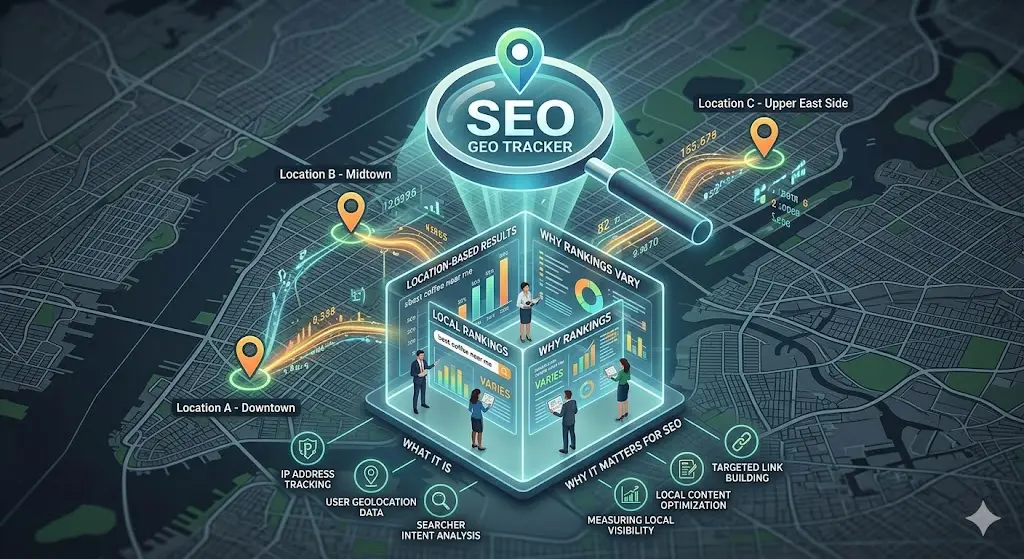
Geo tracking for SEO means tracking keyword rankings by location, such as city, ZIP code, neighborhood, or region. It matters because Google shows different results based on where the searcher is. A business might rank in one area and barely appear in another, even for the same keyword. Geo tracking for SEO helps local businesses, agencies, franchises, and service-area brands see where they actually stand, spot weak areas, measure local SEO progress, and make smarter content, Google Business Profile, and link-building decisions.
Can your SEO data can lie to you?
Yes, local SEO data can actively mislead you. Metrics often show high impressions, great rankings, or rising click numbers while your actual local phone calls, foot traffic, and sales flatline.
Why Your Local Data Can Be Misleading
- Personalized and Localized Rankings: Standard ranking tools check positions from a fixed server or a single GPS coordinate. If you check rankings from your office, the data does not reflect how a customer sees your business two miles away or on the other side of town.
- Vanity Metrics in Dashboards: Google Business Profile insights track "views" and "discovery searches," but casual swipes on a map or impressions from irrelevant keyword variations inflate these numbers without driving buyers.
- Bot and Spam Traffic: Automated web crawlers, scrapers, and competitor bots can skew your local landing page traffic and analytics data, making you think local interest is surging.
- Misleading Map Pack Radios: A business might rank #1 in the map center, but local search results hyper-localize rapidly. Data showing top-three placement can mask total invisibility for potential customers situated just a few blocks outside your immediate micro-neighborhood.
How to Spot and Fix the Discrepancies
- Track Action Metrics: Ignore passive views. Focus strictly on direct phone calls, direction requests, appointment bookings, and form fills originating from your local channels.
- Use Local Rank Trackers Correctly: Configure your tracking software to sample rankings from multiple precise grid coordinates across your actual service radius rather than a single point.
- Audit Actual Conversions: Cross-reference your digital dashboard numbers with your point-of-sale data, front desk logs, or CRM inquiries to see if the web traffic turns into real human beings.
What Is Geo Tracking for SEO?
Geo tracking for SEO is the process of monitoring, analyzing, and mapping search engine rankings from highly specific geographic locations. Instead of checking your website's rank at a broad country or city level, geo tracking measures performance down to exact postal codes, neighborhoods, or specific GPS coordinates.
Why Geo Tracking is Essential for Local SEO
Search results change dramatically depending on the exact spot where a user is standing. If a customer searches for a service from a coffee shop, they will see a completely different "Map Pack" (the top three local map results) than someone searching for the exact same term three blocks away.
Standard rank tracking tools give you an inaccurate, average score. Geo tracking solves this by uncovering how your visibility shifts across a specific territory.
 [ Your Business Location ] 📍 #1 Rank
		└── 1 Mile North 🚗 #3 Rank
			  └── 2 Miles North 🗺️ #8 Rank (Invisible in Map Pack)
How Geo Tracking Works
- Grid-Based Tracking: Advanced software overlays a visual map grid (such as a 5x5 or 7x7 matrix) over a specific target market area.
- Coordinate Simulation: The system sends automated search queries to Google while mimicking the exact latitude and longitude of each specific grid intersection point.
- Visual Heatmaps: The tool compiles the ranking data from each point to generate a color-coded heatmap. Typically, green pins indicate a top-three ranking, while yellow and red pins reveal where your visibility drops.
Core Metrics Monitored
- Share of Local Voice (SoLV): The percentage of time your business appears in the top map results across the entire scanned grid area.
- Rank by Node: Your exact position (e.g., #1, #5, #20) at any specific coordinate point on the map.
- Competitor Domination: Identification of which local competitors rank ahead of you at specific coordinate points, revealing their geographic strongholds.
Discover the most important local SEO metrics for 2026 success. My expert guide covers GBP, rankings, conversions, and ROI for your business growth.
Why do Google Rankings Change by Location?
Google rankings change by location because search engines are engineered to prioritize user intent and contextual relevance, recognizing that a user’s immediate proximity alters what information is useful to them. To deliver these results, Google heavily factors in the user's explicit physical coordinates, local search history, and device signals.
The Core Drivers of Location-Based Changes
- The Proximity Factor: For queries with local intent (e.g., "coffee shop," "plumber," "emergency room"), Google’s algorithm calculates the precise distance between the searcher and nearby businesses. This means a user will see a completely different "Map Pack" of results standing on one street corner compared to a user searching three blocks away.
- Localized Search Intent: Google categorizes queries based on implicit intent. If you search for "pizza," the search engine assumes you want a meal nearby right now, prioritizing local eateries over national chains or generic pizza recipes.
- Relevance to Local Infrastructure: Algorithms evaluate how well a business serves a micro-neighborhood. Factors like local reviews, localized backlink profiles, and geographic mentions in web content help Google determine if a business is a trustworthy solution for that specific coordinate.
- Variable Competitor Density: The competitive landscape changes from one neighborhood to the next. In a dense downtown core, thousands of businesses might compete for top local spots, forcing rankings to fragment down to the city block level. In a rural area, the geographic radius expands significantly.
How Search Engines Track User Location
Google relies on multiple data layers to pin down a searcher's physical location:
| Data Source | Precision Level | How It Influences Rankings |
|---|---|---|
| Device GPS | Hyper-Local (Within feet) | Dictates the exact composition of the local 3-pack maps results. |
| Wi-Fi & Cell Signals | High (Building/Street level) | Refines location accuracy even when GPS is disabled indoors. |
| IP Address | Moderate (City/Regional level) | Used as a baseline fallback for desktop searches to determine city-wide organic results. |
| Search History | Variable | Contextualizes broad searches based on recently visited locations or location-specific queries. |
The Two Types of Local Results You See
To illustrate how location warps search results, consider a user searching for a service in a major metropolitan area:
- Hyper-Local Map Pack: This map feature sits at the top of the page. It is highly volatile and tightly bound to the searcher's exact GPS node. Moving a few hundred yards can completely shuffle who ranks #1, #2, or #3.
- Localized Organic Results: These are the traditional blue links underneath the map. While they are still influenced by location, they usually change on a broader scale (city-wide or zip-code level) rather than shifting street by street.
Why does Geo Tracking for SEO Matter?
Geo tracking for SEO matters because it is the only way to see what your local customers actually see when they search for your business. Standard rank trackers mask the reality of local search, which is hyper-localized, highly volatile, and fragmented by physical distance.
The Real-World Impact of Proximity
- The "Two-Block" Invisibility: A business can rank #1 in the map pack when searched from its own front desk, but drop to #8 (completely off the first page) just three blocks away. Geo tracking reveals these hidden blind spots.
- Competitor Infiltration: It shows you exactly where a competitor's physical location or localized authority is stealing your local market share, allowing you to deploy targeted local landing pages or review campaigns.
- Accurate ROI Reporting: If your dashboard says your rankings are up, but your shop is empty, geo tracking exposes whether you are ranking for useless keywords or ranking in areas where your target demographic doesn’t actually live.
How Visibility Shifts Across a City
Rankings shrink or expand based on competitor density and how close a searcher is to your physical address.
Strategic Benefits of Geo Tracking
- Smarter Ad Spend: You can pinpoint specific zip codes where your organic map visibility is weak and run hyper-targeted Google Local Services Ads (LSAs) only in those exact zones.
- Listing Optimization: Knowing your ranking radius helps you optimize your Google Business Profile categories, local citations, and geo-targeted website content to push your visibility further out into adjacent neighborhoods.
- Accurate Algorithm Tracking: Google updates its local algorithm constantly. Grid tracking shows you if a sudden drop in calls is due to a penalty or if the algorithm simply shrunk the local proximity radius across your entire industry.
What is Geo Tracking for Local SEO?
Geo tracking for local SEO is the automated practice of measuring and mapping search engine rankings from hyper-precise geographical coordinates, such as specific city blocks, neighborhoods, or exact latitude and longitude intersections, rather than a broad city-wide average. Because search results shift radically depending on a user's exact physical footprint, this tracking method allows businesses to see their true visibility radius in real-time.
The Mechanics of Geo-Grid Tracking
- Coordinate Grid Overlay: Software maps a virtual grid (like a 3x3, 5x5, or 7x7 matrix) over a business's target service area.
- Proximity Simulation: The tool queries Google by spoofing the exact location signals of each individual grid intersection point.
- Heatmap Generation: Results display as a color-coded map where green nodes indicate top map-pack placement and red nodes reveal search invisibility.
Why It Matters for Local Businesses
- Exposes Blind Spots: It reveals if your business drops out of the top three map results just a few blocks away from your storefront.
- Tracks True Competitors: It identifies hyper-local rivals who dominate specific neighborhoods, helping you customize local content.
- Informs Ad Targeting: It pinpoints precise zip codes where your organic map visibility is weak so you can run highly targeted local ads.
Who Needs Geo Tracking for SEO?
Geo tracking for SEO is essential for any business that relies on customers within a specific physical radius. If your revenue depends on ranking in Google’s local 3-Pack (the map results at the top of a search page), standard city-wide tracking will hide your true visibility gaps.
1. Brick-and-Mortar Storefronts
Businesses that require customers to physically walk through their doors need geo tracking to understand their local draw radius.
- Who they are: Restaurants, medical clinics, dentists, retail shops, gyms, and car dealerships.
- Why it matters: Customers rarely drive past a closer, highly-rated competitor. Storefronts use geo tracking to see exactly how many blocks away their visibility drops off, allowing them to target hyper-local zip codes with mailers or localized digital ads to win back those neighborhoods.
2. Service-Area Businesses (SABs)
SABs do not serve customers at their physical address; instead, they travel to the customer.
- Who they are: Plumbers, electricians, roofers, mobile locksmiths, and HVAC technicians.
- Why it matters: Because SABs hide their address on Google, ranking across a wide territory is incredibly difficult. Geo tracking helps these businesses identify "cold spots" across a county or metropolis where their dispatch vans could be going, showing them exactly where to build dedicated local landing pages.
3. Multi-Location Brands and Franchises
Companies managing dozens or thousands of corporate locations or franchise footprints need geo tracking for macro-level market analysis.
- Who they are: Urgent care networks, regional bank branches, hotel chains, and fast-food franchises.
- Why it matters: Corporate marketing teams cannot manually check rankings for 500 stores. Geo-grid heatmaps let corporate managers instantly see which specific branches are losing local market share to local competitors, helping them allocate their corporate ad budgets efficiently.
4. Local SEO Agencies and Consultants
Agencies managing digital marketing for local businesses use geo tracking as a core reporting tool.
- Why it matters: Traditional rank trackers present a single, flat number (like "Rank: #2"). When an algorithm update hits, that number might not change, but the radius of visibility might shrink drastically. Agencies use visual geo-grids to prove their optimization work is expanding the client's reach across the entire town, protecting their client retention rates.
Is Geo Tracking Right for Your Business Type?
| Business Type | Do You Need Geo Tracking? | Primary Tracking Focus |
|---|---|---|
| E-commerce Stores | No | National or global organic keyword rankings. |
| Hyper-Local Storefronts | Yes | 1 to 5-mile micro-grids around the shop. |
| Regional Service Providers | Yes | Multi-zip code grids matching service boundaries. |
| B2B Software (SaaS) | No | Universal organic rankings and feature-driven intent. |
Learn the differences between AEO, GEO and SEO and how to optimize for each.
What does Geo Tracking for SEO Actually Measure?
A lot of people hear "geo tracking" and think it just means checking where you rank in different cities. It goes further than that.
A good geo tracking setup can measure organic keyword rankings by location, map pack visibility by location, ranking shifts over time in each area, competitor presence in those same areas, and desktop versus mobile performance.
Some local rank tracking platforms also use grid-based tracking. This means they check rankings from multiple points across a map, not just one city center. That gives a far better picture of local search coverage. You can see where your Google Business Profile is strong, where it fades, and where a competitor overtakes you.
This kind of data is especially useful for businesses that rely on local pack visibility. A map grid can show whether your business has real market reach or just strong proximity near the office.
Geo tracking for SEO can also reveal content gaps. If one city page performs well and another fails, there is usually a reason. The page may be thin, the internal linking may be weak, the local signals may be poor, or the area may simply be more competitive.
What are the Differences Between Standard Rank Tracking and Geo Tracking?
Standard rank tracking usually gives you one ranking per keyword, often tied to a default country, city, or neutral location. That works fine for broad national SEO. It is not enough for local search.
Geo tracking adds location depth. Instead of one number, you get rankings across the places that matter. This matters because a keyword like "family lawyer" or "emergency dentist" does not behave the same way in every neighborhood.
A standard tracker might tell you that you rank number five for a keyword in Chicago. That sounds useful until you realize that most of your leads come from two suburbs where you actually rank number 12 and 15. The single ranking made performance look better than it really was.
Geo tracking fixes that problem. It shows how visibility changes by market, not just by keyword.
That makes reporting more honest. It also makes action easier. Instead of celebrating a ranking that does not drive leads, you can focus on the locations where rankings still need work.
How to Use Geo Tracking for SEO the Right Way
The biggest mistake is tracking too broadly and learning nothing useful. Good geo tracking starts with business logic.
Start with your real service area. If you only serve three towns, track those towns closely rather than trying to monitor an entire state. If you serve a large metro area, break it into meaningful sections. City centers, suburbs, ZIP codes, and neighborhoods often matter more than a single big-city label.
Next, choose keywords that reflect real buyer intent. Local service keywords matter most. Think "plumber," "roof repair," "med spa," "criminal defense lawyer," or "physical therapist," along with city-modified slang variations where relevant. Branded keywords matter too, but non-branded local intent terms usually reveal more about market opportunity.
Track both organic and map pack rankings if possible. For many local businesses, map pack visibility drives the lead.
Then compare locations over time. Geo tracking for SEO becomes useful when you can spot trends. Are you getting stronger in your priority suburbs? Are rankings flat in one neighborhood despite new content? Did a competitor gain visibility after review growth or link acquisition?
This data should feed your next moves, not just sit in a dashboard.
How Geo Tracking Helps Content Strategy
A lot of local content gets published for one reason only: someone said every city needs its own page. Then the site ends up with twenty thin pages that sound the same and rank nowhere.
Geo tracking helps stop that kind of waste.
When you track rankings by location, you can see which pages are actually gaining traction. Maybe your "personal injury lawyer in Mesa" page is climbing well, while your "personal injury lawyer in Chandler" page is stuck. That tells you something important. One page may have stronger local relevance, better internal links, stronger backlinks, or simply better copy.
This lets you improve with purpose. You can expand weak city pages, add local proof, build better supporting content, strengthen local internal linking, and match the actual search intent in that area.
Geo tracking also helps you spot content opportunities. If you are ranking just outside the top results in a valuable suburb, that may be the next page or cluster to build out. If a nearby area has decent demand and weak competition, that is another opening.
Good local content is not about publishing pages everywhere. It is about building pages for places where your business can actually compete and convert.
Geo Tracking and Google Business Profile Performance
For local SEO, your Google Business Profile plays a huge role in visibility, especially in the map pack. Geo tracking for SEO helps you understand how far that visibility extends beyond your physical location.
This matters because proximity is a major factor in local pack rankings. Even a strong profile with good reviews, complete categories, photos, and regular updates will often rank best closest to the business. As distance increases, rankings can drop.
That does not mean you are stuck. It means you need to know where the drop happens.
Geo tracking can show whether your profile performs well across the market or only in a tight radius. That helps you decide where to push harder with reviews, local landing pages, citations, links, and supporting location signals.
It also helps you compare branches if you manage multiple locations. One office may have much better local pack coverage than another. Once you see that, you can investigate why.
Geo Tracking for Competitor Analysis
One of the best uses of geo tracking is competitor analysis. It shows not just who outranks you, but where they outrank you.
A competitor may look dominant from a broad city-level view. But once you break rankings down by neighborhood or ZIP code, the picture may shift. Maybe they control the city center but are weak in the suburbs. Maybe they own map pack visibility in the west side while you are stronger in the east. Maybe a smaller local business is beating both of you in a specific district.
This matters because SEO budgets are limited. You want to push where the gain is realistic.
Geo tracking helps you find soft spots in the market. If a competitor is weak in a target suburb, a focused local page, better local links, stronger reviews, and profile work may help you break through faster there than in the most crowded area.
This also makes reporting to clients or stakeholders much clearer. Instead of saying "Competitor X ranks above us," you can say "Competitor X is stronger in three ZIP codes, but we lead in five and are closing the gap in two more."
That is useful. That leads to better decisions.
What are Common Mistakes with Geo Tracking?
The most common mistakes for tracking locally is tracking too many locations or not enough. It goes deeper than that though. For instance:
- Tracking only one location and calling it local SEO reporting. That usually hides the truth.
- Tracking too many locations without tying them to business goals. More data is not always better. If you serve ten areas, track those ten well. Do not clutter the report with irrelevant details.
- Ignoring device differences. Mobile local results can look very different from desktop. If most of your leads come from phones, mobile geo tracking should matter more.
- Creating city pages before checking whether those locations have ranking potential. Geo tracking can help you prioritize pages based on real visibility gaps.
- Stare at rankings and forget conversions. Ranking improvements matter, but they should lead to calls, leads, forms, or visits. Geo tracking works best when tied to business outcomes.
- Treating rankings as static. Local search moves. Competitors gain reviews. New offices open. Google updates how it handles proximity and intent. Geo tracking should be ongoing, not a one-time check.
Best Practices for Geo Tracking for SEO
- Start with your most valuable service areas, not every possible location.
- Track your top commercial keywords first.
- Separate branded and non-branded terms.
- Track both map pack and organic rankings where possible.
- Review mobile and desktop results separately.
- Use location data to guide content, internal links, local page updates, and Google Business Profile work.
- Compare your visibility with top competitors, not just your own past rankings.
- Review trends monthly so you can spot movement before it becomes a problem.
Most of all, use the data. Geo tracking for SEO is only useful if it changes what you do next.
FAQ About Geo Tracking for SEO
Conclusion
When local visibility matters, one ranking number is not enough. Geo tracking for SEO gives you the view that actually matches how people search. It shows where you are strong, where you are slipping, and where the next gains are most likely to come from. For local businesses and agencies, that kind of clarity is hard to beat. If you need a GEO-focused SEO strategy we have the expertise to help you implement it effectively.
About the Author

Brian Keary
Founder & Lead Developer
Brian is the founder of BKThemes with over 20 years of experience in web development. He specializes in WordPress, Shopify, and SEO optimization. A proud alumnus of the University of Wisconsin-Green Bay, Brian has been creating exceptional digital solutions since 2003.
Expertise
Writing since 2003