What Are EEAT Principles?
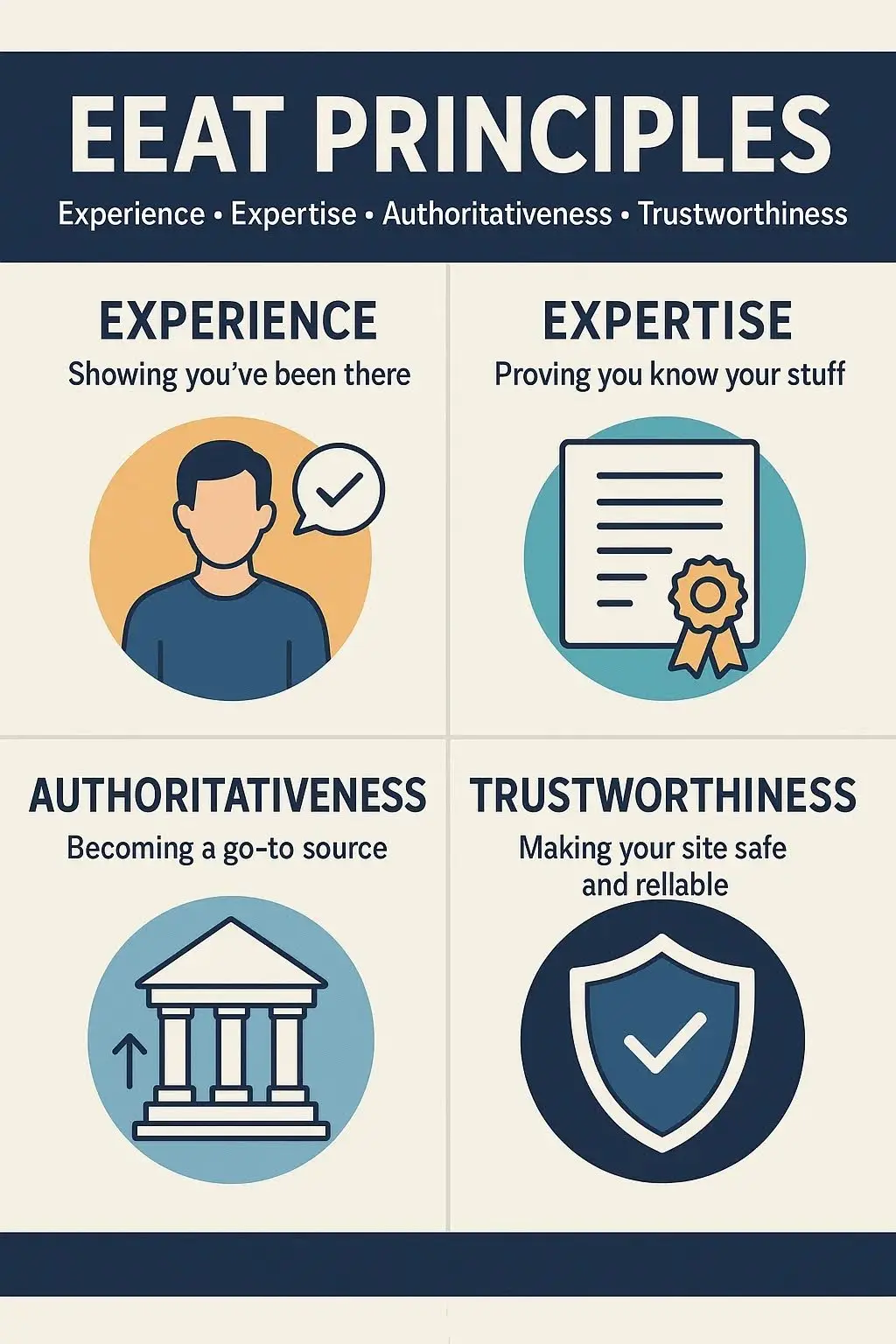
E-E-A-T stands for Experience, Expertise, Authoritativeness, and Trustworthiness. It is a fundamental framework found in Google's Search Quality Rater Guidelines used to evaluate the quality, credibility, and helpfulness of online content.
The Four Pillars of E-E-A-T
1. Experience
This principle evaluates whether the content creator has firsthand, real-world experience with the topic. Google added this pillar to distinguish unique, practical insights from generic, rehashed information.
- Example: A travel blogger sharing their personal photos and itinerary from a trip to Japan, or a homeowner detailing how they personally fixed a leaky pipe.
2. Expertise
This looks at the formal knowledge, qualifications, and credentials of the content creator. It ensures the writer has the professional background necessary to speak accurately on a topic.
- Example: A medical article written and reviewed by a board-certified cardiologist, or a tax advice guide written by a Certified Public Accountant (CPA).
3. Authoritativeness
This measures the overall reputation of the website and the author as a go-to source within their specific niche. Google looks for industry recognition, citations, and external validation.
- Example: The Mayo Clinic is highly authoritative for health information; ESPN is highly authoritative for sports scores and analysis.
4. Trustworthiness
This is the most critical pillar of the framework. It assesses the transparency, honesty, safety, and accuracy of the website. If a page is deemed untrustworthy, the other pillars cannot save it.
- Example: A secure website (HTTPS) that clearly states its editorial policies, provides verifiable facts, features an easily accessible contact page, and uses clear, honest headlines.
Why Does E-E-A-T Matter?
E-E-A-T matters because it directly determines how Google assesses content quality, filters out misinformation, and determines which websites deserve high visibility in search results. For users, it guarantees safe and accurate answers; for website owners, it dictates their organic search traffic and search engine optimization (SEO) success.
1. It Protects Users from "YMYL" Harms
The absolute highest standards of E-E-A-T are reserved for Your Money or Your Life (YMYL) topics. These are subjects that can drastically impact a person's health, financial stability, safety, or happiness.
| Topic Category | Why E-E-A-T Matters Here | Low E-E-A-T Risk |
|---|---|---|
| Medical & Health | Ensures diagnoses and treatments are backed by science. | Bad medical advice can cause physical harm or death. |
| Finance & Investment | Protects readers from scams, bad stock tips, or poor tax planning. | Flawed advice can lead to bankruptcy or legal penalties. |
| Legal & Civics | Guarantees accurate information on voting, laws, and government services. | Misinformation can compromise legal rights or democratic processes. |
| Safety & News | Delivers verified facts during crises, natural disasters, or major events. | Fake news can incite panic or put lives in immediate danger. |
2. It Powers Google’s AI and Core Algorithm Updates
Google updates its ranking algorithms hundreds of times a year. Major updates—like Core Updates—frequently target content quality.
- Training the Algorithm: Google employs thousands of human Search Quality Raters. These raters manually evaluate sites using the E-E-A-T guidelines. Google uses their feedback to train its machine learning systems to automatically recognize high-quality sites.
- Fighting AI Spam: With the explosion of generative AI, anyone can launch thousands of generic pages instantly. E-E-A-T is Google’s primary tool to filter out this low-effort, rehashed "content fluff" by prioritizing firsthand Experience and verifiable Expertise.
3. It Prevents Invisible Penalties (Algorithm De-valuation)
If a site lacks E-E-A-T, it won't necessarily get an explicit "penalty" notification in Google Search Console. Instead, its rankings will simply erode over time.
- The Trust Ceiling: A site can have perfect technical SEO and thousands of keywords, but if Google cannot verify who wrote the content or why they are qualified, the site hits a visibility ceiling.
- Loss of Traffic: During Core Updates, sites with weak E-E-A-T signals often experience sudden, severe drops in search traffic that are incredibly difficult to recover from without rebuilding institutional trust.
4. It Builds Real-World Business Value
The principles that make Google trust a website are the exact same principles that make human customers trust a business. Implementing E-E-A-T directly improves your bottom line:
- Higher Conversion Rates: Transparent pricing, clear refund policies, and prominent contact information (Trustworthiness) make users comfortable opening their wallets.
- Better Brand Authority: Showcasing awards, media mentions, and deep industry case studies (Authoritativeness) positions a business as a market leader, making it easier to attract premium clients.
What is The Importance of EEAT in SEO?
In SEO, E-E-A-T is highly important because it aligns your web pages with the core quality signals Google uses to rank people-first content. While Google explicitly clarifies that E-E-A-T is not a single, direct algorithmic ranking factor, optimizing for it indirectly improves organic visibility by satisfying the automated systems built to reward safe, credible, and high-value information.
These specific reasons why E-E-A-T drives SEO success are:
1. It Protects Sites from Algorithmic Devaluation
Google routinely rolls out core updates designed to target low-quality or manipulative search tactics.
- The Core Objective: Google uses human evaluators to read websites according to the criteria in the Google Search Quality Rater Guidelines.
- The Impact: Feedback from these human tests trains Google's AI systems to recognize good content traits automatically. Sites that neglect E-E-A-T often suffer sharp drops in visibility during core algorithmic rollouts because they fail to exhibit these automated signals.
2. It Serves as the Ultimate Filter for AI-Generated Spam
With generative AI making it easier than ever to pump out millions of generic, rehashed articles, Google relies heavily on E-E-A-T to prioritize what is actually useful.
- The "Experience" Factor: In the Google Search Central Helpful Content Guidance, publishers are explicitly told to clarify "Who" created the content and "How" it was made.
- The Advantage: Demonstrating real, firsthand experience—such as adding original case studies, personal photos, or unique data—helps human-written content cut through mass-produced AI fluff.
3. It Dictates Visibility for High-Stakes "YMYL" Topics
“Your Money or Your Life" (YMYL) niches—such as personal finance, medicine, civic laws, or physical safety—E-E-A-T is practically mandatory for ranking.
- Higher Standards: Google's ranking systems assign immense weight to trust when a page's information could potentially cause real-world harm to a person's life or financial stability.
- The Gatekeeper effect: Without transparent credentials, verified facts, and secure web practices, a YMYL article will find it nearly impossible to place on the first page of search results.
4. It Generates High-Quality Off-Site Ranking Signals
Many of the traditional SEO signals that professionals intentionally build are heavily correlated with E-E-A-T concepts.
- Backlink Quality: Earning backlinks from other reputable websites acts as a digital vote of confidence, cementing your site's "Authoritativeness".
- Digital Footprint: Mentions across notable forums, digital news outlets, or academic platforms help Google's crawlers map out an entity's institutional authority over time.
How Google Evaluates EEAT
Google evaluates E-E-A-T using a combination of automated algorithmic signals and feedback from human quality raters, mapping out digital footprint markers across three distinct perspectives. According to the Boostability Ultimate E-E-A-T Guide, these evaluations specifically look at what a site says about itself, what independent third parties say about it, and what is visible directly on the page.
1. The Two Evaluation Mechanisms
To understand how Google evaluates these criteria, it is essential to distinguish between the humans who test the guidelines and the machines that rank the content.
- Human Quality Raters (The Feedback Loop): Google contracts thousands of human reviewers who manually score search results using the official Google Search Quality Rater Guidelines. As clarified in Google Search Central’s Helpful Content Documentation, these human ratings do not directly change a single webpage's ranking. Instead, they act like customer feedback cards, helping engineers verify if automated algorithm updates are successfully rewarding high-quality, trustworthy content.
- Automated Ranking Algorithms (The Scale): Google's engineers design algorithmic ranking systems to automatically look for quantifiable data points—or signals—across the web that mirror what human raters consider to be safe and credible.
2. The Three Layers of Algorithmic Scrutiny
When Google’s crawlers process an article, they analyze E-E-A-T across three distinct structural levels:
A. Document-Level (The Page Itself)
Google evaluates the specific depth, transparency, and intent of the individual article.
- Evaluating Experience: The systems scan the text for unique, firsthand observations, personal insights, and practical advice that cannot be generated without direct involvement.
- Evaluating Accuracy: The algorithm looks for structural data points like outbound links to verified, primary reference materials, peer reviews, or official government databases.
- Evaluating Transparency: The systems look for answers to "Who" wrote the piece, "How" it was created, and "Why" it exists. Deceptive layouts or missing disclosures lower the page's trust score.
B. Source Entity-Level (The Author)
Google uses advanced entity recognition models to trace who is behind the content.
- The Digital Footprint: The algorithm maps relationships between people, organizations, and concepts. It tracks an author’s consistency across multiple web platforms.
- Author Credentials: It looks for external signals of expert status, such as whether an author's name is cited in external, authoritative databases, industry encyclopedias, or scientific publications.
C. Domain-Level (The Website)
The overall reputation of the hosting platform plays a massive role in validating individual pieces of content.
- Third-Party Reputation: Google assesses "what others say" about the website. This includes checking independent customer review aggregates, news mentions, and awards won by the brand.
- Backlink Authority: The systems measure the volume and authority of external websites linking back to the domain. A backlink from a highly respected institution (like a university or major media network) transfers a strong signal of institutional trust.
- Technical Security: Fundamental site health factors, such as valid HTTPS encryption, transparent contact pages, and explicit privacy policies, serve as baseline requirements for building foundational trustworthiness.
Ways to Improve EEAT on Your Website
Here are some easy ways to boost EEAT:
- Add author bios with real credentials.
- Link to trustworthy sources.
- Keep your content updated and factual.
- Use clear navigation and HTTPS.
- Showcase awards, certifications, or testimonials.
Even small changes—like linking to scientific studies or including expert quotes—can make a big difference.
EEAT for Different Types of Websites
- Blogs: Share real experiences and cite reliable sources.
- E-Commerce: Add reviews, secure payments, and clear return policies.
- YMYL Sites: Use only verified experts since these topics (like finance or health) affect people’s wellbeing.
Common Mistakes That Hurt EEAT
Avoid these EEAT killers:
- Copying content from others
- Lacking author or source details
- Outdated or misleading info
- Clickbait or exaggerated claims
These errors tell Google your content isn’t reliable.
What are Some Real-Life Examples of Strong EEAT?
Analyzing real-world examples of strong E-E-A-T is the best way to understand how Google's automated systems recognize high-quality content. High-E-E-A-T websites do not just state they are credible; they leave tangible evidence across their pages that human raters and machine learning algorithms can easily verify.
1. Real-World "Experience" Example: RTINGS.com
When Google added the second "E" for Experience, it aimed to reward content creators who have actually handled a product, visited a location, or faced a scenario firsthand.
- The Site: RTINGS.com (Product Testing & Consumer Tech Reviews).
- How They Show It: Instead of regurgitating a product's manufacturer specifications, RTINGS features a dedicated section showing physical photos of their team testing the product inside an actual laboratory. They document custom methodology graphs, list the exact tools used for measurements, and explain the physical environment of the tests.
- Why it satisfies Google: The site uses original media and highly granular, firsthand datasets. This strongly signals to Google's ranking systems that the content cannot be generated or copied by an AI writing tool that lacks a physical presence.
2. Real-World "Expertise" Example: Healthline
For Expertise, Google evaluates whether the creator has the formal credentials, qualifications, or specialized education necessary to discuss high-stakes topics safely.
- The Site: Healthline.com (Medical & Wellness Information).
- How They Show It: Every medical article features a dual-layered authorship system at the top of the page. It clearly showcases a credentialed writer (such as a medical journalist) alongside a prominent "Medically Reviewed By" tag linking to a practicing, board-certified physician or doctor.
- Why it satisfies Google: The site explicitly details who wrote the piece and who verified its safety. Clicking the reviewer's name leads to a robust author bio page that details their medical license numbers, university degrees, and professional associations, which map perfectly into Google's entity-recognition systems.
3. Real-World "Authoritativeness" Example: Investopedia
Authoritativeness relies heavily on off-site reputation—meaning it tracks what external, independent third parties say about a website or author.
- The Site: Investopedia.com (Financial & Investment Education).
- How They Show It: Investopedia builds authority by being heavily cited across the financial web. Major academic journals, financial news networks, and industry publications reference their definitions and economic case studies.
- Why it satisfies Google: Google's algorithms track brand mentions, press coverage, and inbound link profiles across the entire web. When hundreds of other trusted financial sites point to Investopedia as a definitive resource, it acts as a digital vote of confidence that elevates the site's authority status.
4. Real-World "Trustworthiness" Example: Wirecutter
Trustworthiness is the ultimate pillar; a website can have all the credentials in the world, but if it lacks transparency or harms users, its rankings will suffer.
- The Site: Wirecutter (The New York Times Product Review Site).
- How They Show It: Wirecutter builds supreme trust by being radically transparent about its business model and failures. They place clear affiliate disclosures right at the top of their reviews. Crucially, they write dedicated follow-up articles when a previously recommended product fails over long-term testing, explicitly telling readers why they changed their minds.
- Why it satisfies Google: According to the Google Search Central Guidance on Helpful Content, honest, people-first content must be transparent about its limitations and commercial intent. Wirecutter's clear site ownership information, robust privacy policies, and public accountability provide the exact safety signals Google looks for.
Tools and Resources to Measure EEAT
- Google Search Console: Tracks site performance.
- Ahrefs & Semrush: Measure backlinks and domain authority.
- SurferSEO: Checks on-page SEO and content quality.
Use these tools to identify gaps and strengthen your EEAT over time.
The Future of EEAT in SEO (2026 and Beyond)
AI and machine learning are making it easier for Google to spot trustworthy content. In 2026, EEAT will keep evolving—but one thing won’t change: authenticity wins.
Websites that show real human experience and ethical transparency will continue to rise in search rankings.
FAQs About EEAT Principles
Conclusion: Building Lasting Trust with EEAT
EEAT isn’t just an SEO rule—it’s a mindset. When you focus on helping people, showing expertise, and being transparent, your site naturally earns trust and visibility.
We can help get your website's authority increased so you can become the source.
About the Author

Brian Keary
Founder & Lead Developer
Brian is the founder of BKThemes with over 20 years of experience in web development. He specializes in WordPress, Shopify, and SEO optimization. A proud alumnus of the University of Wisconsin-Green Bay, Brian has been creating exceptional digital solutions since 2003.
Expertise
Writing since 2003