What Is a Content Cluster Strategy?
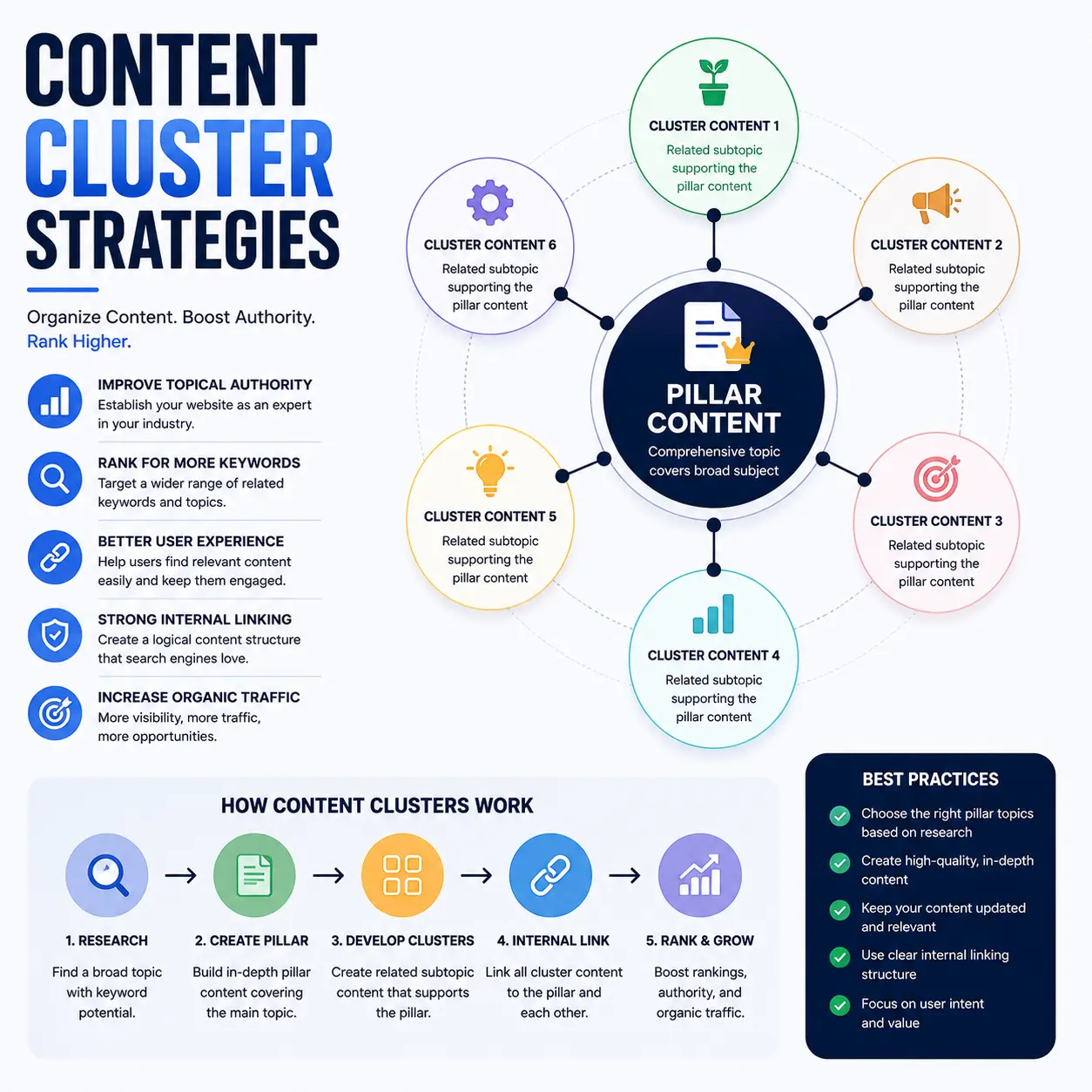
A content cluster strategy is a digital marketing and SEO approach that organizes a website's content into interconnected groups centered around specific, broad topics.
Key Takeaways
- Long tail keywords are specific, multi-word phrases indicating high user intent.
- A content cluster strategy involves a central pillar page linked to multiple cluster pages covering subtopics.
- This strategy builds topical authority and improves SEO performance for niche queries.
- Thorough keyword research is the foundation for identifying relevant long tail opportunities.
- Internal linking between pillar and cluster pages is critical for structure and SEO value.
- Monitor performance metrics to assess the effectiveness of your content cluster strategy.
Content Cluster vs Topic Cluster: What's the Difference?
There is no functional difference between a content cluster and a topic cluster. The two terms are completely interchangeable synonyms used by marketers to describe the exact same SEO framework. Whether you call it a content cluster, a topic cluster, or a hub-and-spoke model, the structure remains identical: one comprehensive pillar page surrounded by multiple subtopic pages that are tied together via internal linking.
Why Do Two Different Names Exist?
The minor variation in terminology comes down to branding and perspective:
- Topic Cluster: This term focuses on the SEO strategy and architecture. It was popularized by HubSpot in 2017 to emphasize shifting away from individual keywords and toward broad, authoritative topics.
- Content Cluster: This term focuses on the production and assets. It looks at the actual content creation process—grouping specific blog posts, articles, and landing pages together.
| Feature | Topic Cluster | Content Cluster |
|---|---|---|
| Core Concept | Organizing content by overarching subject matter. | Organizing content by overarching subject matter. |
| SEO Impact | Builds topical authority and structures internal links. | Builds topical authority and structures internal links. |
| Components | Pillar page, cluster content, internal links. | Pillar page, cluster content, internal links. |
Core Components of a Content Cluster
Every content cluster relies on three main parts working together:
- Pillar Page (The Hub): A comprehensive, long-form page that gives a broad overview of a main topic. It targets high-volume, competitive keywords.
- Cluster Content (The Spokes): Supporting blog posts or pages that dive deep into specific subtopics and target long-tail keywords.
- Internal Links (The Connections): Hyperlinks that tie the pages together. Every cluster page links to the pillar page, and the pillar page links back out to the cluster pages.
Why Use a Content Cluster Strategy?
- Builds Topical Authority: Publishing multiple connected pages proves to search engines like Google that your site has deep expertise in a subject.
- Improves Site Navigation: Users can easily find related information and subtopics without digging through unorganized pages.
- Strengthens SEO Rankings: Strategic internal linking shares ranking power (link equity) across all pages in the cluster and helps search engines crawl your site.
- Prevents Keyword Cannibalization: Grouping content by overarching topics ensures your individual pages do not compete against each other for the exact same search terms.
What are Long Tail Keywords and Content Clusters?
Long tail keywords are the backbone of targeted SEO. Unlike broad, high-volume terms (e.g., "shoes"), long tail keywords are specific and conversational (e.g., "best waterproof hiking boots for women with wide feet"). Their specificity means they often indicate a user closer to making a purchase or seeking very particular information. According to industry analysis, long tail searches account for a significant majority of total search queries, often exceeding 70% of all searches performed daily.
A content cluster is a group of interconnected web pages that comprehensively cover a broad topic. At its heart is a pillar page – a long-form, comprehensive piece of content that broadly covers a topic. Supporting this pillar page are cluster pages – individual blog posts or articles that delve deeply into specific subtopics related to the pillar. Crucially, all cluster pages link back to the pillar page, and the pillar page links out to relevant cluster pages. This structure creates a powerful topical map for search engines and users alike.
See our accompanying content cluster video of this post
Why Do Long Tail Keywords Matter?
Long-tail keywords matter because they target specific, high-intent user searches that drive higher conversion rates and face significantly less competition than broad terms. The advantage of long tail keywords lies in their intent. When a user searches for "how to fix a leaky faucet in a vintage clawfoot tub," their intent is clear. They are not casually browsing; they have a specific problem and are actively seeking a solution. This translates directly into higher conversion rates. Businesses that cater to these specific needs find that while the search volume for each individual long tail keyword might be low, the aggregate traffic and the quality of leads generated are exceptionally high.
Furthermore, long tail keywords are less competitive. Broad terms attract a vast array of established websites, making it difficult for newer or smaller sites to rank. By focusing on niche, long tail phrases, you can carve out a defensible position in search engine results pages (SERPs). This allows for quicker wins and builds momentum for your SEO efforts.
What is the Content Cluster Model?
The Content Cluster Model (or topic cluster model) is an SEO strategy where a central, broad pillar page links to multiple specific cluster pages, which all link back to the pillar to build subject authority.
Here are the core components:
- Pillar Page: This is the foundational piece of content. It's an extensive, in-depth resource that provides a broad overview of a primary topic. Think of it as a comprehensive guide or ultimate resource. Its purpose is to rank for the main, broader keyword associated with the topic, while also serving as a hub for more specific subtopics. A well-optimized pillar page might be 3,000-5,000 words or more, covering all essential aspects of the subject.
- Cluster Pages: These are individual articles or blog posts that explore specific subtopics mentioned in the pillar page in much greater detail. Each cluster page focuses on a particular long tail keyword or a tightly related group of keywords. For example, if the pillar page is about "digital marketing strategies," cluster pages might focus on "SEO for small businesses," "social media advertising ROI," "email marketing automation best practices," or "content marketing for lead generation."
The linking strategy is paramount. Each cluster page must link back to the pillar page, reinforcing its authority. Additionally, the pillar page should link out to its relevant cluster pages, guiding readers to explore related subtopics. This internal linking structure creates a semantic relationship between your content, signaling to search engines that you have a deep understanding of the overarching topic.

Topic Clusters vs. Traditional Keyword Targeting
| Dimension | Keyword-Centric SEO | Topic Cluster SEO |
|---|---|---|
| Core idea | Optimize individual pages around specific keywords | Build comprehensive coverage around a central topic |
| Primary focus | Keywords and search terms | Topics, entities, concepts, and user intent |
| Content structure | One main keyword → one page | Pillar page → multiple related cluster pages |
| Targeting approach | Often targets exact-match or closely related keywords | Targets a broader semantic field and multiple search intents |
| Example | Create a page targeting “best running shoes” | Build a running-shoes hub covering types, sizing, comparisons, care, and buying guides |
| Keyword strategy | Keyword-by-keyword | Topic-by-topic |
| Content depth | Can result in many narrowly focused pages | Encourages comprehensive topical coverage |
| Internal linking | Often page-to-page based on individual relevance | Deliberately links cluster content back to a central pillar and among related pages |
| Search intent | Usually mapped to a specific keyword | Mapped across informational, commercial, navigational, and transactional intents |
| Semantic relationships | Secondary consideration | Central to the strategy |
| Risk of content overlap | Higher if many similar keywords get separate pages | Lower when related keywords are consolidated into coherent topic architecture |
| Authority building | Builds authority around individual keywords/pages | Builds topical authority across an entire subject area |
| Scalability | Can become a large collection of disconnected pages | Creates an organized, scalable content ecosystem |
| Best suited for | Highly specific queries and straightforward SEO campaigns | Competitive niches requiring breadth, depth, and topical authority |
| Measurement | Rankings and traffic for individual keywords | Topic visibility, rankings across related queries, organic traffic, engagement, and conversions |
| Modern SEO alignment | Useful, but can be overly narrow when used alone | Generally better aligned with semantic search and comprehensive content strategies |
| Biggest advantage | Simple to plan and measure | Creates stronger topical coverage and a more interconnected site |
| Biggest drawback | Can lead to keyword cannibalization or thin/disconnected content | Requires more strategic planning and content investment |
The short version
Keyword-Centric SEO: “What keyword should this page rank for?”
Topic Cluster SEO: “How can our site become a comprehensive authority on this topic?”
In practice, the strongest strategy usually combines both: use keyword research to discover demand, then organize those keywords into meaningful topics and content clusters rather than treating every keyword as a completely separate page.
The Anatomy of an Effective Internal Linking Strategy
- Pillar-to-Spoke Links: How to contextually pass link equity downward.
- Spoke-to-Pillar Links: Signalling main authority pages to search crawlers.
- Anchor Text Best Practices: Avoiding over-optimization while maintaining relevance.
Step-by-Step Content Cluster Mapping Template
Building Your Content Cluster Strategy: A Step-by-Step Guide
Implementing a successful content cluster strategy for long tail keywords requires a methodical approach. It begins with thorough research and planning, followed by meticulous content creation and strategic linking.
Step 1: Comprehensive Keyword Research for Long Tail Opportunities
This is the bedrock of your strategy. You need to identify the broad topics you want to own and then drill down into the specific long tail keywords your target audience is using. See Keyword Research Techniques to Speed Up Your Site to learn more.
- Identify Broad Topic Pillars: What are the core areas of your business or expertise? Brainstorm 5-10 broad topics that align with your products, services, and audience's needs. For instance, if you sell sustainable fashion, your pillars might be "ethical sourcing," "eco-friendly materials," "slow fashion movement," and "sustainable wardrobe building."
- Utilize Keyword Research Tools: Employ tools like Ahrefs, SEMrush, Google Keyword Planner, or Moz Keyword Explorer. Look for keywords with decent search volume (even if it's just dozens or hundreds per month for long tail) and low to moderate competition. Pay close attention to "People Also Ask" sections and related searches on Google for inspiration.
- Analyze Search Intent: For each potential long tail keyword, understand why someone is searching for it. Are they looking for information (informational intent), comparing options (commercial investigation intent), or ready to buy (transactional intent)? Your content should align with this intent.
- Map Keywords to Potential Clusters: Group related long tail keywords together. These groups will form the basis of your cluster pages, with one overarching theme being selected for your pillar page. For example, "how to choose organic cotton t-shirts," "benefits of bamboo fabric clothing," and "recycled polyester vs. organic cotton" could all cluster under a broader pillar like "sustainable fashion materials."
Step 2: Crafting Your Pillar Page
The pillar page is your flagship content piece. It needs to be comprehensive, authoritative, and highly engaging.
- Depth and Breadth: Aim for a substantial word count (3,000-5,000+ words). Cover every facet of the main topic, providing actionable advice, definitions, examples, and insights.
- Structure and Readability: Use clear headings (H2s, H3s), bullet points, images, and perhaps even embedded videos to break up the text and improve readability. A table of contents is essential for longer pillar pages.
- Keyword Optimization: Naturally integrate your primary pillar keyword throughout the content, especially in the title, headings, introduction, and conclusion. Avoid keyword stuffing.
- Internal Linking: This is crucial. Include links to your planned cluster pages within the relevant sections of the pillar page. Ensure anchor text is descriptive and relevant to the cluster page's topic.
Step 3: Developing Supporting Cluster Pages
Each cluster page drills down into a specific long tail keyword or a tight cluster of related keywords.
- Focus and Specificity: Each cluster page should address a single, well-defined subtopic. For example, if your pillar is about "content marketing," a cluster page might be titled "10 Proven Strategies for Creating High-Converting Landing Pages."
- Keyword Targeting: Optimize each page for its specific long tail keyword(s). Ensure the keyword appears naturally in the title, headings, meta description, and body content.
- Value and Actionability: Provide in-depth information, practical tips, case studies, or tutorials. Answer the user's specific query thoroughly.
- Internal Linking: Critically, each cluster page must link back to the main pillar page. Use descriptive anchor text that clearly indicates the pillar page's topic. For instance, link back to your "content marketing" pillar page using anchor text like "learn more about content marketing."
Step 4: Strategic Internal Linking and Promotion
The interconnectedness of your content is what makes the cluster strategy work.
- Reinforce Topical Authority: Consistent internal linking between pillar and cluster pages signals to search engines that you have a deep and authoritative understanding of the topic. This helps distribute "link equity" (SEO value) throughout your content network.
- Improve User Navigation: Internal links guide users seamlessly from broad topics to specific details and back again, enhancing their experience and increasing time on site.
- Promote Your Content: Share your pillar and cluster pages on social media, via email newsletters, and through outreach to relevant publications. Consider repurposing content from your cluster pages into different formats (e.g., infographics, social media posts).
How do you Measure the Success of Your Content Cluster Strategy?
You measure the success of a content cluster strategy by tracking organic search performance, user engagement, and conversion metrics across both your pillar and subtopic pages.
Key Performance Indicators (KPIs) to Monitor
- Organic Traffic: Track overall organic traffic to your pillar page and its associated cluster pages. Look for increases in traffic to these specific URLs.
- Keyword Rankings: Monitor your rankings for both the broad pillar keyword and the specific long tail keywords targeted by your cluster pages. You should see improvements over time, especially for the long tail terms.
- Engagement Metrics: Analyze metrics like bounce rate, time on page, and pages per session for your pillar and cluster content. Improved engagement indicates that users find your content valuable and relevant.
- Conversion Rates: If your content is designed to drive conversions (e.g., sign-ups, purchases), track how effectively your pillar and cluster pages contribute to these goals. Long tail keywords often have higher conversion rates, so look for this trend.
- Backlinks: Monitor the number and quality of backlinks pointing to your pillar page. A strong pillar page can act as a magnet for external links, further boosting your authority.
Tools for Tracking Performance
- Google Analytics: Provides comprehensive data on website traffic, user behavior, and conversions.
- Google Search Console: Offers insights into keyword rankings, impressions, click-through rates, and any technical SEO issues affecting your pages.
- SEO Platforms (Ahrefs, SEMrush, Moz): These advanced tools offer in-depth keyword tracking, backlink analysis, competitor research, and site audit capabilities, essential for monitoring the health of your content clusters.
Case Study: A Sustainable Fashion E-commerce Site
Consider "EcoThreads," an online retailer specializing in sustainable apparel. They implemented a content cluster strategy focused on the broad topic of "ethical fashion."
Pillar Page: "The Ultimate Guide to Ethical Fashion: Your Source for Sustainable Style in 2026." This 4,500-word page covered definitions, history, benefits, certifications, and an overview of ethical brands. It targeted the broad term "ethical fashion."
Cluster Pages:
- "Understanding Organic Cotton Certifications: GOTS vs. OCS Explained" (long tail: "organic cotton certifications")
- "The Environmental Impact of Fast Fashion vs. Slow Fashion" (long tail: "fast fashion vs slow fashion impact")
- "How to Build a Sustainable Wardrobe on a Budget" (long tail: "build sustainable wardrobe budget")
- "Fair Trade Clothing Brands: Ensuring Ethical Labor Practices" (long tail: "fair trade clothing brands")
Results: Within six months, EcoThreads saw a 40% increase in organic traffic to their "ethical fashion" content hub. Their rankings for the targeted long tail keywords improved significantly, with several cluster pages ranking in the top 3. Importantly, they observed a 25% increase in conversions originating from this content, demonstrating the power of niche targeting. The pillar page also attracted several high-authority backlinks, further solidifying its position. This success underscores the effectiveness of a well-executed content cluster strategy for long tail keywords.
What are Some Content Cluster Tactics and Considerations?
Once your foundational content clusters are in place, consider these advanced strategies to maximize their impact.
Topic Authority and E-E-A-T
In 2026, search engines place immense value on Expertise, Experience, Authoritativeness, and Trustworthiness (E-E-A-T). A robust content cluster strategy naturally builds these signals. By consistently publishing comprehensive, well-researched content on related subtopics, you demonstrate deep expertise and authority within your niche. Ensure your content is factually accurate, cites credible sources, and is written or reviewed by subject matter experts where appropriate. For instance, citing statistics from reputable organizations like the World Health Organization on health-related topics, or reports from established bodies like the International Labour Organization on labor practices, significantly bolsters trustworthiness.
Leveraging User-Generated Content (UGC)
Incorporate reviews, testimonials, and Q&A sections within your pillar and cluster pages. This adds a layer of authenticity and social proof, enhancing E-E-A-T. Encourage users to share their experiences with your products or services related to the topic.
Video and Multimedia Integration
Embed relevant videos, infographics, and interactive elements within your content. Video content, in particular, can significantly increase engagement and time on page. Search engines are increasingly indexing video content, so optimizing your video titles and descriptions is also crucial.
Transform Your Content Strategy for 2026
Custom SEO Solutions
Align your site’s architecture with search algorithm standards to drive targeted growth.
View SEO StrategiesRegular Content Audits and Updates
The digital world evolves rapidly. Schedule regular content audits (e.g., quarterly or bi-annually) to identify outdated information, broken links, or underperforming content. Update your pillar and cluster pages with the latest data, trends, and insights to maintain their relevance and search engine ranking potential. This continuous improvement is key to long-term success.
Conclusion: Owning Your Niche with Content Clusters
Implementing a content cluster strategy for long tail keywords is not merely a tactic; it's a comprehensive approach to content marketing that builds topical authority, attracts highly qualified traffic, and drives meaningful conversions. By focusing on the specific needs and queries of your audience, you can establish your website as the go-to resource in your niche. The structure of pillar pages supported by detailed cluster pages creates a powerful, interconnected web of information that benefits both users and search engines. In 2026, this strategic investment in targeted content is essential for sustainable growth and market leadership.
Frequently Asked Questions
What is the primary benefit of using a content cluster strategy for long tail keywords?
The primary benefit is establishing strong topical authority in a specific niche, which leads to higher rankings for both broad and specific keywords, attracting more qualified organic traffic and improving conversion rates due to the precise nature of long tail search intent.
How many cluster pages should support a pillar page?
There's no strict number, but a good guideline is to have at least 5-10 cluster pages for a comprehensive pillar page. The goal is to cover all significant subtopics related to the main pillar topic in sufficient depth.
Can this strategy be applied to any industry?
Yes, the content cluster strategy for long tail keywords is highly adaptable and can be effectively applied across virtually any industry, from e-commerce and SaaS to B2B services and informational websites, provided thorough keyword research is conducted.
How long does it typically take to see results from a content cluster strategy?
Results can vary, but typically, significant improvements in rankings and traffic can be observed within 3-6 months, with continued growth and authority building over 12 months and beyond. Consistency in content creation and updates is key.
What role do external backlinks play in a content cluster strategy?
External backlinks to your pillar page are crucial. They significantly boost the authority of the pillar page, which in turn positively impacts the rankings of its associated cluster pages. High-quality backlinks signal to search engines that your content is valuable and trustworthy. For more on link building, resources like SEMrush's guide offer valuable insights.
Should I update old content as part of this strategy?
Absolutely. Regularly auditing and updating existing content to align with your content cluster structure, refresh information, and ensure it targets relevant long tail keywords is a vital part of maintaining and improving your topical authority and search rankings.
About the Author

Brian Keary
Founder & Lead Developer
Brian is the founder of BKThemes with over 20 years of experience in web development. He specializes in WordPress, Shopify, and SEO optimization. A proud alumnus of the University of Wisconsin-Green Bay, Brian has been creating exceptional digital solutions since 2003.
Expertise
Writing since 2003