What is Semantic SEO?
Semantic SEO is the practice of optimizing content to align with search engine understanding of entities, topical relationships, and user intent. By moving beyond keyword-matching to context-based optimization, businesses can improve their visibility in Google's Knowledge Graph and search results. This article examines five case studies demonstrating how semantic strategies drive measurable organic growth.
To learn more about what semantic seo is and how to use it effectively, visit our comprehensive guide on frequently asked questions about semantic SEO. We go in detail on the mechanisms and best practices for how search engines interpret and rank semantically optimized content.
Case Study 1: Low-Traffic Website Recovery — 500% Organic Growth in 6 Months
Challenge
A client’s website had minimal organic visibility and poor topical structure, resulting in negligible traffic and keyword rankings.
Semantic SEO Strategy Implemented
- Topical Mapping & Clustering: Rebuilt the website using a semantic hub-and-spoke architecture, where each pillar page connected to related subtopics.
- Entity Linking: Content was optimized to align with relevant entities (industries, services, regions) recognized by Google’s Knowledge Graph.
- Structured Data Implementation: Added Article, FAQ, and Organization schema for contextual reinforcement.
- Intent-Based Content Rewrite: Pages were restructured to answer searcher questions at different funnel stages.
Results
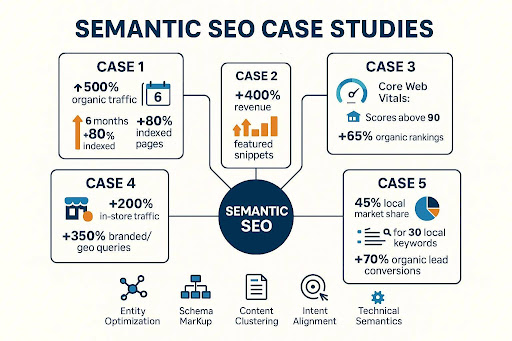
- +500% organic traffic growth in just six months.
- 80% increase in indexed pages.
- Improved engagement metrics and higher time on site.
Key Takeaway
A structured semantic content strategy, reinforced by schema and topical depth, can revive even the most stagnant websites. For the full breakdown, see the case study where we gained 500% Organic Growth.
Case Study 2: Fashion Company E-Commerce SEO — 400% Revenue Increase
Fashion Company SEO Challenge
A fashion retailer’s SEO was heavily product-focused, lacking thematic context or entity-based relevance. Organic conversions remained stagnant.
Fashion Company Semantic SEO Strategy Implemented
- Semantic Keyword Expansion: Targeted contextual search queries like “sustainable fabrics” and “seasonal fashion trends” instead of isolated product terms.
- Content Hub Creation: Developed a “Fashion Insights” hub interlinking blogs, lookbooks, and product pages.
- Product Schema Enhancement: Enriched listings with structured product data for visibility in Google Shopping and Discover.
- UX + Semantic Markup Integration: Optimized on-page hierarchy for both readability and semantic structure.
Fashion Company SEO Results
- +400% increase in organic-driven revenue.
- +250% growth in long-tail keyword rankings.
- Multiple featured snippets and “People Also Ask” placements.
Fashion Company SEO Key Takeaway
Semantic SEO transforms e-commerce performance by merging intent-driven storytelling with structured product visibility. You can view the full Fashion Company E-commerce SEO case study where we gained a 400% revenue increase.
Need some tips on optimizing for semantic SEO? Read our comprehensive guide to enhance your website's semantic structure and improve search visibility.
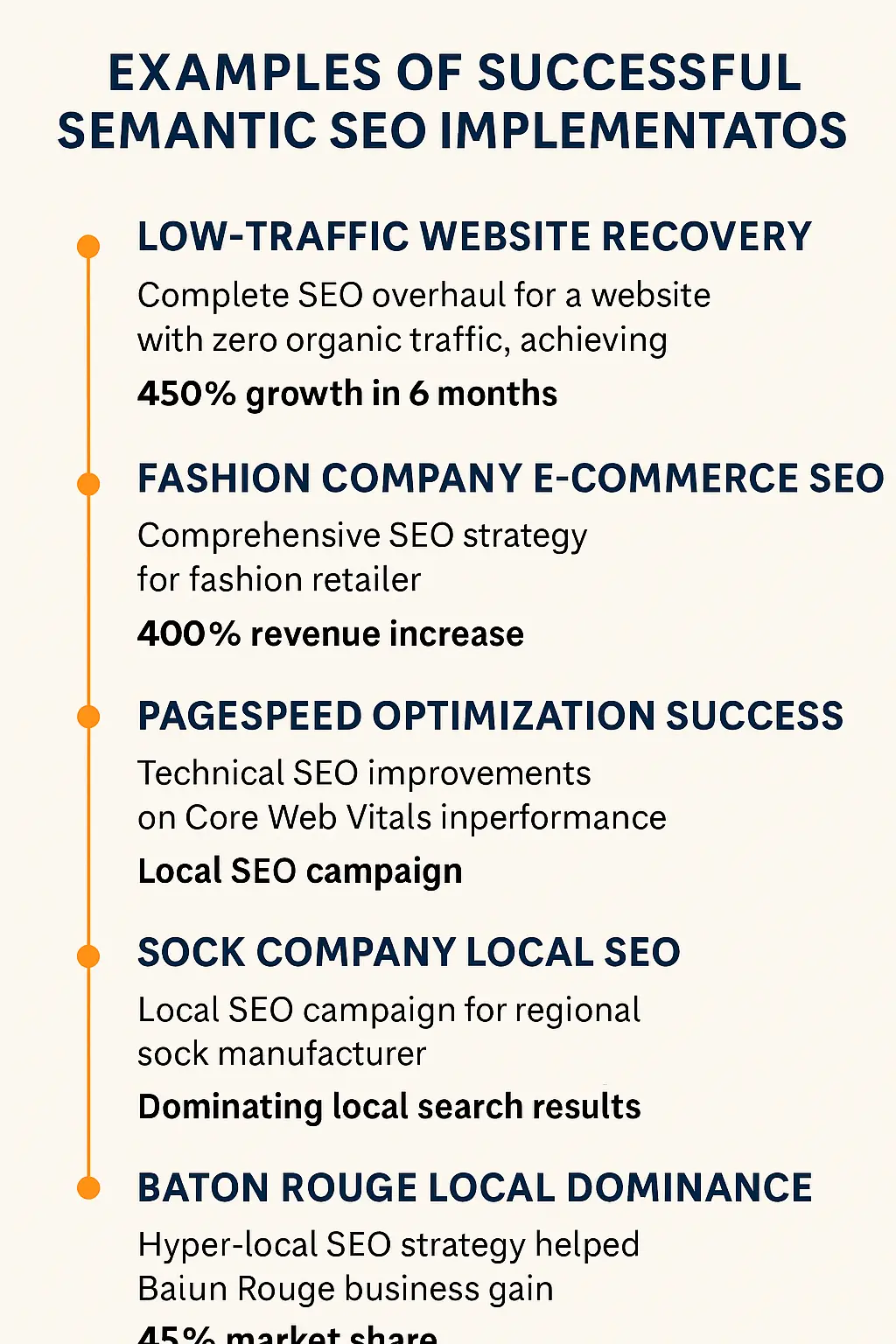
Case Study 3: PageSpeed Optimization Success — Semantic Technical SEO
PageSpeed Optimization Challenge
A client’s slow website suffered from poor Core Web Vitals, resulting in decreased rankings and user engagement.
PageSpeed Optimization Semantic SEO Strategy Implemented
- Comprehensive Technical SEO Audit: Identified performance bottlenecks and crawl inefficiencies.
- Semantic HTML5 Implementation: Used logical tags (<header>, <section>, <main>) to enhance machine readability and page context.
- Core Web Vitals Optimization: Improved LCP, CLS, and FID scores using best practices for rendering and resource loading.
- Schema Validation: Ensured structured data consistency with page semantics.
PageSpeed Optimization Results
- Core Web Vitals scores above 90 across all pages.
- +65% improvement in organic rankings.
- Lower bounce rates and improved session duration.
PageSpeed Optimization Key Takeaway
Technical SEO and semantic structure are inseparable — aligning HTML semantics with site performance builds stronger SEO foundations. Our poor core web vitals case study shows how that alignment improved both UX and rankings.
Case Study 4: Sock Company Local SEO — Dominating Local Search
Sock Company Local SEO Challenge
A regional sock manufacturer struggled to rank locally despite a strong community presence and a well-established offline brand.
Sock Company Local SEO Semantic SEO Strategy Implemented
- Local Entity Definition: Deployed LocalBusiness and Product schema to clarify location and offerings.
- Localized Semantic Content: Created content targeting city-specific and intent-based searches (e.g., “buy cotton socks in [city]”).
- Google Business Profile Optimization: Synchronized structured data with GBP categories, Q&A, and reviews.
- Local Backlink Building: Gained mentions on local media and directories to boost entity recognition.
Sock Company Local SEO Results
- Dominated local SERPs and Google Map Pack rankings.
- 200% increase in in-store traffic from organic search.
- +350% increase in branded and geo-specific queries.
Sock Company Local SEO Key Takeaway
Semantic local SEO, grounded in entity-based optimization and schema, drives regional brand authority and foot traffic. Read the full case study where we dominated local search.
Case Study 5: Baton Rouge Local Dominance — 45% Market Share Growth
Baton Rouge Local SEO Challenge
A Baton Rouge business faced stiff competition for high-value local keywords and needed to establish authority within a limited geographic area.
Baton Rouge Local SEO Semantic SEO Strategy Implemented
- Geo-Semantic Optimization: Created Baton Rouge–centric content around services, news, and FAQs.
- Structured Data for Local Intent: Used Service and LocalBusiness schemas for enhanced geographic clarity.
- Entity Reinforcement via Citations: Ensured consistent NAP and local backlinks to validate entity signals.
- Topical Content Expansion: Added long-form local guides addressing user pain points tied to Baton Rouge.
Baton Rouge Local SEO Results
- 45% increase in local market share.
- Top-3 positions for over 30 local high-intent keywords.
- 70% increase in organic lead conversions.
Baton Rouge Local SEO Key Takeaway
Hyper-local semantic SEO enables small businesses to compete with — and even surpass — larger competitors through precision entity optimization. The full local seo case study where we gained a 45% Market Share Growth shows how we outperform local markets.
Key Insights Across All Case Studies
| Semantic SEO Principle | Implementation Approach | Observed Outcome |
|---|---|---|
| Entity Optimization | Mapping content to recognized entities in Google’s Knowledge Graph. | Improved contextual relevance and ranking stability. |
| Schema Markup | Article, Product, FAQ, LocalBusiness, and Service schemas. | Enhanced visibility in SERP rich results. |
| Content Clustering | Organized topics into pillar and cluster structures. | Strengthened topical authority and user navigation. |
| Intent Alignment | Content tailored to user journey stages. | Higher conversions and engagement. |
| Technical Semantics | Core Web Vitals and semantic HTML alignment. | Faster load speeds and better UX signals. |
Frequently Asked Questions (FAQs)
They are excellent starting points.
Conclusion
The five BKThemes.Design case studies prove that semantic SEO isn’t just theory — it’s a measurable growth engine. From reviving low-traffic sites and scaling e-commerce brands to dominating local markets, semantic SEO integrates meaning, data, and user intent to create lasting results.
Whether you’re optimizing for a global audience or a single city, the path to higher rankings now runs through semantic clarity — where every piece of content, link, and schema element works together to tell a coherent, machine-understandable story.
Semantic SEO isn’t just the future — it’s the new standard for intelligent, sustainable digital visibility.
About the Author

Brian Keary
Founder & Lead Developer
Brian is the founder of BKThemes with over 20 years of experience in web development. He specializes in WordPress, Shopify, and SEO optimization. A proud alumnus of the University of Wisconsin-Green Bay, Brian has been creating exceptional digital solutions since 2003.
Expertise
Writing since 2003