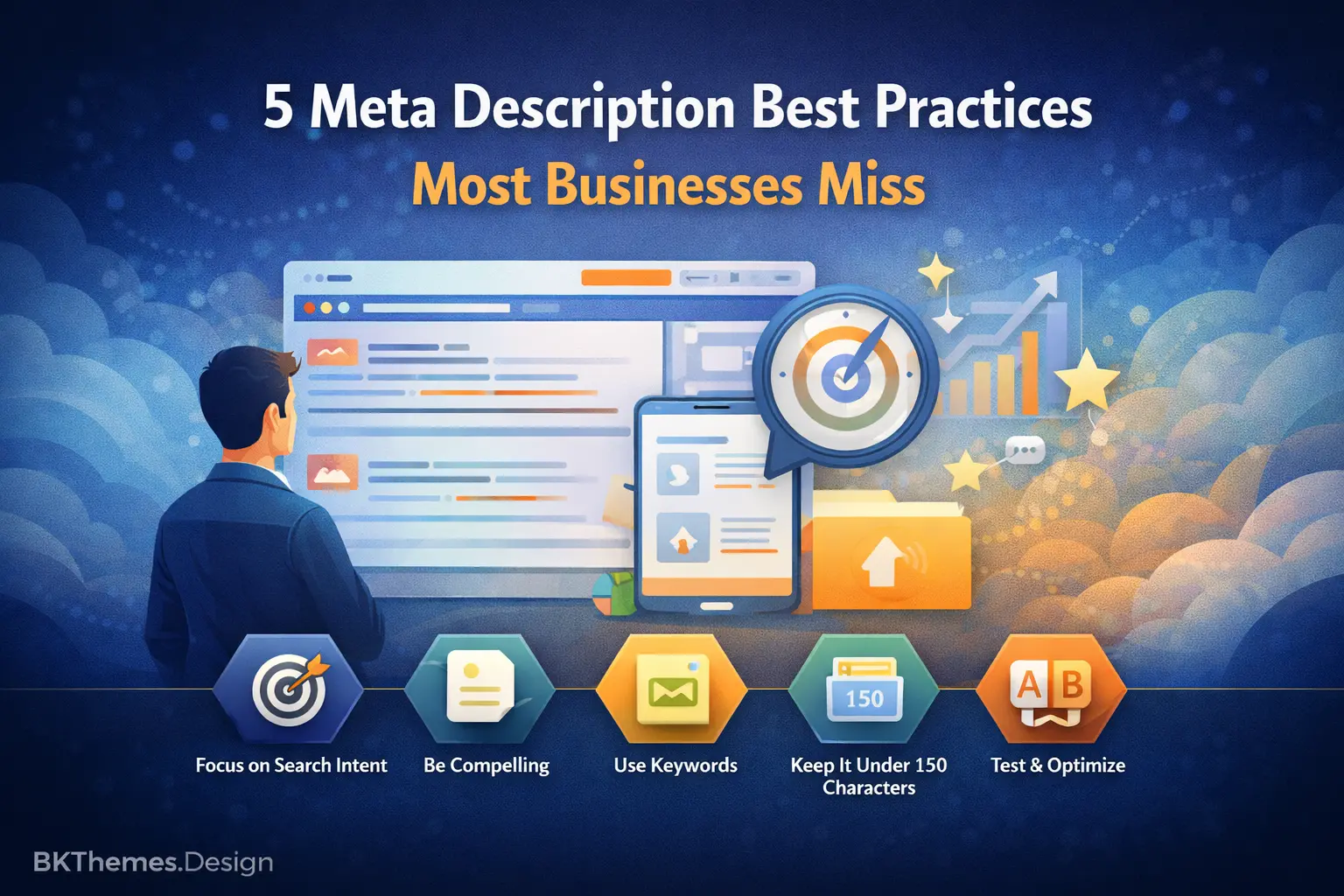
Why your 155-character snippet matters more than you think—and the common mistakes killing your click-through rates
Learn the meta description best practices that actually drive clicks, plus the costly mistakes most small businesses make. Discover why Google rewrites 63% of descriptions and how to write ones that stick.
TL;DR
- Match search intent first - Write descriptions that address the searcher's problem before describing your page. Generic company descriptions don't convert.
- Front-load within 120 characters - Put your core message in the first 120 characters since mobile and some desktop displays truncate earlier than 155.
- Build 3-5 reusable templates - Create consistent structures for different page types (services, comparisons, content) with variable slots for specifics.
- Include one concrete proof point - Numbers, timeframes, or credentials ("1,000+ projects," "Since 2015") outperform generic superlatives every time.
- Write human-first, verify keywords second - Readable descriptions that get clicked beat keyword-stuffed descriptions that get ignored.
The Meta Description Paradox: Why Most Small Businesses Get It Wrong
Here's an uncomfortable truth about meta description best practices: Google rewrites meta descriptions almost 63% of the time for top-ranking pages. Even more surprising, 25% of top-ranking pages don't have a meta description at all.
So why bother? Because when Google does use your meta description, it becomes your 155-character sales pitch in a crowded search results page. For small business owners competing against larger competitors, that snippet determines whether someone clicks your result or scrolls past it.
The problem isn't that businesses ignore meta descriptions. It's that they treat them as an afterthought, stuffing keywords or copying the same template across every page. Meanwhile, almost 41% of top-10 pages have meta descriptions that get truncated because they're too long.
Meta descriptions aren't a direct SEO ranking factor. But they directly influence click-through rates, which signals to Google that your content matches search intent. That indirect effect on SEO ranking factors makes them worth getting right.
What This Guide Delivers
This guide targets small business owners and marketing managers who lack dedicated SEO teams but need measurable improvements in search visibility. You won't find generic advice about "writing compelling copy" here. If you want a live example of SEO execution tied to better lead quality, see our software development company SEO case study.
We're excluding technical SEO audits, backlink strategies, and content creation frameworks. This is specifically about the 155 characters that appear below your title in search results.
You'll walk away with five actionable meta description best practices that contrast effective approaches with the common mistakes that hurt your click-through rates. Each practice includes specific examples and implementation guidance you can apply today.
How We Selected These Practices
We evaluated meta description strategies based on three criteria: measurable impact on CTR, alignment with current Google behavior patterns, and practical implementation for resource-constrained teams. Practices that required enterprise tools or extensive testing budgets were excluded in favor of approaches that any small business can implement immediately.
1. Match Search Intent Before Writing a Single Word
Why Search Intent Matters
Most businesses write meta descriptions that describe their page. That's backwards. Your meta description should describe the outcome the searcher wants. As SalesHive notes, "Your snippet isn't there to 'get traffic,' it's there to pre-sell the right buyer and make the click feel inevitable."
The common mistake: writing the same generic company description for every page. This ignores that someone searching "WordPress speed optimization" has a different intent than someone searching "WordPress developer near me."
What Search Intent-Matched Meta Descriptions Look Like Today
Effective meta descriptions in 2025 acknowledge the searcher's problem before presenting the solution. They use language that mirrors how your target audience describes their challenges, not industry jargon.
For a page about on-page SEO essentials, an intent-matched description might read: "Struggling with low search visibility? Learn the 7 on-page fixes that moved our clients from page 3 to page 1 in 90 days."
How to Apply Search Intent Matching
Before writing, search your target keyword and read the top 5 results' meta descriptions. Identify the common promise they make. Then differentiate by being more specific about the outcome or the method. Avoid matching their exact language, as that creates a sea of sameness where no result stands out.
2. Respect the 155-Character Ceiling (But Optimize for 120)
Why Character Limits Matter
Google displays roughly 120-155 characters depending on device and display format. Write 180 characters, and your most important message might get cut off with an ellipsis. That truncation often removes your call-to-action or key differentiator.
The common mistake: treating 155 characters as a target rather than a maximum. Writers pad descriptions with filler words to hit the limit, diluting the message.
What Character Limit Awareness Looks Like Today
Smart practitioners front-load their value proposition in the first 120 characters, then add supporting detail that can be truncated without losing the core message. This approach works for improving click-through rates across both mobile and desktop.
Mobile displays show fewer characters. If your mobile traffic exceeds 50% (check your analytics), optimize for 120 characters as your primary target.
How to Apply Character Limit Awareness
Write your meta description, then read only the first 120 characters aloud. Does it make sense? Does it compel action? If not, restructure so your primary message lands within that window. Use the remaining 35 characters for secondary benefits or specificity.
3. Build Reusable Templates for Consistency at Scale
Why Templates Matter
Small businesses often have dozens or hundreds of pages. Writing unique meta descriptions for each page from scratch isn't realistic. But leaving them blank or auto-generating from page content produces generic snippets that don't convert.
The common mistake: copying the same meta description across multiple pages, or worse, leaving the CMS default in place.
What Template Usage Looks Like Today
SalesHive recommends building 3-5 reusable meta description templates for different page types: problem-solving content, comparison pages, service pages, and pricing pages. Each template has a consistent structure with variable slots for specific details.
Example template for service pages: "[Specific problem] slowing your [business type]? Our [service] delivers [specific outcome] in [timeframe]. [Credibility marker]."
How to Apply Template Usage
Audit your site and categorize pages by type. Create one template per category. For each template, identify which elements stay constant (structure, tone) and which vary (specific outcomes, timeframes, credibility markers). Document these in a shared file your team can reference. For detailed guidance on auditing your existing meta descriptions, see our on-page deep dive on auditing titles and meta descriptions.
4. Include One Specific Proof Point
Why Specific Proof Points Matter
Generic claims like "best service" or "top quality" appear in thousands of search results. They're invisible. Specific proof points, such as numbers, timeframes, or credentials, create pattern interrupts that catch the eye.
The common mistake: using superlatives ("best," "leading," "top-rated") that every competitor also claims, making your result indistinguishable.
What Specific Proof Points Look Like Today
Effective meta descriptions in 2025 include at least one concrete detail: "1,000+ projects completed," "Average 40% speed improvement," or "Since 2015." These specifics build credibility in a format where trust must be established in seconds.
This approach aligns with title tag optimization principles, as both elements work together to establish credibility before the click.
How to Apply Specific Proof Points
Identify 3-5 proof points your business can claim: project counts, years in business, client ratings, specific results achieved, certifications held. Rotate these across your meta descriptions based on what's most relevant to each page's topic. A page about on-page SEO techniques might emphasize results achieved, while a services page might highlight experience.
5. Write for Humans, Then Verify Keyword Presence
Why Writing for Humans Matters
Google bolds search terms that appear in meta descriptions, creating visual emphasis that draws the eye. But keyword-stuffed descriptions read awkwardly and reduce click-through rates. The balance matters.
The common mistake: writing keyword-first descriptions that read like "Meta description best practices for SEO ranking factors and title tag optimization services." Technically optimized, practically useless.
What Human-First Meta Descriptions Look Like Today
The Timmermann Group advises: "Write compelling copy that accurately represents what's on the page." Start with a human-readable sentence that would make sense in a conversation. Then check if your primary keyword appears naturally. If not, adjust the phrasing without forcing it.
Remember that meta descriptions influence SEO ranking factors indirectly through CTR. A description that gets clicked beats a description that contains every keyword but gets ignored.
How to Apply Human-First Writing
Write your meta description without thinking about keywords. Read it aloud. Does it sound like something a real person would say? Good. Now check if your primary keyword appears. If it doesn't fit naturally, that's acceptable. Google will bold related terms and synonyms. Prioritize clarity over keyword density every time.
The Patterns Across These Practices
Three themes connect these meta description best practices. First, specificity beats generality at every turn. Whether it's matching precise search intent, including concrete proof points, or respecting exact character limits, vague approaches lose to targeted ones.
Second, systems outperform one-off efforts. Templates, documented proof points, and consistent audit processes create sustainable results that don't depend on inspiration or time availability.
Third, user experience drives SEO outcomes. Meta descriptions that prioritize readability and genuine value propositions outperform those optimized purely for search engines. Google's algorithm increasingly rewards content that satisfies users, making this alignment more important than ever.
Where to Start With Limited Resources
Don't attempt all five practices simultaneously. Start with practice #3 (building templates) because it creates a foundation for everything else. Once you have templates, applying the other practices becomes faster.
If you have existing pages with poor meta descriptions, prioritize your highest-traffic pages first. Check Google Search Console for pages with high impressions but low CTR. Those represent the biggest opportunities for improvement with minimal effort.
For businesses with fewer than 50 pages, manually reviewing and updating each meta description is realistic. For larger sites, focus on category pages and top-performing content first, then systematically work through the rest.
Frequently Asked Questions
About the Author

Brian Keary
Founder & Lead Developer
Brian is the founder of BKThemes with over 20 years of experience in web development. He specializes in WordPress, Shopify, and SEO optimization. A proud alumnus of the University of Wisconsin-Green Bay, Brian has been creating exceptional digital solutions since 2003.
Expertise
Writing since 2003