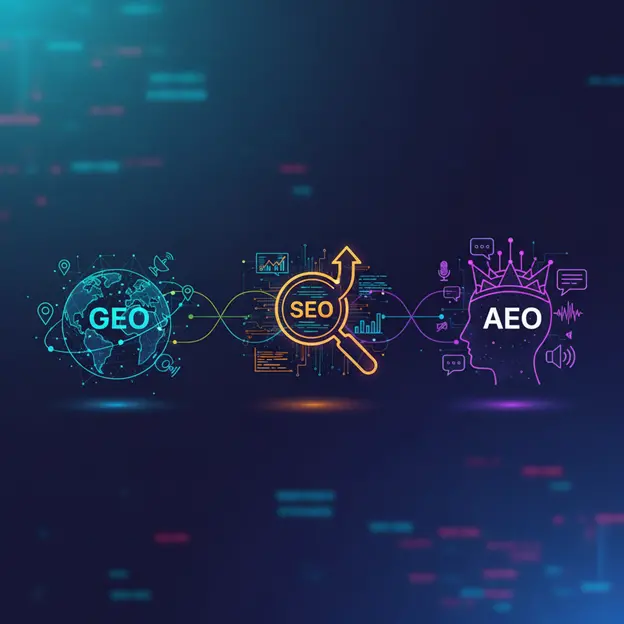
Search Engine Optimization (SEO), Generative Engine Optimization (GEO), and Answer Engine Optimization (AEO) are distinct yet interconnected strategies crucial for modern digital visibility. This guide clarifies their differences, explores their synergies, and provides an authoritative framework for building a comprehensive digital strategy. Understanding how these pillars integrate is essential for a future-proof online presence.
While they are distinct, their interrelationship is paramount. This article aims to clarify the often-confused distinctions and synergies of AEO, GEO, SEO, and what the differences are, providing an authoritative guide for building a comprehensive digital strategy.
If you're specifically fixing NAP consistency and citation coverage, start with Local citations and how to use them to boost local SEO.
Understanding the individual principles of each – Search Engine Optimization (SEO), Generative Engine Optimization (GEO), and Answer Engine Optimization (AEO) – is no longer sufficient. True mastery lies in recognizing how these pillars integrate to form an impenetrable fortress of online presence. We will delve into each concept, compare its objectives, and ultimately illustrate how a harmonized approach is the bedrock of future-proof digital success. Prepare to gain insights that will refine your approach to search, helping you not just rank, but truly resonate with your target audience.
If you need implementation sequencing, use Mastering the Trifecta: Complete Guide to AEO, GEO, and SEO. If your goal is tactical visibility in AI overviews, use How to Rank Content in AI Overviews: Strategies for 2026.

What is Search Engine Optimization (SEO) and Why is it the Foundation of Digital Visibility?
At its heart, Search Engine Optimization (SEO) is the practice of increasing the quantity and quality of traffic to your website through organic search engine results. For over 30 years, SEO has been the cornerstone of digital marketing, evolving from a simple keyword stuffing tactic to a sophisticated discipline focused on user experience, technical excellence, and valuable content creation. It's about ensuring your website is discoverable by search engines and, more importantly, by potential customers actively looking for your products, services, or information.
What are the Core Pillars of Modern SEO?
- On-Page SEO: This involves optimizing elements on your actual website. This includes creating high-quality, relevant content, optimizing title tags, meta descriptions, header tags (H1, H2, etc.), image alt text, URL structures, and internal linking. The goal is to signal to search engines what your page is about and how it provides value to users.
- Off-Page SEO: These are actions taken outside of your website to impact your rankings. The most prominent off-page factor is backlinks – links from other reputable websites to yours. Other factors include social media marketing, local citations, and brand mentions. These signals tell search engines about your website's authority, trustworthiness, and popularity.
- Technical SEO: This refers to optimizing the technical aspects of your website to help search engines crawl, index, and render your site effectively. Key elements include site speed, mobile-friendliness, site architecture, XML sitemaps, robots.txt, canonicalization, and structured data implementation. A technically sound website is a prerequisite for any successful SEO campaign.
- Content SEO: This pillar emphasizes creating and distributing valuable, relevant, and consistent content to attract and retain a clearly defined audience. It's about answering user questions, solving their problems, and establishing authority in your niche through blog posts, articles, videos, infographics, and more.
The overarching goal of SEO is to improve organic search rankings, leading to increased visibility, traffic, and ultimately, conversions. It’s a long-term investment that builds brand equity and establishes a consistent stream of qualified leads. Without a solid SEO foundation, efforts in GEO and AEO will often fall short of their potential, highlighting why SEO remains the bedrock of digital strategy. The Google Search Essentials (formerly known as the Webmaster Guidelines) serve as the foundational blueprint for Search Engine Optimization (SEO). Because Google dominates global search traffic, these guidelines represent the official "rules of the game" directly from the source.
What is Generative Engine Optimization (GEO)?
Generative Engine Optimization (GEO) is the practice of optimizing content so that artificial intelligence models and conversational search engines (such as Google AI Overviews, ChatGPT, and Perplexity) cite and recommend your brand in their generated responses.
While traditional SEO focuses on ranking high in a list of website links, GEO focuses on winning visibility within AI-synthesized summaries where users often get answers without clicking through to a traditional webpage.
How GEO Works
Instead of matching exact keywords, AI engines use Large Language Models (LLMs) to understand user intent and synthesize answers from multiple sources. GEO strategically structures your content so these models find it highly credible and easy to cite.
Key optimization techniques include:
- Authoritative Statistics: Including hard data, unique metrics, and direct data points makes content highly attractive to AI models looking to back up claims.
- Source Citation & Expertise: Clear author bios, structured schema markup, and verifiable expert quotes build the algorithmic trust needed for an AI to quote you.
- Direct & Conversational FAQs: Formatting content to directly answer "Who, What, Why, and How" questions matches the natural conversational style users employ when prompting AI.
- Information Density: Removing filler and ensuring every paragraph provides immediate, high-value facts helps models scrape and summarize your pages easily.
GEO vs. Traditional SEO
The shift from traditional search engines to generative engines changes how digital visibility is measured and achieved:
| Optimization Metric | Traditional SEO | Generative Engine Optimization (GEO) |
|---|---|---|
| Primary Goal | High rankings on Search Engine Result Pages (SERPs) | Inclusion in AI-generated answers and summaries |
| User Action | Clicks on a link to visit a website | Reads synthesized text; may click inline source citations |
| Content Focus | Keyword density, search volume, and backlink authority | Contextual relevance, unique statistics, and explicit facts |
| Discovery Mechanism | Crawler bots indexing text and link equity | LLMs scraping, training on, or fetching real-time data |
What are the Key Components of an Effective GEO Strategy?
An effective Generative Engine Optimization (GEO) strategy is built on a multi-layered framework designed to make your content discoverable, digestible, and authoritative for Large Language Models (LLMs). Unlike traditional SEO, which optimizes for search engine crawlers, GEO builds trust with Retrieval-Augmented Generation (RAG) systems that pull real-time data to answer user prompts.
The key components of a successful GEO strategy are categorized into four core pillars:
1. Content Engineering & Formatting
AI engines do not read content like humans; they prioritize machine-readable extractability. Content must be structured so that an AI can easily chunk, analyze, and re-use it.
- "Answer-First" Architecture: Place a direct, concise summary or answer block at the very top of pages or directly below headers before diving into long-form explanations.
- Data Density & Statistics: According to foundational research, including hard data, metrics, and unique statistics significantly increases an AI's likelihood of citing your content.
- FAQ Ecosystems: Maintain dedicated Q&A sections that explicitly match natural language user prompts (e.g., "How do I calculate...") rather than isolated keywords.
- Scannable Layouts: Heavily utilize bolded lead phrases, comprehensive bulleted summaries, and comparison tables. AI engines frequently transform these straight into their structured summaries.
2. Technical Accessibility & Entity Clarity
If an AI bot cannot easily index your site or verify who you are, it will look elsewhere for information.
- Entity Mapping: Shift focus from keywords to entities (e.g., matching Your Brand Name + Location + Concrete Specialization) so AI models map your business into their internal knowledge graphs.
- Deep Schema Implementation: Use advanced structured data—such as Organization, Product, FAQPage, and Article schema—to pass explicit context straight to the LLM.
- Bot Accessibility Audit: Ensure your robots.txt explicitly allows access to AI-specific user agents (like OpenAI's GPTBot, PerplexityBot, or Google-Extended) and that your HTML renders cleanly without JavaScript barriers.
3. Authority & "Borrowed" Trust Signals
Because LLMs synthesize answers from multiple sources, your off-site digital footprint matters as much as your own website.
- E-E-A-T Realization: Strongly emphasize Experience, Expertise, Authoritativeness, and Trustworthiness. This means featuring clear, named authors with verifiable digital footprints and citing your own credible external sources.
- Community & Earned Media Coverage: AIs actively read user-generated spaces like Reddit, YouTube transcripts, and third-party review platforms (like G2 or TripAdvisor). Building a positive sentiment presence on these platforms directly influences the AI’s brand recommendation rates.
- Digital PR & Mentions: High-authority backlinks and unlinked brand mentions act as vital trust signals, telling the AI that your organization is an industry source of truth.
4. Prompt Architecture & Measurement
Traditional click-through rates and keyword rank tracking are insufficient for measuring generative search visibility.
- Intent Auditing: Actively test how primary AI search engines (like ChatGPT, Perplexity, and Google AI Overviews) respond to various conversational prompts in your niche.
- GEO KPIs: Shift tracking toward new metrics like AI Citation Rate (how often your site is a linked footnote), Share of Voice (SoV) inside AI text summaries, and brand mention frequency.
What is Answer Engine Optimization (AEO)?
Answer Engine Optimization (AEO) represents a modern paradigm shift in search. It moves beyond simply providing a list of relevant websites and focuses on directly answering a user's question, often without requiring them to click through to a webpage. This phenomenon has gained prominence with the rise of voice search, virtual assistants (Siri, Alexa, Google Assistant), and the increasing sophistication of search engines in understanding natural language queries and providing featured snippets, knowledge panels, and direct answers.
To get found in the AI overviews we have many packages available.
What are the Key Drivers and Components of AEO?
- Voice Search: Users performing voice searches tend to ask full questions and expect direct, concise answers. AEO helps optimize content to be the definitive answer for these queries.
- Featured Snippets (Position 0): These highly coveted organic search results display a summary of an answer extracted from a webpage, directly at the top of the SERP, often above the #1 organic result. AEO strategies are heavily geared towards earning these snippets.
- Knowledge Panels and Knowledge Graph: These rich information boxes provide encyclopedic details about entities (people, places, organizations) directly on the SERP, often powered by structured data and Google's understanding of relationships between entities.
- Structured Data (Schema Markup): Implementing schema markup on your website helps search engines understand the context and meaning of your content. This machine-readable data makes it easier for search engines to extract specific information and present it in rich results, which are crucial for AEO. Examples include FAQ schema, How-To schema, Product schema, and Review schema.
- Semantic Search and User Intent: AEO requires a deep understanding of user intent behind queries, not just keywords. It’s about anticipating the questions users might ask and providing comprehensive, authoritative answers in a clear, concise format, often using natural language.

Voice search and AI assistants drive AEO, prioritizing direct, concise answers to user queries.
AEO fundamentally shifts the focus from ranking for keywords to providing the single best answer to a question. It means structuring your content so that search engines can easily identify and present the most relevant information. In an increasingly conversational and instantaneous search landscape, AEO ensures your business is the source of truth, directly addressing user needs and capturing attention even before a click occurs.
Modern Architecture: Retrieval-Augmented Generation (RAG) Pipelines
Behind modern answer engines and conversational search platforms lies Retrieval-Augmented Generation (RAG)—an AI architecture that bridges real-time web retrieval with large language models (LLMs) to synthesize accurate, factual responses.
Instead of generating answers solely from static training data, RAG pipelines query trusted web indexes in real time to retrieve relevant facts before generating conversational output:
- Information Retrieval Phase: When a user asks a complex or conversational query, the RAG system first performs a vector search across indexed web content to retrieve the most authoritative, top-ranking passages relevant to the request.
- Context Augmentation & Synthesis: The system injects these retrieved web snippets directly into the LLM's prompt context, allowing the AI model to synthesize a factual response grounded in verified source data while citing the original web sources.
- Eliminating Hallucinations: Grounding LLM responses through RAG pipelines minimizes artificial hallucinations, ensuring that generated answers rely directly on up-to-date, structured information retrieved from high-authority sites.
Why RAG Matters for AEO: Answer engines depend on RAG workflows to deliver reliable, cited answers. To ensure your website's content is selected during the retrieval phase, structure your pages with concise Q&A headers, high-density factual information, and clear schema markup so RAG pipelines can easily extract and cite your data.
What are the Core Differences Between AEO, GEO, and SEO?
While SEO, GEO, and AEO are all geared towards enhancing digital visibility, their primary focus, scope, and key strategies diverge significantly. Understanding these distinctions is crucial for developing a balanced and effective online marketing strategy. Here’s a detailed breakdown of AEO, GEO, SEO What are the differences? across several key parameters:
| Parameter | Search Engine Optimization (SEO) | generative engine optimization (GEO) | Answer Engine Optimization (AEO) |
|---|---|---|---|
| Primary Goal | Increase overall organic website traffic and rankings for relevant keywords across broad searches. | Increase visibility and traffic from users in a specific geographic area; drive local foot traffic/leads. | Be the definitive source for direct answers to user questions, often without a website click. |
| Scope | Global/National/Broad industry presence. | Hyper-local to regional presence. | Content designed to answer specific questions, typically for voice search or featured snippets. |
| Main Focus | Keywords, content quality, backlinks, technical health, user experience, and authority building. | Location-based keywords, Google Business Profile, local citations, customer reviews, and local links. | Structured data, natural language understanding, Q&A format, featured snippets, direct answers. |
| Key Metrics | Organic traffic, keyword rankings, conversion rates, domain authority, page speed. | Local Pack rankings, "near me" searches, GBP views/actions (calls, directions), local review count/score. | Featured snippet impressions, voice search rankings, direct answer visibility, and rich result clicks. |
| Content Strategy | Comprehensive articles, blog posts, service pages, and product descriptions targeting broad topics and long-tail keywords. | Local landing pages, community guides, localized blog posts, and business descriptions with NAP. | Concise answers, FAQs, structured data-rich content, "How-to" guides, definitions. |
| Technical Aspects | Site speed, mobile-friendliness, crawlability, indexability, and site architecture. | Mobile-friendliness (especially for on-the-go searches) and correct use of location data. | Extensive use of Schema Markup (structured data), clear content hierarchy. |
| User Intent Addressed | Informational, navigational, transactional, and commercial investigations across a wide range. | Local informational ("restaurant near me"), local transactional ("dentist in [city]"), local navigational. | Direct informational ("What is...?", "How to...?") and quick navigational ("Call [business]"). |
This table illustrates that while SEO is the overarching discipline, GEO and AEO are specific, powerful lenses through which SEO is applied to achieve particular goals. Ignoring one in favor of another is a common mistake; true success lies in their strategic integration.

How Do AEO, GEO, and SEO Work Together Synergistically?
It's a misconception to view AEO, GEO, and SEO as competing forces. In reality, they are deeply interconnected and synergistic. A robust SEO foundation inherently supports and amplifies your GEO and AEO efforts. Conversely, optimizing for local and answer-centric searches can significantly boost your overall SEO performance. The most effective digital strategies leverage all three in harmony.
Consider the following integrated approach:
- SEO as the Bedrock: A technically sound, fast, and mobile-friendly website with high-quality, authoritative content is the absolute prerequisite. Strong general SEO ensures that your site has the necessary domain authority and crawlability for any specific optimization efforts to succeed. If Google can't easily find and understand your content, neither GEO nor AEO will be effective.
- GEO Enhances SEO Visibility: For businesses with a physical footprint, local SEO (GEO) adds a critical layer of relevance. When someone searches for "best Italian restaurant," if they're in New York, a restaurant in London is irrelevant. GEO ensures that your high-ranking content (from SEO efforts) is shown to the right local audience, often in prime real estate like the local pack, which is a powerful organic search visibility booster. Positive local reviews, a GEO staple, also feed into overall brand authority, which benefits SEO.
- AEO Drives Direct Answers and Authority: A well-optimized piece of content for AEO, designed to directly answer a specific question using structured data, can earn a featured snippet. This 'Position 0' visibility significantly benefits SEO by driving qualified traffic and enhancing brand authority. Moreover, voice searches, powered by AEO, are often local in nature ("Hey Google, find a coffee shop near me"). Here, AEO and GEO merge to capture immediate, high-intent queries.
- Content Strategy Unifies All Three: A single piece of content can be optimized for all three. A blog post titled "Top 5 Benefits of Professional HVAC Maintenance in [City Name]" uses local keywords (GEO), provides valuable information to rank organically (SEO), and can be structured with clear headings and FAQs to answer specific questions, potentially earning a featured snippet (AEO).
“In the modern digital landscape, thinking of SEO, GEO, and AEO as separate disciplines is akin to trying to build a house with only a hammer. To construct a truly resilient and visible online presence, you need the full toolkit, understanding how each tool complements the others to achieve a unified, stronger outcome.”
– An SEO Veteran's Perspective
The convergence of these strategies means that an investment in one area often yields dividends in another. Optimizing your Google Business Profile for GEO, for example, not only helps local rankings but also provides a verified entity for Google's Knowledge Graph, supporting AEO. Likewise, implementing structured data for AEO helps search engines better understand your content, which is a fundamental tenet of SEO. This holistic perspective is the core of modern search strategy.
If you want to see how that local-layer execution translates into measurable rankings and visibility, our Baton Rouge SEO case study shows what happens when local relevance, on-page optimization, and trust signals align. For a non-local B2B execution model, our software development company SEO case study shows how technical and on-page strategy can improve both visibility and lead quality.
What are the Best Practices for an Integrated AEO, GEO, and SEO Strategy?
Implementing an integrated strategy that harmonizes AEO, GEO, and SEO requires a deliberate and structured approach. Here are actionable best practices to ensure your efforts in each area complement and reinforce one another:
1. Comprehensive Keyword Research with Intent in Mind:
- SEO: Identify broad, competitive keywords alongside long-tail phrases that reflect various user intents (informational, navigational, transactional).
- GEO: Incorporate "near me," "[service] in [city/state]," "local [product]," and neighborhood-specific terms.
- AEO: Focus on question-based queries ("what is," "how to," "best way to"), comparative searches, and specific facts. Use tools like "People Also Ask" sections and Google Autocomplete to find these.
2. Content Creation for Multi-faceted Visibility:
- SEO: Create in-depth, authoritative content that fully covers a topic, establishing your site as a go-to resource.
- GEO: Develop location-specific service pages, blog posts about local events, and content that highlights your connection to the community. Ensure NAP consistency on all relevant pages.
- AEO: Structure content with clear headings (H1, H2, H3), use short, concise paragraphs, employ bullet points and numbered lists, and include dedicated FAQ sections with direct answers. Aim for brevity and clarity.
3. Technical SEO as a Universal Enabler:
- Site Speed & Mobile-Friendliness: Essential for all three. Fast-loading, responsive sites improve user experience, reduce bounce rates, and are favored by search engines across the board.
- Structured Data (Schema Markup): While all three rely on the Schema.org vocabulary written in JSON-LD format, they utilize different schema types to achieve distinct goals:
- For SEO: uses schema to earn visual enhancements (rich snippets) and improve traditional click-through rates, such as Organization, Product, Review, and Article schema.
- For GEO: uses schema to map macro-level entities and establish deep factual relationships so Large Language Models (LLMs) trust and cite the brand inside comprehensive generative summaries.
- For AEO: uses schema to feed direct, modular text fragments to voice assistants and quick single-answer snippet boxes.
- This tells search engines exactly what your content means, not just what it says, boosting chances for rich results and direct answers.
- Site Architecture: A logical, easy-to-navigate site structure helps search engines crawl and understand your content, benefiting all three.
Managing Permissions for Artificial Intelligence & LLM Crawlers
In an AI-driven search ecosystem, technical SEO extends to controlling how generative AI models and answer engines discover, parse, and cite your site's content. Specialized web crawlers deployed by AI developers continuously scan the web to feed real-time RAG (Retrieval-Augmented Generation) search models and training corpora.
To maintain visibility in AI search environments while protecting proprietary assets, manage user-agent permissions inside your robots.txt file for primary AI crawlers:
Key AI User-Agents to Monitor:
- GPTBot & OAI-SearchBot: OpenAI's crawlers used for training models and powering ChatGPT search features.
- PerplexityBot: Perplexity AI’s live web crawler used for answer engine retrieval and citation.
- ClaudeBot & Anthropic-AI: Crawlers used by Anthropic to index web data for Claude models.
- Google-Extended: Google’s explicit user-agent token allowing publishers to manage AI training data access separately from standard Googlebot search indexing.
Strategic Access Management:
Allow discovery crawlers access to your public, authoritative content while blocking staging environments, internal search parameters, or sensitive user-generated content. Unintentionally blocking bots like PerplexityBot or OAI-SearchBot prevents generative engines from indexing your content in real time, rendering your domain invisible within generative AI summaries and conversational citations.
4. Authority and Trust Signals:
- SEO: Build high-quality backlinks from reputable sources. Focus on earning, not buying, links.
- GEO: Cultivate positive customer reviews on Google Business Profile and other local directories. Actively respond to all reviews. Ensure consistent NAP across all online platforms (citations).
- AEO: Establishing overall domain authority through strong SEO naturally increases the likelihood of your content being chosen for featured snippets and direct answers. Your site needs to be seen as a credible source.
5. Local Business Profile (GBP) Optimization:
- A specific GEO best practice that feeds into overall SEO and AEO. Fill out every section completely and accurately. Post regular updates, photos, and respond to questions. This is your digital storefront for local search.
By consciously weaving these practices into your overall digital strategy, you create a robust, multi-channel approach that addresses the diverse ways users interact with search engines today. This isn't just about ranking; it's about being omnipresent and providing value at every stage of the user journey.

What are Real-World Examples of Integrated AEO, GEO, and SEO Success?
Real-world data and digital marketing agency campaigns demonstrate that SEO, AEO, and GEO are completely interdependent. Because search engines root their AI models directly in their core web indexes, a website rarely achieves an AI citation without established, high-ranking SEO foundations.
The most successful digital marketing strategies fuse these three approaches into a singular pipeline, as illustrated by these real-world case studies:
Case Study 1: The Auto Insurance Provider
- The Problem: The brand was suffering from a massive decline in click-through rates (CTR) as informational Google searches (e.g., "How do I file an auto claim after a hit-and-run?") were increasingly swallowed up by zero-click AI summary answers.
- The Integrated Solution:
- SEO: Revamped the site's entire content network into highly structured "Topic Clusters" to capture traditional long-tail keyword authority.
- AEO: Deployed explicit, modular answer cards (40–60 words) immediately underneath H2 headers to capture Featured Snippets and satisfy voice search lookups.
- GEO: Implemented an aggressive entity-building strategy using nested JSON-LD Organization schemas and earned high-authority third-party digital PR mentions.
- The Real-World Result: The brand achieved a 447% increase in Google AI Overview mentions in six months, while successfully insulating its traditional organic keyword rankings.
Case Study 2: B2B Fintech & SaaS Platforms (e.g., Mentimeter & Webflow)
- The Problem: Competitive software keywords are expensive and overcrowded. Traditional link acquisition lists were no longer translating directly into sales pipeline conversions.
- The Integrated Solution:
- SEO: Built clean, programmatic technical site architectures allowing AI crawlers to efficiently parse deep-site product pages.
- AEO: Optimized internal software documentation and help desk portals with question-based, conversational formatting.
- GEO: Focused content on embedding original proprietary research, data tables, and explicit "solution frameworks" directly into their technical guides.
- The Real-World Result: Data tracked across agency campaigns showed that B2B SaaS platforms like Mentimeter successfully generated 124,000+ ChatGPT sessions and thousands of direct conversions. Notably, tech companies utilizing this method realized a 6x higher conversion rate from targeted AI tool referral traffic compared to legacy Google search traffic alone.
Case Study 3: The Building Materials Supplier
- The Problem: The brand was a highly niche B2B manufacturer struggling to get past massive industry aggregators or traditional high-domain authority directories in organic search listings.
- The Integrated Solution:
- SEO: Optimized highly specific product attribute catalogs, alt text, and product image schema strings.
- AEO: Added robust, answer-first FAQ sections to commercial product pages using natural human phrasing to address buyer hesitations.
- GEO: Earned unlinked brand mentions, reviews, and detailed product comparisons inside niche subreddits, forum environments, and industry review sites that LLMs scrape for contextual consensus.
- The Real-World Result: Over a three-month execution window, the brand drove a 67% increase in organic web traffic paired with a 540% spike in direct AI overview citations and mentions—allowing an early-stage brand to bypass legacy site dominance.
The Unified Playbook: How These Successes Are Modeled
Analyzing these integrated wins reveals a distinct three-step strategy:
[ Traditional SEO ] ──> Builds the index base, technical crawl hygiene, and link health.
         │
[ Conversational AEO ] ─> Formats content into bite-sized, question-answering blocks.
         │
[ Entity-Driven GEO ] ──> Establishes undeniable E-E-A-T trust signals via third-party digital PR.
- SEO ensures you exist: It handles code indexation, speeds up loading times, and ensures your site layout can be crawled.
- AEO dictates structure: It refines content so voice interfaces and single-answer algorithms can extract and read the text with ease.
- GEO earns the endorsement: It builds an unshakeable ecosystem of brand mentions across the web, convincing AI engines that your website is an objective source of truth worth citing over your competitors.

How to Develop Your Integrated Optimization Strategy: A Template and Checklist
Crafting a cohesive strategy for AEO, GEO, and SEO can seem daunting, but a structured approach can simplify the process. Here’s a high-level template and checklist to guide your planning and execution.
Integrated Optimization Strategy Template:
This comprehensive, copy-and-paste Integrated Optimization Strategy Template bridges the gaps between SEO (visibility), AEO (instant answers), and GEO (AI citations). Use this framework to restructure your existing pages or brief your content and technical teams on upcoming projects.
Integrated Organic Search Strategy: SEO + AEO + GEO
Project Name: [Insert Page / Campaign Name]
Target Entity / Brand: [Insert Company Name]
Primary Target Query/Intent: [e.g., "How to scale B2B SaaS infrastructure efficiently"]
Strategy Owner: [Insert Name/Role]
Section 1: Core Content Blueprint (The "Answer-First" Architecture)
AI models (GEO) and voice engines (AEO) look for immediate, high-value data chunks at the top of a page. Traditional searchers (SEO) look for depth. This layout satisfies all three.
1. The H1 & Main Entity Intro (SEO Focused)
- Target Headline (H1): [Include primary high-volume keyword naturally. Ensure it matches human search intent.]
- The Intent Setup: A brief 1–2 sentence introduction establishing the context and the problem.
2. The Golden Snippet Block (AEO / GEO Focused)
- Target Subheading (H2): [Phrase this as a direct question, e.g., "What is the fastest way to..."]
- The AI Answer Box (40–60 words):
[Core Concept/Answer bolded in the first sentence]. Follow up with a highly dense, filler-free explanation using active voice. Do not use fluff terms like "In today's digital landscape..."
3. The Proprietary Data & Structural Layer (GEO Focused)
- The Visual/Data Anchor: [Insert a structured Table or bulleted checklist ranking items. AI engines scrape these formatting blocks to build their own summaries.]
- Unique Statistic/Fact: [Include at least one specific, hard metric or proprietary data point, e.g., "According to our 2026 internal audit, 84% of businesses fail to..."]
4. Deep-Dive Editorial Text (SEO Focused)
- Detailed Breakdown: [Elaborate on the nuances. Use rich contextual subheadings (H3s) to establish deep thematic authority and map related sub-entities.]
Section 2: Technical & Semantic Markup Specification
Before publishing, pass these technical validation requirements to ensure search engines can index the code and AI engines can map the entities.
1. JSON-LD Schema Checklist
Ensure the following schema arrays are dynamically generated or manually embedded into the page HTML:
- Article or BlogPosting: Includes verified timestamps (datePublished and dateModified).
- Organization or LocalBusiness: Must include the sameAs property linking the brand to external authority hubs (Wikidata, Crunchbase, official LinkedIn).
- Person (Author): Connects the content creator to an active sameAs portfolio verifying their subject matter expertise (E-E-A-T).
- FAQPage / HowTo: Encodes the questions and sequential steps written in Section.
2. Bot & Crawl Hygiene Check
- robots.txt Verification: Confirm that AI-specific user agents (e.g., GPTBot, PerplexityBot, Google-Extended) are not accidentally blocked from crawling this folder.
- HTML Rendering: Ensure all text, data tables, and FAQ arrays render natively in the initial server-side HTML without requiring heavy client-side JavaScript execution.
Section 3: The Off-Site Offense (GEO Validation Pipeline)
GEO citations rarely happen solely because of on-site content. AI engines use RAG (Retrieval-Augmented Generation) to scan the broader web to verify consensus about your brand.
- 1. Community Seed Strategy: Plan to post or organically contribute insights regarding this content topic inside niche-specific subreddits, Quora threads, and trusted industry forums where LLMs scrap conversational perspectives.
- 2. Digital PR Target List: Identify 3–5 industry publications or independent authoritative sites to pitch for brand mentions and backlinks. (An unlinked brand mention alongside your core target keywords on a highly trusted site is a critical trust vector for GEO).
- 3. Review & Sentiment Injection: [Specify where to actively request customer reviews or user-generated feedback highlighting this specific product feature or service line.]
Section 4: Multi-Engine Performance Tracking (KPI Matrix)
| Optimization Stream | Primary Metric Tracker | Current Baseline | Q1 Target |
|---|---|---|---|
| SEO (Traditional) | Organic Rankings & Web Impressions (Google Search Console) | [e.g., Position #12] | [e.g., Top 3] |
| AEO (Voice/Snippets) | Featured Snippet Ownership & Zero-Click PAA (People Also Ask) | [e.g., 0 Snippets] | [e.g., 2 Snippets] |
| GEO (Generative) | Brand Citation Frequency in Google AI Overviews / Perplexity / ChatGPT | [e.g., Mentions 5% of prompts] | [e.g., Mentions 20%] |
| AEO+GEO Synergy | Cross-Engine Visibility & Consistency | [e.g., Low] | [e.g., High] |
Integrated Optimization Checklist:
Technical Foundation:
- Website is fast and mobile-responsive.
- XML sitemap submitted and up-to-date.
- Robots.txt file correctly configured.
- No broken links or crawl errors.
- HTTPS enabled across the entire site.
Content & Keywords:
- All core pages have unique, high-quality content optimized for relevant keywords.
- Blog posts address a variety of broad informational and specific question-based queries.
- Content uses clear H1s, H2s, and H3s.
- Each piece of content has a clear purpose and intent.
LLM Presence (GEO):
- Proactively contribute organic insights or answers relevant to this content topic inside user-generated spaces (such as Reddit threads or specialized industry forums) that LLMs actively index.
- Actively monitor and build your review volume on key third-party platforms (G2, Google Business Profile, etc.) to establish positive consensus data.
Answer-Engine Optimization (AEO):
- Key pages have relevant Schema Markup implemented (LocalBusiness, FAQPage, HowTo).
- Content includes clear, concise answers to common questions.
- Dedicated FAQ sections are present on service/product pages where appropriate.
- Content is formatted for readability (short paragraphs, lists) to encourage featured snippets.
Authority & Trust:
- Ongoing link-building efforts are active.
- Social media presence is active and engaging.
- Brand mentions are monitored.
This template and checklist provide a robust framework. Remember, optimization is an ongoing process, not a one-time task. Regular review and adaptation are key to sustained success.
Frequently Asked Questions (FAQs) on AEO, GEO, & SEO
Conclusion: Why an Integrated and Intelligent Approach is the Future of Digital Visibility
As an SEO practitioner with three decades of experience, I've seen the digital landscape transform from simple algorithms to sophisticated AI-driven systems. The journey from keyword stuffing to nuanced intent-based optimization has been extraordinary. Today, the question is no longer about choosing between SEO, GEO, or AEO, but rather understanding what are the differences and, more importantly, how they coalesce into a powerful, unified strategy.
Traditional SEO remains the foundational discipline, ensuring your website is discoverable, authoritative, and technically sound. GEO refines this foundation for large language models, aligning content with regional and local relevance to capture high-intent users effectively. AEO represents the cutting edge, optimizing for the instant, direct answers demanded by voice search and the evolving capabilities of AI-powered search engines. To truly thrive in this dynamic environment, businesses must adopt an integrated approach, where each optimization effort reinforces the others, creating a robust, multi-channel presence.
The future of digital visibility belongs to those who embrace this holistic perspective. By understanding the distinct roles and profound synergies of SEO, GEO, and AEO, you can build a strategy that not only withstands the inevitable shifts in search engine algorithms but also anticipates user needs, delivers unparalleled value, and establishes your brand as an undeniable leader in your niche.
About the Author

Brian Keary
Founder & Lead Developer
Brian is the founder of BKThemes with over 20 years of experience in web development. He specializes in WordPress, Shopify, and SEO optimization. A proud alumnus of the University of Wisconsin-Green Bay, Brian has been creating exceptional digital solutions since 2003.
Expertise
Writing since 2003