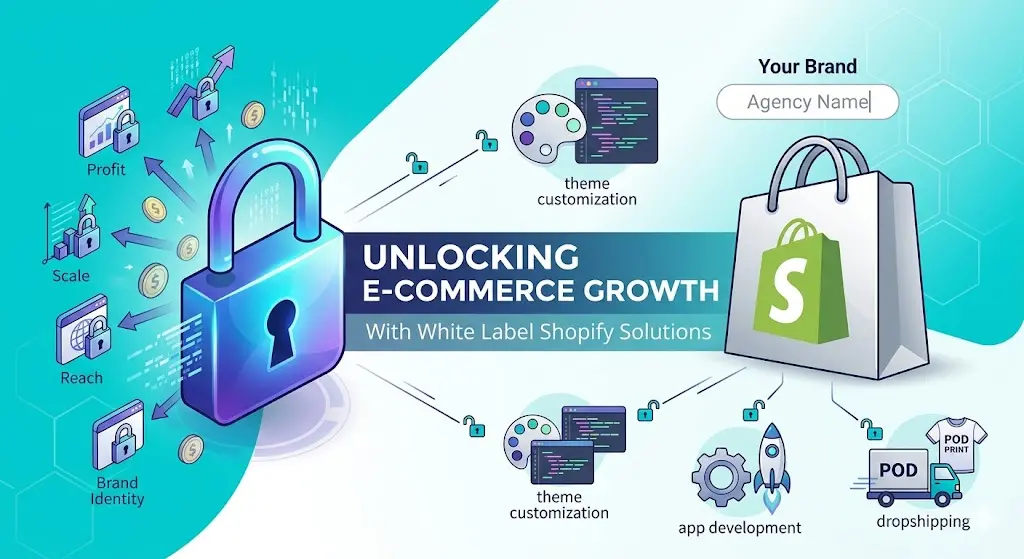
Shopify white labeling allows digital marketing agencies and e-commerce consultants to sell custom store builds, app integrations, and theme modifications under their own brand without maintaining an in-house development team. By outsourcing technical execution to specialized Shopify partner agencies, resellers can expand their service catalog, protect operational margins, and accelerate project delivery times.
What Is E-Commerce White Labeling and How Does It Work?
White labeling in e-commerce is a business model where a third-party provider creates a product or service that a retailer rebrands as their own. White label means one business creates something, and another sells it as its own. Not the creator but the seller puts their name on it. Picture a team-building tool for online stores using Shopify. Rather than selling those tools themselves, they let others claim them. Someone else steps in, attaches their logo, and calls it theirs. No need to build from nothing. The middle company skips long development cycles. Skills gaps do not block progress here. Money usually spent on inventing gets saved. Time moves faster when copying isn’t needed. Hidden work powers visible results elsewhere. Ownership blurs - yet everyone gains differently. What looks handmade is often borrowed quietly. Behind every solo launch might sit shared effort. Appearance shifts while function stays fixed. One maker feeds many storefronts unseen.
What makes the white-label approach stand out is how it speeds things up while helping companies build their identity. Instead of building from zero, firms get solid products already made, then share them as if they created them - complete with their logo and look. Because of this, trust grows faster, allowing teams to focus on what they do best: finding new people who need help, spreading the word, or diving deep into specialized areas. On one side, creators see their work used more widely; on the opposite end, those offering it skip months of development by starting with something polished and proven.
"White labeling democratizes access to sophisticated solutions, allowing smaller entities to compete with larger players by leveraging existing excellence under their own brand."
One common approach shows up often in online service businesses - think firms handing out rebranded SEO tools, help with social platforms, or website builds. In the case of Shopify, that same idea encompasses building apps, tweaking themes, setting up shops, finding products, and handling deliveries, opening many ways to operate.
Not every white-label setup looks the same - some involve blank template tools relabeled for different sectors. Think of banking products managed by outside firms yet sold as if they’re made in-house. Small differences show up across cases, still, the core idea stays: using someone else’s skills while keeping your logo front and center helps stand out. Though details shift, the aim remains clear.
Which White-Label Services Can Shopify Agencies Upsell?
White-labeling extends far beyond Shopify. Across tech and online marketing, it shows up everywhere. Run an agency? Start thinking bigger than building stores. Offer more services behind the scenes. That move often brings in extra income. Clients see greater worth, too.
Custom Websites Built for Resale
Some digital marketing and web agencies focus strictly on client strategy, SEO, or paid media and rely on specialized third-party development providers to handle complex store builds. Instead of coding in-house, these agencies assign projects to white-label developers who craft each store behind the scenes. Once completed, the agency delivers the final store to the client under its own brand identity.
To maintain security, brand isolation, and operational efficiency during this process, agencies leverage Shopify Collaborator Accounts:
- Password-Free Access via Partner Organizations: Instead of requesting client store passwords or consuming limited staff seats, white-label contractors request access directly from their own Shopify Partner Dashboard using the merchant's unique 4-digit Collaborator Request Code.
- Least-Privilege Scoped Permissions: Agencies (or store owners) approve only the precise administrative permissions required for the project (e.g., granting access exclusively to Theme Editing, Apps, or Products, while strictly blocking access to sensitive financial reports, customer PII, or payment gateway configurations).
- Zero Credential Exposure & Account Isolation: Because contractors log in securely through their own Partner logins authenticated via two-factor authentication (2FA), primary store owner credentials and sensitive client data are never exposed or shared with third-party freelancers.
- Seamless Offboarding & Expiry: Once the build is verified and handed over to the client, the agency or merchant can instantly revoke collaborator access with one click from
Settings > Users & Permissions. Additionally, Shopify automatically expires inactive collaborator sessions after 90 days of inactivity to eliminate dormant security risks.
White Label Pay Per Click Management
Running paid ads - like those on Google or social platforms - means needing sharp skills and constant tweaks. When an agency lacks its own ad experts, turning to outsourced pay-per-click help makes sense. The outside firm handles everything for the reseller’s customers, keeping results running smoothly behind the scenes. Reports show up stamped with the reseller’s logo. Clients talk only to their main point of contact, never seeing the support crew beneath.
Most people find this setup appealing since PPC campaigns usually connect directly to online shops, which fits neatly alongside building Shopify sites. When a team handles both launching stores and attracting visitors, they become a go-to resource for customers.
- One reason firms succeed? They handle campaigns with precision. Tools show exactly where bids work best. Results come through clearly, tied straight to outcomes. Clients stay longer when progress is visible.
- Starting, clear communication matters when sharing what clients want. Reporting must hit the mark - no guesswork, just facts lined up right. How numbers flow into their systems plays a big role, too. Truth in data keeps things steady. Matching tools behind the scenes ensures nothing slips through. Knowing where results come from builds trust slowly. Details fit together only if everyone sees the same picture.
Now picture this: a company wants a fresh Shopify site. Right away, it becomes clear they’ll want help getting visitors too. Instead of hunting down separate teams, they find an agency handling everything - store setup, clean page layouts, even targeted ads - all rebranded seamlessly. Suddenly, scattered tasks turn into one smooth process. That kind of support doesn’t just save time - it reshapes expectations.
What Advanced Technical Services Can Be White-Labeled on Shopify?
Agencies can upsell high-ticket, advanced technical services on Shopify without building in-house engineering infrastructure by leveraging specialized white-label development partners under non-disclosure agreements (NDAs).
These high-margin, enterprise-level technical services include:
1. Headless Commerce & Decoupled Frontends
- Shopify Hydrogen & Oxygen Deployment: Building React-based custom frontends utilizing Shopify’s Hydrogen framework and hosting them on Oxygen edge-runtime infrastructure for ultra-low latency, bespoke micro-interactions, and high-performance global store rendering.
- Content Management System (CMS) Integrations: Connecting headless storefronts to enterprise headless CMS platforms (e.g., Sanity, Storyblok, Contentful) via Storefront APIs, enabling non-technical client teams to edit complex landing pages without developer intervention.
2. Shopify Plus & Enterprise Customizations
- Checkout Extensibility & Custom Apps: Replacing legacy
checkout.liquidlayouts with modern Checkout UI Extensions, allowing enterprise clients to deploy custom branding, dynamic upsells, field validations, and trust badges within the native checkout flow. - Shopify Functions (Custom Backend Logic): Authoring custom WebAssembly (Wasm) functions in Rust or JavaScript to execute real-time backend logic—such as tiered B2B pricing, automated volume discounts, complex shipping rules, and custom payment gateway restrictions—directly on Shopify’s servers.
- Shopify Flow & B2B Portal Workflows: Building automated, multi-step backend routines and configuring dedicated business-to-business (B2B) buying portals with custom price lists, draft order approvals, and net-payment terms.
3. Middleware & Enterprise Integrations (ERP / CRM / WMS)
- Custom API Middleware Development: Engineering secure Node.js, Python, or Go serverless endpoints to link Shopify’s GraphQL Admin API with legacy enterprise resource planning (ERP) platforms (e.g., SAP, NetSuite, Microsoft Dynamics 365).
- Bi-Directional Inventory & Order Syncing: Building real-time webhook architectures to synchronize stock across multiple warehouses, third-party logistics (3PL) providers, warehouse management systems (WMS), and customer relationship management (CRM) platforms like Salesforce.
4. Data Modeling & System Architecture
- Native Metaobject & Schema Engineering: Designing relational data models directly within Shopify using Metafields and Metaobjects (e.g., complex ingredient glossaries, designer bios, multi-field product specifications) linked directly into Online Store 2.0 JSON templates.
- Custom Public & Private App Development: Building standalone, bespoke private apps (or white-labeled public SaaS apps) hosted on AWS/Google Cloud that automate unique client business workflows or offer proprietary functionality.
5. Advanced Migration & Performance Engineering
- Complex Data Migrations: Executing full database extractions, transformation scripts, and imports from legacy or enterprise platforms (e.g., Magento/Adobe Commerce, Salesforce Commerce Cloud, SAP Hybris) to Shopify, preserving historical customer data, password hashes, order history, and 301 redirect mappings for SEO retention.
- Headless & Monolithic Speed Remediation: De-bloating complex JavaScript execution, optimizing Core Web Vitals (LCP, CLS, INP), refactoring legacy Liquid themes, and implementing critical asset preloading without breaking third-party app dependencies.
Frequently Asked Questions About Shopify White Labeling
What is the typical profit margin for Shopify white-label services?
Some profits shift a lot - it depends on what service you offer, how much extra you bring, and your pricing approach. White label coding? Firms often boost costs by anywhere from half again to twice, sometimes more. Apps under white labeling tend toward repeat payments, each carrying a healthy slice of profit. Selling dropshipped goods or print-on-demand items usually pulls in 20 to 40 percent per sale, shaped by where it's bought and priced. Stay sharp: match market rates while showing your worth through branding and extras included. Ecommerce Service Profit Benchmarks
Do I need to be a coder to provide Shopify white-label services?
It depends. Technical skills help with certain setups, such as custom apps, though many agencies outsource that work rather than building it in-house. Running a white-label dropshipping or print-on-demand business means attention goes toward promotion and handling the storefront - not writing code. Knowing just the fundamentals of how Shopify operates makes guiding clients and running operations much smoother.
How do I find reliable white-label partners for Shopify?
Hunting down solid allies means digging deep into details first. Check out shops or coders who show off real work samples, have happy customers talking online, spell out costs plainly, plus keep replies straightforward. Sites such as Upwork, Fiverr (good for tiny jobs), or niche business exchanges tend to feature rebrand-ready vendors. Getting involved in Shopify circles, showing up at trade meetups, and then following personal recommendations can open useful paths, too. Begin every connection with a mini-assignment to see how things flow before signing any lasting deal.
Shopify plus is a platform where white labeling is common. We get most of our white labeling partners for this reason.
Can I really put my own brand on everything through white-labeling?
Right off the bat, white-labeling means that things like apps, reports, or even tangible goods carry your name instead of the maker’s. Often, dashboards and software feel like they were built in-house because branding gets swapped out completely. Custom touches depend entirely on what the deal allows - some let you change nearly everything. Behind the scenes, solid suppliers set up systems so partners can apply their own colors, logos, and web addresses without a hitch. How much blends into your brand hinges on how flexible the arrangement really is.
White labeling - does it stay within legal lines?
White labels? They’re totally legit, nothing shady going on. Think of it this way: someone else makes it; you slap your name on it. As long as contracts cover who owns what, how things are used, and exactly what gets delivered, everyone stays safe. Clear terms mean fewer surprises later down the road.
The future of white-label e-commerce and where you fit
One thing is clear: online shopping keeps growing, requiring sharper, well-made tools. Not every shop wants to build from nothing - saving time matters more now. White-label setups on Shopify fit right into that gap, offering clear paths forward. Complexity in tech pushes small teams and big ones alike toward simpler starts. Ready-made fixes help skip long setup phases. What works today may shift tomorrow, yet preparation stays key. Solutions must bend but not break under change.
Fresh upgrades might shape how white-label services grow. One step ahead, these tools could do more than before. With time, hidden brands may act smarter. Change usually comes slowly, yet shifts appear now and then. Behind the scenes, options tend to expand quietly.
- Tomorrow’s agencies won’t build AI themselves. Instead, they’ll plug into ready-made systems dressed in their own brand. Tools that handle support tasks might arrive alongside ones that track campaign results. One piece fits neatly after another, like stacked blocks forming a full suite. Custom coding fades when pre-built options do the job just as well. These platforms adapt quietly behind the scenes. Performance stays sharp without constant oversight. Agencies shift focus from creating tech to using it wisely. Ready-to-go analytics give insights fast. Marketing workflows run smoother with less manual input. The edge comes not from owning code but applying smart tools swiftly.
- When online shopping grows more varied, niche tools for particular trades will rise. Specialized software matching exact needs becomes key. These focused services create several opportunities for rebranding under different names. Unique demands spark unseen room for custom digital helpers.
- A fresh layer of customization comes from white-labeled tools, allowing stores to shape unique buying journeys under an agency's brand identity. Behind the scenes, these systems adapt to customer habits without compromising visual consistency. Each interaction feels tailored yet seamless, guided by smart algorithms quietly at work beneath a familiar look. Agency branding stays front and center while choices adapt in real time. Experiences shift based on behavior - no two visits unfold exactly alike.
- One reason things are changing? More companies now charge customers monthly instead of charging one-time fees. This move means agencies need tools they can brand as their own to handle billing tasks. Often, those setups rely on a steady income that comes back every few weeks. Behind the scenes, software built for repetition makes this easier to manage. What results is a quiet rise in platforms made just for this kind of work.
White label approaches aren’t merely reacting to what’s happening now - they’re building what comes next. When teams align with skilled partners, fresh tools become available without starting from scratch. One brand holds many offerings, making the experience smoother for those who rely on it. Instead of chasing every update alone, working within this system sharpens focus. Success in online markets often goes to those who quietly but effectively blend resources. Standing out happens through consistency, not noise. Long-term presence becomes easier when capabilities extend under a unified name. Strength builds gradually, shaped by collaboration rather than constant reinvention. This path favors adaptability over speed. The role ahead? Staying ready, staying flexible, staying present.
Today could be the day you begin uncovering new paths forward, setting your company on a course shaped by steady progress along with fresh thinking.
About the Author

Brian Keary
Founder & Lead Developer
Brian is the founder of BKThemes with over 20 years of experience in web development. He specializes in WordPress, Shopify, and SEO optimization. A proud alumnus of the University of Wisconsin-Green Bay, Brian has been creating exceptional digital solutions since 2003.
Expertise
Writing since 2003