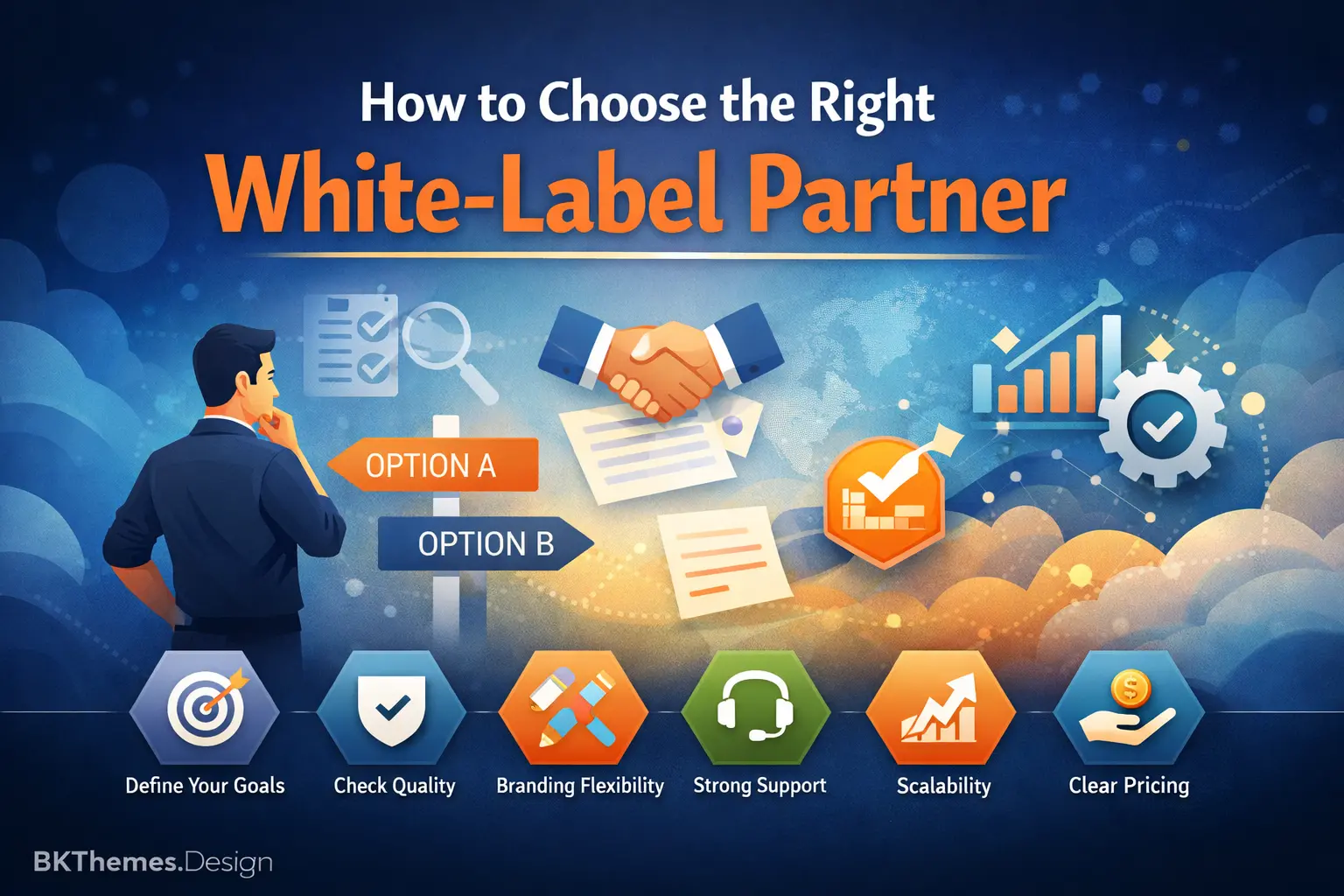
Choosing the wrong white label partner can create the exact problems you were trying to solve in the first place.
If you want the operating-model perspective behind these decisions, see The Agency Growth Operating Model: White Label WordPress Development for Scale.
Most agencies start looking for white label services because they need help with delivery. Maybe deadlines are stacking up. Maybe technical work is slowing the team down. Maybe you want to offer more services without building a larger in-house department. All of those are valid reasons to explore white label fulfillment.
But the moment you bring someone else into your delivery process, your agency reputation is on the line.
If the partner is inconsistent, slow, unclear, or careless, your clients will not blame the fulfillment provider. They will blame you. That is why choosing the right white label partner matters so much. A strong partner helps your agency scale with confidence. A weak one adds friction, missed deadlines, and unnecessary risk.
In this guide, we will walk through what to look for in a white label partner, the warning signs to avoid, and how to evaluate whether a provider is truly a good fit for your agency.
Why Your White Label Partner Matters
A white label partner is not just an outsourced technician. In many cases, they become part of your real delivery system.
That means they influence:
- turnaround time
- quality control
- internal stress levels
- client satisfaction
- team capacity
- retention
- reputation
Agencies often underestimate this. They assume they are simply hiring someone to “help with the work,” but a white label relationship affects far more than execution. It affects how smoothly your business runs and how confidently you can say yes to new opportunities.
The right white label partner helps your agency stay responsive, protect quality, and grow without losing control. The wrong one makes everything harder.
What to Look for in a White Label Partner
Not every provider who offers fulfillment is equipped to support an agency properly. The best white label partners are not just technically capable. They also understand agency operations, deadlines, pressure, and the importance of staying invisible when needed.
Here are the most important qualities to look for.
Clear Communication
A good white label partner communicates clearly, consistently, and without drama.
You should not have to chase updates, translate vague replies, or guess whether work is on track. Strong communication is one of the biggest indicators of a healthy long-term fit.
Look for a partner who can:
- respond in a reasonable timeframe
- confirm scope clearly
- flag blockers early
- ask smart questions when needed
- keep communication simple and useful
The best technical work in the world becomes frustrating if the communication around it is unreliable.
Reliable Turnaround Times
Speed matters, but predictability matters even more.
A dependable white label partner should give realistic turnaround expectations and stick to them. Agencies cannot confidently manage clients if delivery timelines are vague or always slipping.
This does not mean every request must be instant. It means the partner should be honest about timing, consistent in how they work, and capable of delivering within agreed expectations.
Technical Competence
This sounds obvious, but it still needs to be said. A white label provider should be genuinely good at the work they claim to offer.
If your agency needs help with WordPress, Shopify, SEO implementation, or recurring technical tasks, the provider should have proven capability in those areas. You do not want to discover technical weaknesses after your client has already approved the project.
If you need platform-specific support, it helps to work with people who already specialize in those areas, such as a WordPress expert, a certified Shopify expert, or an experienced SEO services team.
Ability to Stay Behind the Scenes
White label support only works well if the provider understands how to remain invisible when necessary.
Some agencies want the partner to be completely client-invisible. Others are open to limited involvement in meetings or technical reviews. Either way, the provider should respect the agency’s role and not create confusion around ownership, communication, or brand representation.
A strong white label partner understands that their job is to strengthen your brand, not compete with it.
Process and Consistency
One-off project help is different from ongoing fulfillment.
If you want a scalable white label relationship, process matters. The provider should have a repeatable way of handling requests, confirming scope, delivering work, communicating updates, and managing revisions.
Consistency is what makes a white label relationship useful over time. Without it, every request becomes a fresh management problem.
Questions to Ask Before Hiring a White Label Partner
Before committing to a provider, it helps to ask questions that reveal how they actually operate.
Here are some of the most useful ones:
- What kind of work do you handle most often?
- What does your typical turnaround time look like?
- How do you handle revisions?
- How do you communicate progress and blockers?
- Have you worked with agencies before?
- Can you stay client-invisible if needed?
- What happens when scope changes mid-project?
- How do you approach quality assurance?
- What tools or systems do you work inside?
- How do you prioritize urgent requests?
The goal is not just to gather answers. It is to understand whether the provider has a calm, professional, repeatable process.
The right partner will make these questions easy to answer.
Red Flags That Signal a Poor Fit
Agencies often ignore warning signs early because they are focused on solving a capacity problem fast. That usually leads to more stress later.
Here are some red flags that should make you pause.
Vague Communication
If a provider is unclear before you hire them, they will probably be unclear after you hire them too.
Slow, confusing, or evasive communication is one of the earliest signs of trouble.
Unrealistic Promises
Be cautious of anyone who promises they can handle everything, move instantly, and never encounter issues. Good fulfillment partners are confident, but they are also realistic.
Overpromising usually turns into underdelivering.
Weak Understanding of Agency Workflows
A provider might be technically capable and still be a poor white label fit.
If they do not understand deadlines, revisions, client pressure, brand sensitivity, or the need to work discreetly, they may struggle to support your agency even if they can complete the task itself.
Inconsistent Quality
A white label relationship only works when delivery quality is dependable. One good result followed by one messy result is not enough. Agencies need consistency they can rely on repeatedly.
Price That Feels Too Good to Be True
Low-cost fulfillment is tempting, but if the price is far below market reality, something is usually missing: communication, quality control, experience, accountability, or all four.
Cheap work becomes expensive fast when it creates rework and client dissatisfaction.
Why Communication and Turnaround Time Matter More Than Agencies Expect
Many agencies focus first on technical ability, which is understandable. But communication and turnaround time often have just as much impact on the success of a white label relationship.
Why? Because agencies do not just need work completed. They need work completed in a way that supports client management.
That means:
- you need realistic timelines
- you need updates you can pass along confidently
- you need to know when something is blocked
- you need quick clarification when scope changes
- you need enough trust to promise delivery dates responsibly
A highly skilled partner who communicates poorly creates just as much operational friction as an average partner with weak technical ability.
A strong white label relationship feels calm, organized, and predictable. That is a huge part of its value.
How to Test a White Label Relationship Before Scaling It
One of the smartest things an agency can do is test a white label relationship before depending on it heavily.
Do not start by handing over your most sensitive or highest-pressure client project. Start with a contained task that reveals how the provider works.
Good test projects include:
- a small WordPress fix
- a Shopify theme adjustment
- metadata implementation
- internal linking updates
- content formatting
- landing page edits
- recurring maintenance support
These smaller tasks help you evaluate:
- communication quality
- responsiveness
- accuracy
- revision handling
- process consistency
- overall ease of working together
If the relationship works well at that level, you can scale it gradually with more confidence.
What the Right White Label Partner Should Help You Protect
A strong white label partner helps your agency protect the things that matter most.
That includes:
- your reputation
- your client relationships
- your margins
- your turnaround time
- your internal team’s focus
- your ability to grow without chaos
The right provider should make your business easier to run, not harder. They should reduce stress, improve consistency, and help your agency feel more capable, not more fragile.
That is a much better standard to use than simply asking whether someone can “do the work.”
Is the Best White Label Partner the Cheapest One?
Usually not.
The cheapest partner is rarely the best long-term option for an agency. If the relationship creates communication problems, delays, rework, or client dissatisfaction, then the real cost becomes much higher than the invoice.
Agencies should think in terms of overall value, not just hourly rate.
The right partner is the one who helps you deliver reliably, stay organized, protect the client experience, and scale without unnecessary operational drag.
That kind of value is worth more than a low sticker price.
Conclusion
Choosing the right white label partner is one of the most important decisions an agency can make when it starts scaling fulfillment. The right provider does more than complete tasks. They strengthen delivery, improve consistency, reduce internal pressure, and help your agency grow without sacrificing quality.
The wrong partner does the opposite. They create uncertainty, slow down projects, increase stress, and put your reputation at risk.
A strong white label relationship should feel professional, predictable, and aligned with the way your agency works. That means clear communication, dependable turnaround, technical competence, respect for your client relationship, and the ability to operate behind the scenes without friction.
That standard is reinforced by broader operations and digital delivery guidance. McKinsey's perspective on operations excellence supports the value of repeatable process and predictable execution, while Forbes' article on white-label solutions helps frame the business case for behind-the-scenes fulfillment. For technical evaluation, WordPress.org's developer resources and Shopify's developer documentation are useful benchmarks when judging whether a provider truly understands the platforms your agency sells.
If your agency is looking for a dependable fulfillment partner, explore our white label services to see how BKThemes supports agencies with reliable behind-the-scenes execution.
Frequently Asked Questions
About the Author

Brian Keary
Founder & Lead Developer
Brian is the founder of BKThemes with over 20 years of experience in web development. He specializes in WordPress, Shopify, and SEO optimization. A proud alumnus of the University of Wisconsin-Green Bay, Brian has been creating exceptional digital solutions since 2003.
Expertise
Writing since 2003