What are Customer Reviews and Google Maps Optimization?
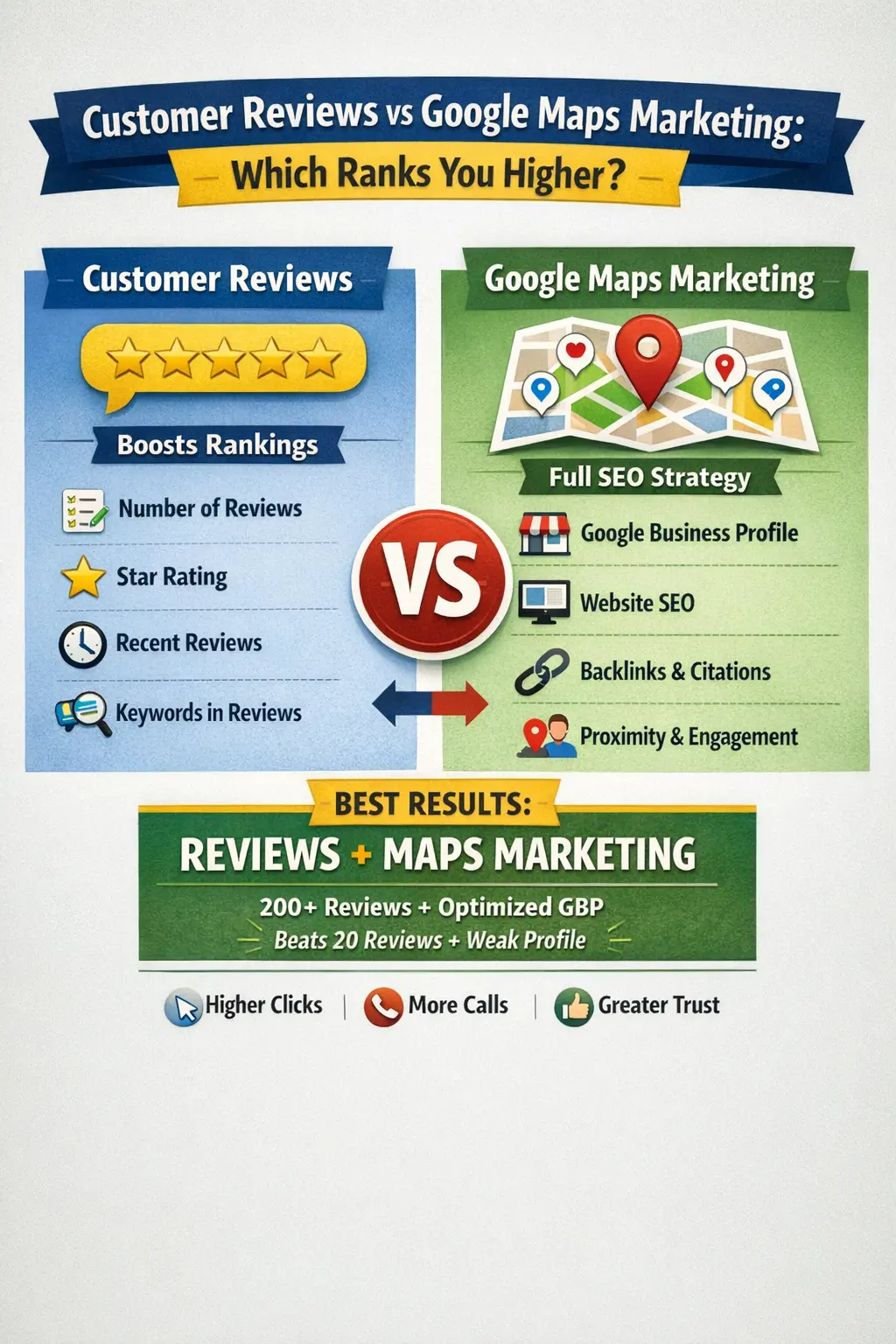
Google Maps profile optimization establishes baseline ranking eligibility across proximity and category relevance (accounting for roughly 32% of Local Pack ranking influence), while customer reviews drive prominence and conversion (representing 16-20% of ranking weight). Businesses with fewer than 10 reviews should prioritize complete Google Business Profile optimization before launching review acquisition campaigns.
Key Takeaways
- Reviews and Maps optimization work together - Treating them as competing strategies misses how Google's algorithm actually ranks local businesses
- Start with Maps optimization for quick wins - Profile completeness, categories, and service areas can shift rankings within weeks, while reviews take months to accumulate
- Reviews drive conversions, not just rankings - Positive reviews are linked to up to 18% revenue growth and 15-20% higher conversion rates
- Recency matters more than you think - 73% of consumers only trust reviews from the last 30 days, making consistent review collection essential
- The 10-review threshold is real - 2025 testing shows a noticeable ranking boost when businesses reach 10 reviews, making this your first milestone
How Do Customer Reviews Compare to Google Maps Optimization for Local Visibility?
According to industry research, both Customer Reviews and Google Maps Optimization (Google Business Profile optimization) are essential for local search visibility, but they impact different stages of the search and conversion funnel:
1. Direct Ranking Impact
- Google Maps Optimization Wins on Raw Ranking Power: Setting up a Google Business Profile (GBP) controls roughly 25% to 32% of local pack ranking signals. Optimizing your primary category selection, service areas, physical address, and profile completeness directly controls proximity and keyword relevance matching in Google's algorithms.
- Reviews Drive Prominence: Review signals account for 10% to 20% of local SEO ranking factors. While volume matters (top-ranking local businesses average ~240 reviews), crossing an initial 10-review threshold provides an immediate ranking boost. Beyond volume, review velocity (freshness) and keyword-rich text inside reviews help Google understand your specific services.
2. Conversion Influence
- Customer Reviews Win on Conversions: While Google Maps optimization ensures your listing gets seen, reviews determine whether a potential customer actually clicks or calls.
- Social Proof & Recency: Positive reviews drive a 15% to 20% lift in conversion rates. Over 70% to 83% of consumers only trust reviews written within the last 30 days. Searchers frequently bypass the #1 ranked business in a map pack to click on a #2 or #3 result that has higher review volume, better star ratings, or recent positive feedback.
3. Implementation Speed vs. Long-Term Moat
| Feature | Google Maps Optimization | Customer Review Strategy |
|---|---|---|
| Speed to Results | Fast (Days to Weeks): Profile edits can shift local Map Pack rankings within 24 to 72 hours. | Slow (Months to Years): Accumulating a baseline volume takes sustained effort over 3 to 6 months. |
| Competitive Moat | Weak: Competitors can easily copy your primary category, business description, and profile details in an afternoon. | Strong: A library of hundreds of authentic, 5-star reviews built over years cannot be easily replicated or bought overnight. |
Recommended Strategy
Treat both tactics as complementary partners rather than competing choices:
- Optimize Your Google Business Profile First: Fix categories, hours, and descriptions immediately to establish baseline relevance and visibility.
- Launch an Automated Review System Immediately After: Capitalize on your initial ranking boost by collecting a steady stream of fresh customer feedback to convert incoming traffic into long-term leads.
Quick Verdict: They're Partners, Not Competitors
Choose reviews as your primary focus if you're starting from scratch or have fewer than 50 reviews. Choose Google Maps optimization if you already have 100+ reviews but aren't appearing in local searches. The truth? 86% of customers use Google Maps to find local businesses, but reviews determine which businesses they actually click.
Reviews fuel Maps rankings. Maps' visibility amplifies review collection. Treating them as separate strategies misses how Google's algorithm actually works.
| Criterion | Customer Reviews Strategy | Google Maps Marketing | Winner |
|---|---|---|---|
| Direct Ranking Impact | ~10% of ranking factors | ~25-30% (proximity, relevance) | Maps Marketing |
| Conversion Influence | 15-20% conversion lift | Visibility only | Reviews |
| Time to Results | 2-4 weeks per 10 reviews | Days to weeks | Maps Marketing |
| Ongoing Effort Required | Continuous | Periodic updates | Maps Marketing |
| Cost | Free (time investment) | Free (time investment) | Tie |
| Competitive Moat | Hard to replicate quickly | Easy to copy | Reviews |
| Trust Building | Direct social proof | Indirect (visibility) | Reviews |
How We're Evaluating Both Strategies
We're comparing these approaches across seven dimensions that matter most to small business owners. Each criterion reflects real constraints: limited marketing hours, tight budgets, and the need for measurable results.
Direct ranking impact measures how much each factor influences where you appear in local search results. Conversion influence tracks whether visibility translates to actual customer actions. Time to results matters because you can't wait six months to see if something works.
Ongoing effort determines sustainability. Cost includes both money and time investment. Competitive moat assesses how easily competitors can copy your gains. Trust-building measures the psychological impact on potential customers.
Which Strategy Has a Stronger Direct Impact on Local Rankings?
While both are essential pillars of local SEO, industry data from major studies like Whitespark's Local Search Ranking Factors shows that Google Business Profile signals control roughly 32% of local pack ranking influence, whereas customer review signals account for about 16% to 20%. Your profile setup dictates relevance and distance, whereas reviews primary drive prominence and trust.
How Do Customer Reviews Impact Local Search Rank?
Reviews account for approximately 10% of local SEO ranking factors according to Brightlocal. That sounds small until you see the data: businesses in the top 1-3 positions on Google Maps typically have around 240 reviews, compared to 170 for positions 4-10.
The relationship isn't linear. Sterling Sky's 2025 testing found that reaching 10 reviews triggers a noticeable ranking boost. After that threshold, quality and recency matter more than raw volume.
How Does Google Maps Marketing Influence Local SEO Rankings?
Google Maps optimization encompasses your Google Business Profile completeness, category selection, service area setup, and business description optimization. These technical factors influence 25-30% of local ranking signals through relevance and proximity matching.
A fully optimized profile with accurate categories, complete business hours, and proper service areas tells Google exactly when to show your business. Without this foundation, even hundreds of reviews won't help you appear for relevant searches.
Ranking Outcome: Maps Optimization vs. Reviews
Maps marketing wins on direct ranking percentage, but this comparison is misleading. An optimized profile without reviews ranks but doesn't convert. Reviews without proper optimization never get seen. Start with Maps optimization (it's faster), then shift focus to reviews.
How Do Reviews Compare to Google Maps Optimization for Conversions?
Customer reviews have a significantly stronger direct impact on conversions than Google Maps (Google Business Profile) optimization. While optimizing your Google Maps listing determines whether customers can find you, your reviews dictate whether they will actually choose you. Maps optimization drives the traffic, but reviews close the sale.
Why Do Customer Reviews Drive Higher Conversion Rates Than Map Listings?
While Google Maps optimization (completing your profile, setting categories, and defining service areas) determines whether your business gets found, customer reviews determine whether a searcher actually chooses your business.
Customer reviews drive higher conversion rates than map listings alone for several key reasons:
1. Social Proof Overcomes Pure Visibility
- Visibility vs. Credibility: Map optimization gets your profile into the top local results, but high rankings only earn exposure. Reviews provide authentic social proof from real people, validating marketing claims and turning passive impressions into active clicks or calls.
- Higher Conversion Lift: Industry data shows that positive customer reviews can drive a 15% to 20% lift in conversion rates and are linked to up to 18% revenue growth, whereas map placement alone only guarantees visibility.
2. Trust and Recency Influence Purchasing Decisions
- The Recency Factor: Consumers look closely at how recent feedback is. Over 70% to 83% of consumers require reviews to be from the last 30 days to consider a business trustworthy. A perfectly optimized Map listing displaying old or sparse reviews fails to build the immediate trust required to close a lead.
- Overcoming Competitors: Searchers frequently bypass the #1 ranked result on Google Maps if the #2 or #3 listing has significantly higher review volume, better star ratings, or more detailed customer feedback.
3. Natural Language Processing (NLP) & Specificity
- Contextual Reassurance: Detailed customer reviews contain natural keywords describing specific services, staff performance, and problem resolution (e.g., "fixed my leaking pipe in under an hour"). Prospective customers reading these specific experiences feel greater confidence that the business can solve their exact problem compared to a standard list of services on a profile card.
What Are the Conversion Limitations of Maps Optimization Without Reviews?
Maps optimization gets you seen, but doesn't close the sale. Appearing in the local pack means nothing if your listing shows 3 reviews from 2019 while competitors display 150 recent testimonials. Visibility without credibility wastes the opportunity.
That said, over half of searchers choose one of the top 5 results. Position alone influences clicks, even before reviews factor in.
Conversion Outcome: Why Reviews Outperform Maps Listings
Reviews win decisively on conversion. Maps optimization secures initial placement in front of searchers, while review social proof determines whether searchers select your business.
How Fast Can You Expect Results from Reviews Versus Maps Optimization?
Google Maps optimization delivers much faster initial ranking results than building customer reviews, but reviews create a faster surge in actual conversions once you are visible.
Timeline Breakdown
- Google Maps Optimization (Days to Weeks): Technical profile updates can yield almost immediate results. Changing your primary business category, updating service areas, or correcting a physical address can shift your local Map Pack rankings within 24 to 72 hours of Google approving the edits.
- Customer Reviews (Months): Building a trusted review profile is a slow, organic process. Google’s algorithms look for "review velocity" (a steady stream over time) rather than a sudden spike, which can look fraudulent. Expect it to take 3 to 6 months of consistent collection to alter your ranking prominence.
Velocity and Impact Comparison
| Strategy | Speed of Implementation | Time to See Ranking Impact | Duration of Impact |
|---|---|---|---|
| Maps Optimization | Immediate (Hours to complete profile details) | 1–2 Weeks (As soon as Google crawls updates) | Short-to-Medium (Stagnates if competitors optimize better) |
| Customer Reviews | Gradual (Requires ongoing customer outreach) | 2–3 Months (Requires a baseline volume to shift rank) | Long-Term (Builds an compounding, authoritative trust barrier) |
The Optimal Workflow
Because of this timeline gap, the most efficient local SEO strategy is a two-step approach:
- Optimize the Profile First: Instantly fix your Google Business Profile categories, hours, and descriptions to maximize your visibility for local keywords today.
- Launch a Review Campaign Immediately After: Use that newfound visibility to funnel incoming customers into an automated review pipeline, turning your initial ranking jump into sustained long-term conversions.
How Long Does a Customer Review Strategy Take to Show Results?
Building a review base takes consistent effort over months. Most businesses can realistically collect 5-15 reviews per month through active requesting. Reaching that 240-review benchmark for top positions could take 16-48 months of sustained effort.
The upside: each review compounds. Unlike ads that stop working when you stop paying, reviews persist and accumulate value.
How Fast Does Google Maps Optimization Impact Rankings?
A Google business profile audit and optimization can happen in a single afternoon. Verification takes 1-2 weeks. Category selection, business description optimization, and service area setup require a few hours of research and implementation.
Among these optimization steps, Primary Category Selection stands out as the single heaviest Google Business Profile ranking factor according to Whitespark's Local Search Ranking Factors study. Selecting the most precise primary category instantly establishes core relevance for your top target keywords, while adding relevant secondary categories ensures you capture broader semantic search intent.
Results appear within days to weeks. Google reindexes updated profiles quickly, and proper optimization can shift rankings noticeably in under a month.
Which Local Strategy Delivers Faster Results?
Maps marketing wins on speed. You can optimize your profile today and see ranking changes this month. Reviews require patience and systems that most small businesses struggle to maintain.
Which Local Strategy Creates a Stronger Competitive Moat?
A sustained customer review strategy creates a significantly stronger competitive moat than Google Maps optimization. While profile optimization is easily copied, an extensive library of authentic, high-quality customer reviews is incredibly difficult for competitors to replicate.
Why Customer Reviews Create a Moat
- Immune to Quick Replication: A competitor can audit your Google Business Profile, copy your exact categories, match your services, and instantly equalize your optimization advantage in an afternoon. They cannot easily replicate 500 authentic, five-star reviews that you accumulated over several years.
- Algorithmic and Psychological Dominance: Even if a new competitor uses aggressive spam tactics to rank above you in the Map Pack, consumers will actively bypass them to click on your business if you have a vastly superior review volume and rating. Your moat protects your conversions, even when rankings fluctuate.
- Review Velocity & Semantic NLP Analysis: Google’s Natural Language Processing (NLP) engines evaluate reviews far beyond raw star counts. The algorithm monitors review velocity—rewarding a steady, natural stream of feedback rather than suspicious, sudden spikes—while applying semantic analysis to identify specific keyword sentiment and service entities mentioned in customer text (e.g., "fast emergency plumbing" or "best custom web design"). Authentic customer phrasing continuously trains Google's AI on your core competencies and relevance.
- Review Diversity as an Entity Signal: Don't just collect reviews on Google. Accumulating reviews across third-party platforms (like Yelp, TripAdvisor, Houzz, or Avvo) allows Google's NLP algorithms to validate your business prominence cross-web, creating a multi-layered local footprint that is nearly impossible for a newcomer to displace.
Moat Strength Comparison
| Feature | Google Maps Optimization | Customer Reviews |
|---|---|---|
| Moat Strength | Weak (Low barrier to entry) | Strong (High barrier to entry) |
| Time to Duplicate | Hours to days | Months to years |
| Defensiveness | Low (Competitors can match you instantly) | High (Requires long-term customer satisfaction) |
| Algorithm Stability | Vulnerable to core updates and proximity shifts | Highly resilient (Velocity and trust endure) |
How Do You Build a Multi-Platform Review Moat?
Building a multi-platform review moat requires creating an ecosystem of social proof across several independent channels, protecting your business against algorithm changes, unfair profile suspensions, or platform-specific drops in visibility.
1. Establish Tiered Platform Priorities
Divide your target review channels into distinct tiers to ensure comprehensive coverage:
- Tier 1 (Core Search Engines): Google Business Profile, Apple Business Connect, and Bing Places. These directly power local map packs, voice search (Siri, Alexa), and primary search engine results.
- Tier 2 (Major Consumer Platforms): Platforms with broad consumer adoption, such as Yelp, Better Business Bureau (BBB), Trustpilot, or Facebook Recommendations.
- Tier 3 (Industry-Specific Vertical Platforms): Specialized sites that signal high entity authority to search engine crawlers (e.g., Avvo or Lawyers.com for legal, Houzz or Angi for contractors, Healthgrades or Zocdoc for medical, TripAdvisor for hospitality).
2. Implement Smart Review Routing
To prevent over-concentrating all feedback on a single platform (like Google), build a dynamic routing system into your post-service communication workflow:
- Segmented Outbound Requests: Rotate review platform destinations in your automated email or SMS post-service requests based on customer parameters or monthly volume targets.
- Conditional Routing Logic: Direct customers to your priority platform for that quarter (e.g., boosting Yelp or Trustpilot if Google review volume is already strong).
- Direct Deep Linking: Provide direct link buttons to specific profile review forms to eliminate friction, ensuring the customer reaches the exact submit page in one click.
3. Maintain Steady Review Velocity & Recency
Search engine algorithms evaluate the consistency and freshness of incoming reviews rather than sudden spikes:
- Automate Post-Purchase Triggers: Integrate review requests directly into your CRM, POS, or field service software so requests are sent consistently within 24 to 48 hours of service completion.
- Avoid Artificial Surges: Never send massive batch email blasts asking for reviews all at once, as major platforms flag sudden spikes in review velocity as unnatural or fraudulent behavior.
4. Encourage Keyword-Rich, Authentic Feedback
The text within customer reviews provides rich semantic signals that train natural language processing (NLP) search engines on your services and locations:
- Prompt Specific Experience Questions: When requesting feedback, ask open-ended questions like "Which service did we perform for you today?" or "How was your experience with our team in [City Name]?"
- Natural Sentiment: Customers will naturally incorporate relevant service entities, long-tail terms (e.g., "emergency furnace repair" or "custom kitchen remodeling"), and local geographic signals into their written feedback without violating platform anti-gating policies.
5. Cross-Syndicate Social Proof via Schema
Unify your multi-platform review footprint so search engines can associate reviews from external sites directly with your main domain:
- LocalBusiness JSON-LD Schema: Embed
LocalBusinessstructured data on your website and utilize thesameAsproperty to link your official profiles across third-party review networks. - Aggregate Rating Schema: Where permitted, implement
AggregateRatingschema to display review star ratings in organic search engine results pages (SERPs). - On-Site Testimonial Hubs: Showcase dynamic review widgets on high-converting landing pages that pull in verified reviews from multiple third-party sources.
6. Active Multi-Platform Reputation Management
- Respond to All Feedback Promptly: Respond professionally to both positive and negative reviews across all platforms. Prompt responses show potential customers and search crawlers that the listing is actively monitored.
- Monitor Unintended Edits & Flags: Regularly audit secondary listings to catch spam, duplicate profiles, or unauthorized user edits before they impact your overall brand sentiment or local rankings.
Why Customer Reviews Are Difficult for Competitors to Replicate
A competitor can't buy 200 genuine reviews overnight. Building review volume and maintaining recency requires real customer relationships and consistent service quality. This creates a durable competitive advantage that takes years to replicate.
Google reviews now account for 81% of all online review volume, up from 79% in 2023. The platform's dominance means your Google review investment isn't diversification risk; it's concentration on the channel that matters most.
Why Google Maps Marketing Is Less Defensible
Any competitor can copy your optimization tactics within hours. They can select the same categories, write similar descriptions, and set up identical service areas. Technical optimization creates temporary advantages at best.
The exception: businesses with physical locations closer to searchers have proximity advantages that can't be copied without actually moving.
Moat Assessment: Why Review Velocity Is Harder to Replicate
Reviews win on defensibility. Your review history represents years of customer relationships that competitors can't shortcut.
When Should You Prioritize Reviews Over Profile Optimization?
Prioritize Google Maps optimization when launching a business with fewer than 10 reviews: Start with Google Maps optimization to establish visibility, then immediately implement a customer reviews strategy. The 10-review threshold triggers ranking benefits that justify prioritizing early review collection.
Your Google Business Profile likely has optimization gaps if you already have 50+ reviews but low local visibility. Audit your category selection (are you in the most specific relevant categories?), verify your service areas match where you actually serve customers, and ensure your business description includes relevant local search terms.
You are in a highly competitive market: Reviews become your primary differentiator. When every competitor has an optimized profile, review volume, recency, and quality determine who wins the top positions.
If you want to see this play out on the ground, our Sock Company local SEO case study shows how local optimization, review alignment, and entity signals combined to dominate regional search.
Most Reviews are older than 90 days, you should focus on review recency over volume: 83% of consumers require recent reviews for trust. Ten reviews from this month outperform 100 reviews from last year for conversion purposes.
Serving multiple locations? Maps optimization becomes critical. Proper service area setup and location-specific content determine whether you appear for searches in each area you serve.
What Both Strategies Miss
Neither reviews nor Maps optimization solves fundamental business problems. A poorly run business with great reviews eventually gets exposed. Perfect optimization can't compensate for services people don't want.
Missing Entity Bridge: Neither strategy connects your Google Business Profile (GBP) to your website on its own. Implementing LocalBusiness Schema (JSON-LD) structured data on your website serves as a crucial entity bridge—explicitly linking your GBP profile via @id, sameAs properties, address, and NAP details to transfer domain authority directly to your local pack presence.
Both strategies also depend entirely on Google's platform. Algorithm changes can shift ranking factors overnight. The 10% weight on reviews today could become 5% or 15% tomorrow. Building your entire visibility strategy on a platform you don't control carries inherent risk.
Neither approach directly addresses website performance, which affects what happens after someone finds you. Slow sites and poor mobile experiences waste the visibility gains from both strategies.
What Are the Migration Risks and Switching Costs Between GBP and Reviews?
When choosing between focusing on your Google Business Profile (GBP) optimization and building your Customer Review footprint, understanding the migration risks and switching costs helps protect your business during strategic transitions, relocations, or brand updates.
1. Migration Risks & Platform Rigidity
Review Non-Transferability (High Risk)
- Platform Lock-In: Customer reviews tied to a Google Business Profile or third-party site (like Yelp or Trustpilot) cannot be exported, transferred, or merged freely to another profile or brand.
- Rebranding & Renaming Exposure: If a business undergoes a major rebrand, name change, or category shift that requires creating a brand-new profile, accumulated reviews do not automatically migrate. Unless Google approves a profile edit or explicit listing merge request, you risk losing years of hard-earned review equity and social proof overnight.
- Strict Google Policies: Google’s review migration guidelines are strict. If Google determines that a location moved beyond its original service area or experienced a fundamental shift in business model, it may decline to transfer existing reviews to the new listing.
Profile Re-Verification Delays
- Verification Roadblocks: Updating core GBP elements (such as changing the primary business address or phone number) frequently triggers Google's secondary verification protocols (e.g., video verification, postcard mailings, or business license submissions).
- Temporary Map Suspension: During the re-verification process, your profile may suffer temporary algorithmic suppression or listing suspension in the local 3-pack, leading to a sudden drop in map visibility and customer calls.
2. Strategic & Operational Switching Costs
Data Transferability & Framework Portability (Low Switching Cost)
- Optimization Frameworks Move Easily: Unlike reviews, technical profile optimization details—such as category mapping, service area definitions, local business descriptions, and UTM parameters—are fully portable.
- Replicable Strategy: Optimization insights and competitor research conducted for GBP can easily be applied to new listings or alternative search platforms (such as Apple Business Connect or Bing Places).
Attention & Velocity Loss (High Operational Cost)
- The "Focus Oscillation" Penalty: Alternating back and forth between optimizing your profile and collecting reviews creates a hidden cost in lost momentum.
- Review Velocity Drops: Pausing review collection workflows to focus exclusively on technical profile edits causes your review recency and velocity to stall. Because search algorithms and potential customers heavily favor recent feedback (reviews within the last 30 to 90 days), stopping outreach can diminish conversion rates even if map rankings hold steady.
Best Practices to Mitigate Migration Risk
- Submit Official Merge/Transfer Requests: When changing physical addresses or legal business names, update your existing verified GBP rather than creating a duplicate new profile to retain review history.
- Build a Multi-Platform Review Footprint: Avoid over-concentrating review collection on a single channel. Distributing customer requests across Google, industry vertical sites, and your website schema shields your brand reputation if one profile is ever suspended or altered.
- Synchronize On-Site Schema: Ensure your website’s
LocalBusinessJSON-LD markup and citation listings across core data aggregators reflect identical NAP (Name, Address, Phone) details prior to initiating any profile migration.
The Integrated Approach: Our Recommendation
Stop treating these as competing strategies. Google Maps marketing creates the visibility foundation. Customer reviews strategy builds the trust layer that converts visibility into revenue. Neglecting either leaves money on the table.
For most small businesses, we recommend this sequence: First, complete a Google business profile audit and optimize all technical elements (1-2 days of focused work). Second, implement a systematic review request process (ongoing, but setup takes a few hours). Third, track Google profile performance to identify what's working.
The businesses that rank higher on Google and convert that visibility into customers aren't choosing between reviews and Maps optimization. They're executing both with consistency and patience.
Frequently Asked Questions
What is a Google Business Profile, and why is it important for local businesses
A Google Business Profile (formerly Google My Business) is your free business listing that appears in Google Maps and local search results. It displays your hours, location, contact info, photos, and reviews. For local businesses, it's often the first impression potential customers see, and 86% of customers use Google Maps to find local businesses.
How many reviews do I need to rank in the top 3 on Google Maps?
According to Localo's analysis of 2M+ profiles, businesses in the top 1-3 positions average around 240 reviews. However, the 10-review threshold triggers initial ranking benefits. Focus on reaching 10 reviews first, then build consistently toward higher volumes.
Do old reviews still help my Google ranking?
Old reviews contribute to your total count, which influences rankings. However, they lose conversion power. 73% of consumers only trust reviews from the last 30 days. For both ranking and conversion, prioritize generating fresh reviews over relying on historical volume.
Which categories should I choose for my Google Business Profile?
Select the most specific primary category that accurately describes your main service. Add secondary categories for additional services you offer. Avoid broad categories when specific ones exist. Your category selection directly affects which searches trigger your listing to appear.
How long does it take to see results from Google Maps optimization?
Technical optimizations (categories, descriptions, service areas) can show ranking changes within 1-4 weeks. Review-based improvements take longer, typically 2-3 months of consistent collection before noticeable ranking shifts. Verification itself takes 1-2 weeks via postcard or phone.
Can I do Google Maps marketing myself, or do I need professional help?
Most small business owners can handle basic optimization themselves: claiming the profile, selecting categories, writing descriptions, and requesting reviews. Professional help becomes valuable for competitive markets, multi-location businesses, or when you've hit a ranking plateau despite consistent effort.
Sources
- https://www.merchynt.com/post/the-no-bullsh-t-guide-to-ranking-higher-on-google-maps-in-2025
- https://shapo.io/blog/google-review-statistics/
- https://starfish.reviews/google-business-profile-statistics/
- https://www.sterlingsky.ca/number-of-reviews-impact-ranking/
- https://bkthemes.design/blog/local-seo-audit-checklist/
About the Author

Brian Keary
Founder & Lead Developer
Brian is the founder of BKThemes with over 20 years of experience in web development. He specializes in WordPress, Shopify, and SEO optimization. A proud alumnus of the University of Wisconsin-Green Bay, Brian has been creating exceptional digital solutions since 2003.
Expertise
Writing since 2003